
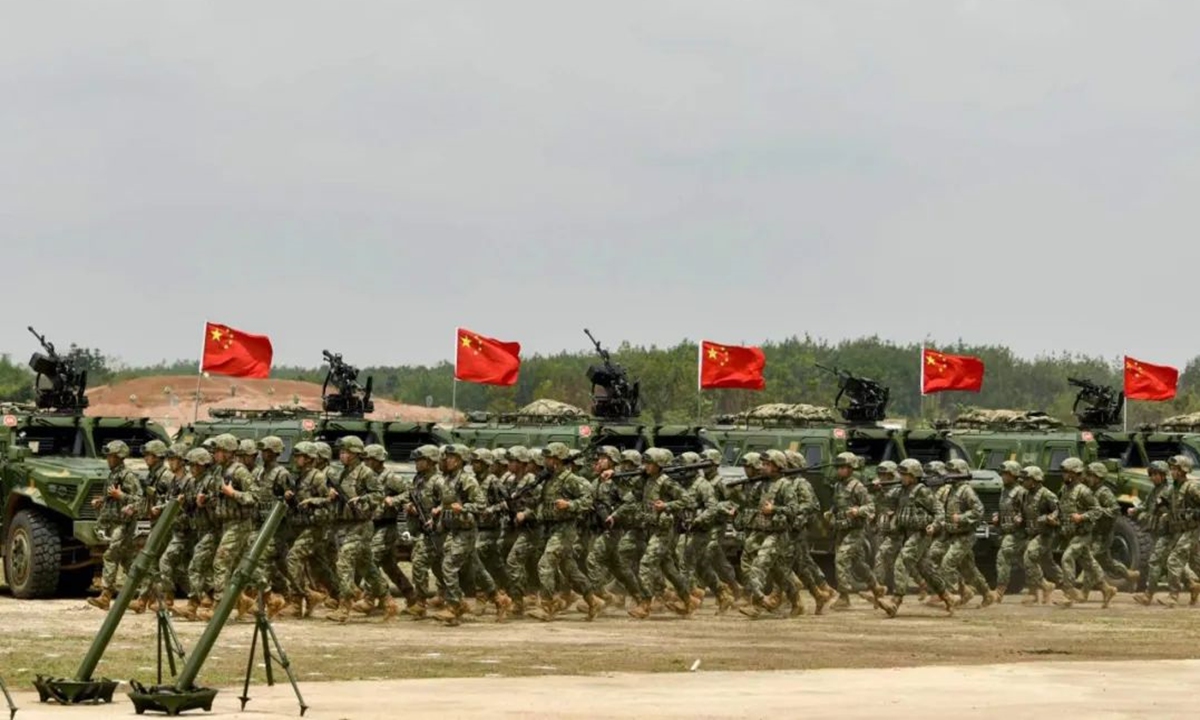
For most analysts, the question of a Chinese invasion of Taiwan, and a resulting war with the United States, is not if, but when. Dr. Gregory J. Moore, Professor of Government at Patrick Henry College and Senior Fellow at the National Institute for Deterrence Studies, presented an assessment for the United States Air University in which he argued that Xi Jinping’s decision on when to invade Taiwan and risk war with the U.S. depends on 13 critical factors, along with four additional enduring conditions.
Based on Dr. Moore’s analysis, Xi’s calculus rests on 13 key factors: (1) the People’s Liberation Army’s (PLA) level of military preparedness, (2) China’s struggling economy, (3) Taiwan’s identity drifting further from mainland China, (4) China’s demographic decline, (5) the importance of Taiwan’s semiconductor industry, (6) the growing importance of semiconductors to China amid technological isolation, (7) the expanding U.S. commitment to Taiwan, (8) the current lack of U.S.–Taiwan joint exercises and interoperability, (9) China’s present advantage in ship-killer hypersonic weapons, (10) U.S. efforts to develop hypersonic weapons and defenses, (11) the poor state of U.S.–China relations, (12) Xi’s perception of U.S. intentions as increasingly hostile, and (13) the 2024 victory of Taiwan’s pro-independence Democratic Progressive Party.
Of these 13 factors, 11 suggest that an invasion may be imminent, while only two argue for delay. Yet postponement would erode the advantages provided by the 11 factors already aligned in Beijing’s favor. The two that point toward waiting are People’s Liberation Army (PLA) military preparedness and China’s struggling economy.
The PLA still has gaps in training, logistics, and capability, and would benefit from more time to modernize. China’s economy also faces mounting headwinds: disputed growth figures, a collapsing housing market, youth unemployment surpassing 21 percent, deflation driven by the trade war with the United States, slowing exports, and growing isolation as countries pursue “de-risking” and “decoupling” strategies.
The other 11 indicators favor earlier action. Taiwan’s national identity continues to drift away from China, with surveys showing only 3.6 percent of Taiwanese identifying as Chinese by 2022, compared to 61 percent identifying exclusively as Taiwanese. China’s demographic decline threatens future military recruitment, adding pressure to act before manpower shortages deepen.
Taiwan’s dominance in advanced semiconductors, largely through TSMC, remains an attractive prize, but one that may diminish as production diversifies to Arizona, Germany, and Japan. With U.S. export controls tightening, Beijing’s isolation from advanced chips makes Taiwan’s fabs even more valuable now.
Military dynamics further tilt the balance. China currently holds an advantage in ship-killer and hypersonic weapons, particularly the DF-17 system, while the U.S. lacks reliable countermeasures. This edge, however, will not last, as Washington accelerates development of its own hypersonic weapons and defenses.
U.S. commitment to Taiwan has also grown steadily through arms sales, military aid, and stronger political backing, and will likely only deepen with time. At present, Taiwan and the U.S. lack the kind of joint exercises and interoperability enjoyed with treaty allies like Japan or South Korea, but that gap will close if Xi delays.
Diplomatic and political factors also press Xi toward action. U.S.–China relations are already at a low point, reducing the cost of further deterioration. Xi himself has described American strategy as “comprehensive containment, encirclement and suppression,” reinforcing his perception of U.S. hostility and his belief that Washington will increasingly use Taiwan as a tool to weaken China.
Finally, Taiwan’s 2024 election, which handed victory to the pro-independence Democratic Progressive Party, eliminated hopes for warmer cross-strait ties and reinforced Taiwan’s trajectory away from Beijing.
Beyond these dashboard indicators, Moore identifies four enduring conditions that amplify the urgency. First, the CCP’s “sacred commitment” to Taiwan anchors Beijing’s ideology of territorial integrity and national identity. Second, authoritarian decision-making creates distortions, as Xi may not receive honest assessments of PLA readiness due to military purges and a culture of fear.
Third, Xi’s personal political incentives drive urgency: reclaiming Taiwan would cement his legacy and strengthen his position at the 2027 Party Congress, where his fourth term will be decided. Finally, Xi’s directive that the PLA be ready by 2027, confirmed publicly by CIA Director William Burns, sets a hard timeline for preparation.
Moore concludes that a Chinese invasion of Taiwan within one to three years, likely before the October 2027 Party Congress, must be treated as a plausible scenario. While military preparedness favors delay, the weight of the other indicators, and the distortions of authoritarian decision-making, make earlier action increasingly likely. Ignoring these realities risks leaving the United States and its allies unprepared for what may become the most volatile flashpoint in U.S. foreign policy.