
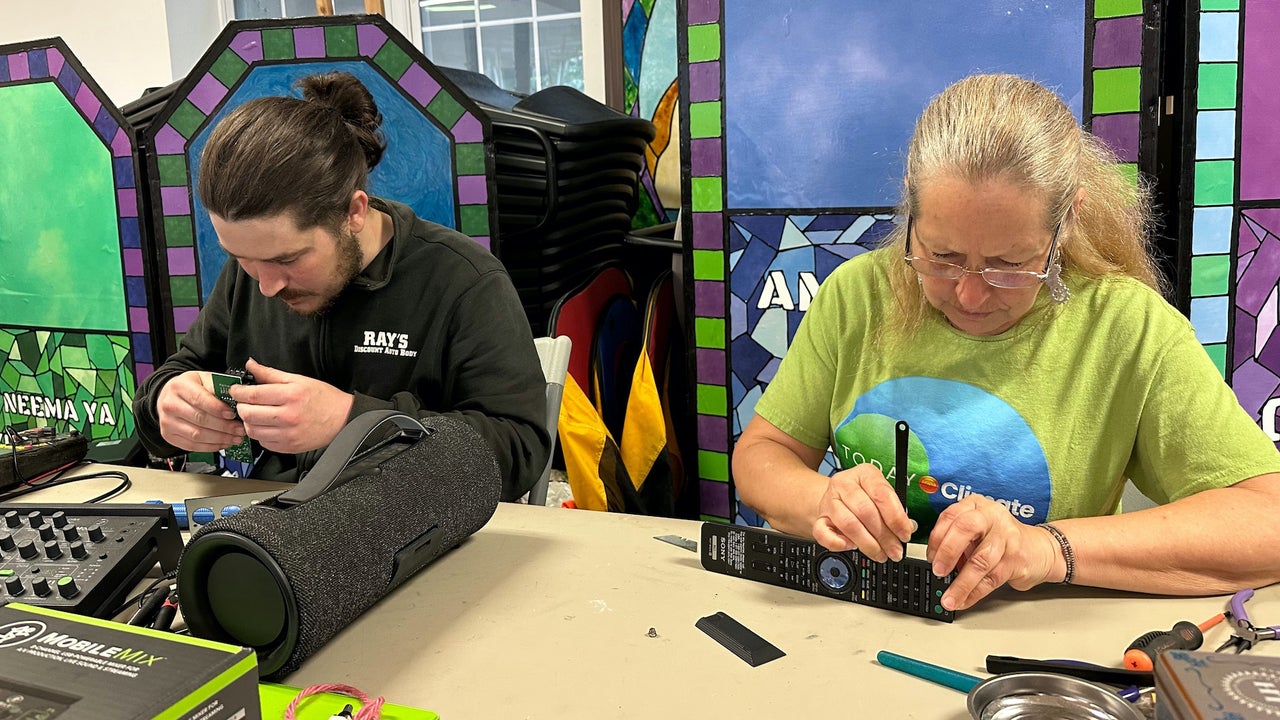
On a drizzly Saturday morning late last month, the basement of the New Paltz United Methodist Church filled with old lamps, blunt knives, malfunctioning sound mixers and balky zippers.
About a dozen volunteers welcomed the broken goods and their owners to a worldwide movement that’s evangelizing new relationships between people and their things.
Repair Cafes — free events where volunteers with technical know-how help neighbors fix myriad household items — are part of a new brand of anticonsumerism that’s trying to offer an alternative to the mass-produced disposable goods that have dominated the global economy for the last half-century. Helping fuel that move to repairing, not buying, are U.S. consumer prices, which climbed sharply again last month as the war with Iran delivered higher gasoline prices and more pain for Americans.
After starting in the Netherlands with a single event in 2009, Repair Cafe has grown into a global nonprofit with more than 59,000 members, some 4,000 cafes and close to 850,000 items fixed a year.
“We need to change our mindset. We need to change the economy,” Repair Cafe founder Martine Postma said. “Even if Repair Cafes can’t solve the problem alone, then still they are a very clear sign that change is needed on a much higher level.”
Repair Cafes are both a way to fix things and to form community
In New Paltz, a Hudson Valley college town about two hours from New York, 50 people brought about 85 items to the Repair Cafe: an antique fan that required rewiring, shirts, pants, jackets, stuffed animals. There were old family photos that needed restoring and jewelry awaiting work like restringing beads or replacing clasps.
Repair experts waited behind long cafeteria tables to teach alternatives, giving people chances to learn that flawed goods aren’t automatically junk.
“Maybe their initial reason for coming is monetary or sentimental,” organizer Holly Shader said.
More than that, she added, “it gives people a chance to work together and extend the life of something. People form relationships.”
The experts on hand fixed 71 of the items, found that four needed more work and deemed 10 beyond repair. They said they volunteer for the low-pressure joy of fixing things, with networking as a side benefit.
“I get to come and actually do the work and meet the nice people and show them how to put something together,” contractor Patrick L. Murphy said.
Networks touting this new brand of anticonsumerism are growing
The Buy Nothing Project, “right to repair” legislation, and a growing number of tool libraries also are dedicated to repairing, trading, and giving instead of buying and selling.
Starting in Washington state in 2013, the Buy Nothing Project maintains an app and social media presence that links people giving things away with people nearby who want them — a worldwide network of gift economies, as described on its Facebook page.
Founder Liesl Clark said the network has expanded to at least 12.5 million people on Facebook, showing a growth rate with the ability to influence corporate and state behavior.
“What was a social movement has really become a safety net for millions of people,” she said. “People are seeing that you don’t have to go to the Amazons of the world to get what you might need, there is a robust material culture in your community.
“We want to change the way that the world consumes.”
The movement “started as a social and economic and environmental experiment,” she noted.
“There’s going to be a conversation that you have, when you and someone else are fixing something together,” she said. “We’re finding that we’re crossing a lot of barriers.”
In today’s modern, disposable culture, many people have lost the ability to repair household goods, a skill that was once nearly universal, said Peter Counter, an engineer who’s studying Repair Cafes and working on a doctorate at the University for the Creative Arts in Farnham, England.
“The idea that you can fix your own stuff has receded because the skills are not being passed down,” he said. “If you want something fixed, it’s almost certainly cheaper to go buy a new one.”
Community repair is thriving, Counter said, because it is volunteers who spend their time, making it financially viable even if you need to buy spare parts.
The “right to repair” movement wants consumers to be empowered to repair their own products instead of being forced to go to the manufacturer for tools and instructions. A national campaign pushed in 2023 for states to consider bills requiring manufacturers to give access to tools and instructions for both customers and repair shops. A handful of states have passed legislation.
And around the country, some jurisdictions are hosting tool libraries that allow people to borrow expensive tools just like library books.
‘It’s wonderful to see people restoring older things’
In New Paltz, Paula Weinstein, 79, brought in a 1930s-era Hammond clock and handed it to Bob Morton.
Morton — an 82-year-old former IBM electrical engineer — said he enjoys using his skills to stay intellectually busy and help people.
“I’ve been blessed to still have a brain,” the grandfather of three said. “It’s a chance to do something.”
Weinstein added, “It’s wonderful to see people restoring older things.”
After hours of patient work together, the hands of her clock moved.
“Yes, it’s working!” she shouted. “Oh, my goodness, thank you!”
“I’m glad I stuck with it,” Morton said.
—Michael Weissenstein, Associated Press