
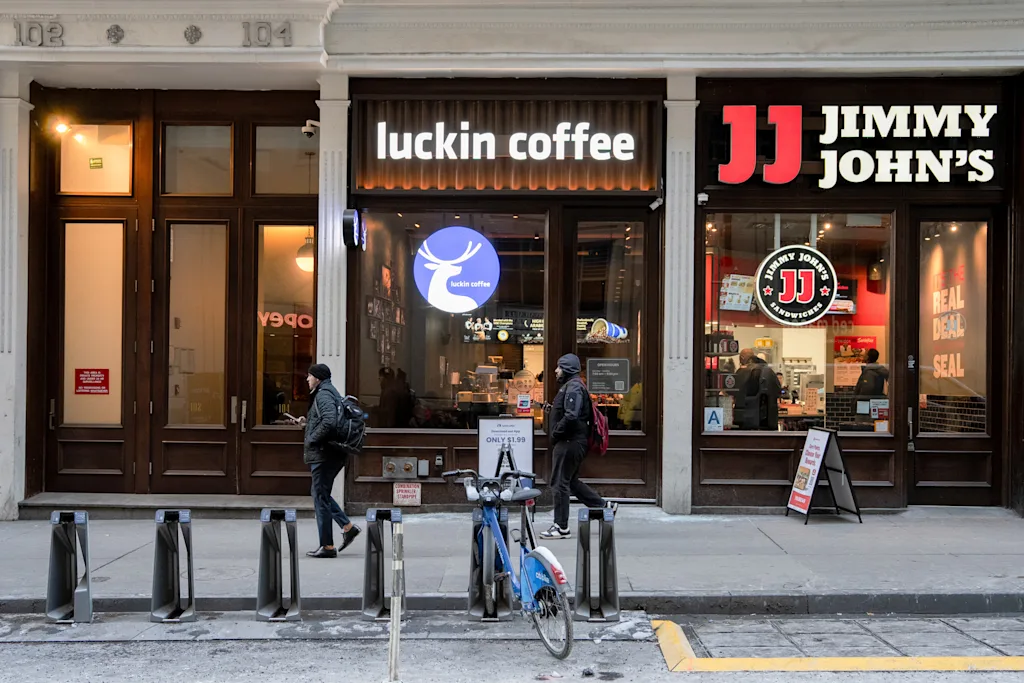
The Chinese coffee giant Luckin is reportedly acquiring the third wave coffee mecca Blue Bottle in a deal worth just shy of $400 million. It’s more than another acquisition: Luckin is making its most aggressive move on Starbucks since it opened its first U.S. locations in New York in 2025 in a rivalry that is quickly heating up.
But to understand what’s at play, we need to zoom out for a moment to take a quick scan of the global coffee market.
Inside the coffee wars
With around 40,000 stores and $37 billion in revenue, Starbucks is the biggest coffee company in the world. While it’s had a few stagnant years, its all-star CEO Brian Niccol has been staging a design-led turnaround, in which cozier cafes and a protein-laden menu have siren-called customers back with some early success.
Luckin, a company controlled by the Chinese private equity firm Centurium Capital, is its only sizable challenger—which grew its global footprint by a hyper aggressive 39% in 2025 to reach around 31,000 stores. Luckin is in some ways the antithesis of Niccol’s Starbucks. The stores are smaller footprint, emphasizing digital ordering. They will also gladly operate at a loss to unlock new markets—all while Starbucks has been closing its underperforming stores. (Luckin has reportedly seized this moment to actually buy some old Starbucks locations—undoubtedly hoping to swap someone’s daily Starbucks run for their own brand.)
Neither of these companies is operating in a vacuum, though. A slew of smaller challengers are eating the coffee market. You’ll find 12,000 Dunkin’s globally, and other chains including Tim Hortons, Dutch Bros, Scooter’s, and Blank Street, none of which break the four figures. Each of these brands is finding a most certain appeal with consumers, ranging from pumping out relatively inexpensive giant iced coffees to offering simple drinks with a minimal decor to serving up desserts disguised as coffee straight of a drive-thru window.
But none of them is really good coffee, if we’re being honest. They all lack the third wave coffee vibe where single origin pour overs still rule, where spending over $10 for a cup is far from rare.
On one hand, perhaps the third wave coffee market matters less than we think these days. Blue Bottle’s 140 stores globally aren’t profitable. Starbucks closed two of its high-end “reserve” stores in Seattle in 2025 amidst higher spectacle investments, while it’s spent nearly two decades now tuning its own response to third wave coffee (don’t forget, this is the company that bought the theatrical/techie coffee company Clover in 2008). We live in the age of iced coffee and matcha anyway (60% of drinks from Starbucks are sold on ice these days).
On the other hand? One report suggests that Centurium Capital is already talking to malls in China, scoping closed Starbucks Reserve stores that might fit a Blue Bottle.
In other words, Luckin sees an opportunity to own the next tier of coffee snobbery by leveraging Blue Bottle has a bonafide and distinct premium sub brand. Luckin can stay Luckin—it can be the best in convenient coffee—while Blue Bottle becomes its reserve identity.
Is that it for the story?
So does this mean Luckin played the game better than Starbucks? Not so fast. There’s a strange, third party twist in the story where the real winner here may be Nestlé—which by some measures is the real close-second coffee company in the world. Coffee is one of the top categories for its $115 billion business—representing $32 billion in sales last year—just $5 billion shy of Starbucks.
Nestlé bought its majority stake in Blue Bottle for $425 million back in 2017 (eventually buying out the full company for an estimated $700 million) back when third wave coffee shops were consolidating, and big budget cold brew was hitting grocery store shelves. It left Blue Bottle stores running with relative independence, while it made Blue Bottle a shining star of its rich, at-home portfolio.
Nestlé owns—wait for it—the biggest instant coffee brand in the world with Nescafé (instant coffee was a $42 billion industry in 2023, by the way, and is growing). It also owns Seattle’s Best, Coffee Mate (those creamers), and rights for Starbucks dry prepackaged coffee, pods, and instant offerings. (PepsiCo handles the premade Starbucks drinks you buy from the store in a 50/50 split with Starbucks.)
As part of Blue Bottle’s sale to Centurium Capital, it appears Nestlé retained the entire grocery store side of Blue Bottle. So it seemingly took a $300 million loss, dumped off the management of unprofitable high end coffee shops while retaining their cachet on the shelf. Nestlé doesn’t report revenue on Blue Bottle store products, so we have no idea how long that $300 million will take to recoup, but we do know their Starbucks line was pulling in about $2 billion in revenue a year way back in 2018. While Blue Bottle would be vastly smaller, Nestlé stands to recoup its loss and even see gains in the long term if Centurium Capital makes Blue Bottle cafes a bigger deal.
But in the short term, did anyone win from the Blue Bottle acquisition? We might not know for a while. It all depends on where Luckin takes the brand, how Starbucks responds, and whether all those millennials who made third wave coffee a thing will even notice.
We have reached out to Blue Bottle and Luckin to verify reports of sale and will update the story with any details as they come.