
As Trump’s “excursion” veers into quagmire territory, he may just try to walk away amid a host of new distractions.
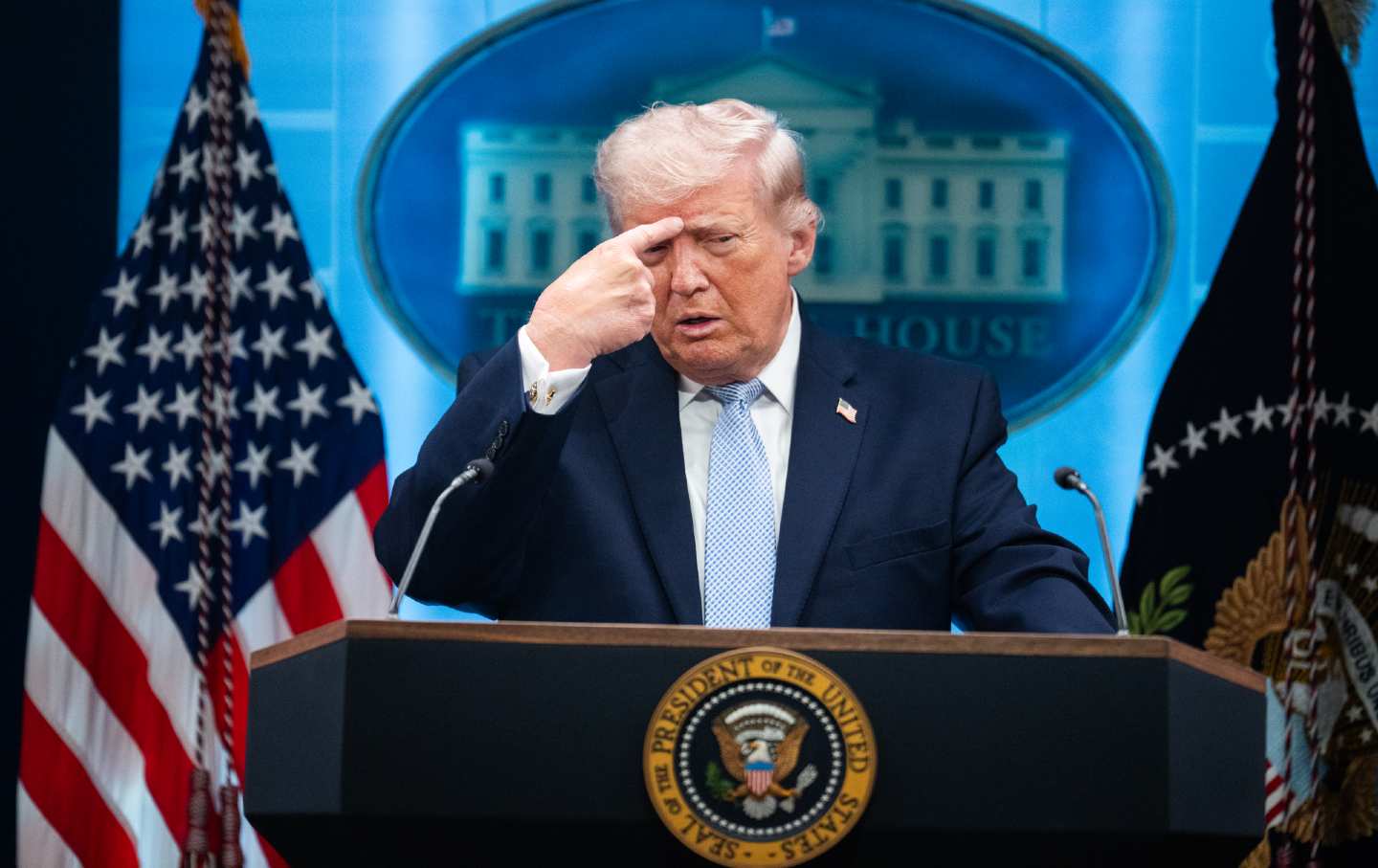
President Donald Trump at an April press conference about the war in Iran.
(Tom Williams / CQ-Roll Call, Inc via Getty Images)
Beyond the bubble of hardened MAGA cultists and a smattering of elite pundits, the joint American-Israeli war on Iran announced by a somnolent President Trump on February 28 is widely regarded as a pointless fiasco that is doing incalculable and growing damage to the global economy. The fact that the president once again unilaterally extended the ceasefire with Iran last week means that he still has no credible ideas about how to get traffic moving through the Strait of Hormuz. He’s similarly flummoxed when it comes to imposing America’s settlement terms on an emboldened regime in Tehran—despite his constant insistence that the war has resulted in an unprecedented, monumental American victory.
Regardless of if or when Trump’s crack negotiating team featuring zero Iran experts returns to Islamabad to meet with Tehran’s delegation, the status quo in the Strait of Hormuz is untenable. Oil prices are creeping up again after dropping on President Trump’s flurry of hallucinatory statements on April 17 proclaiming that the war would be wrapping up soon. The end was inevitably near, Trump insisted, because Iran had agreed to open the Strait of Hormuz, forgo the ability to enrich uranium forever and relinquish its stockpile of what the president with almost child-like wonder calls “nuclear dust.”
Unsurprisingly, none of those claims turned out to be remotely true, leaving observers once again to conclude that the president’s primary audience for these spasms of optimistic wish-casting is the menagerie of Wall Street grifters and gamblers who cause the S&P 500 line to jolt upward, in total defiance of reality.
But what if Trump simply tried to slink away and change the subject without any definitive end to the war, leaving the situation in a slightly altered version of the status quo? The war’s odd, liminal status and Saturday night’s security incident at the White House Correspondents’ Dinner have already succeeded in pushing the conflict out of the headlines.
Trump seems to be stumbling toward a kind of endless steady state, in which the ceasefire either gets repeatedly extended into the future like a continuing budget resolution, or the parties agree to stop shooting through the end of the midterm elections. This plunge into total diplomatic indeterminacy—call it Schrödinger’s ceasefire—is reminiscent of when Trump returned completely empty-handed from his June 2018 summit with Kim Jong Un after a year of stoking panic about the country’s nuclear weapons and abruptly declared that “there is no longer a nuclear threat from North Korea.” Since then, North Korea has continued to add to its nuclear arsenal, test longer-range missiles and make enough significant progress on its Sea-Launched Ballistic Missile program for it to supply the plot in the 2025 nuclear thriller House of Dynamite.
The difference is that Trump could declare the North Korean nuclear threat to be over because there were no immediate consequences for lying about it. It’s impossible to apply the same formula to a situation in which 20 percent of the world’s energy is bottled up in and around a single contested shipping channel, while hundreds of stranded cargo ships and thousands of crew members twiddle their thumbs, attend movie nights, and wait for deliverance. President Trump’s singular, unequivocal responsibility for the chaotic Iran war is the chief reason his approval ratings are now nearing the nether zone occupied by George W. Bush in his second term. It’s also why congressional Republicans are freaking out about an electoral bloodbath in the fall, since that was what Bush bequeathed them in the 2006 midterms.
Current Issue

For Trump to be able to pull off his magical disappearing-crisis trick again, both sides in the conflict must come to see the utility of getting things moving through Hormuz again. Both sides also need to be able to plausibly claim that they won and didn’t give in to the other. In this scenario, rather than an agreement that formalizes Iranian control of the Strait of Hormuz in the form of a multimillion-dollar per-ship toll, the United States would simply end its current blockade. That, in turn, would allow Iran to continue extorting ships without objections from the Americans and Israelis—and without any resolution of the underlying nuclear issues.
This general arrangement appears to be more or less what Iran is offering in an updated proposal submitted by intermediaries on Saturday. Any version of this plan would of course represent a staggering strategic setback for the United States, as well as a possibly fatal blow to the existing global seafaring regime. But neither of those things really matter to President Trump. He needs the war off the front page and for oil prices and inflation to come down. What happens when he’s out of office or even after the midterm elections is someone else’s problem.
But if shipping doesn’t start moving through the Strait of Hormuz pronto, neither Trump nor anyone else is going to be able to dodge the very serious economic fallout, much of which is already getting worse with each passing day. At home, gas prices remain elevated, and the March inflation numbers were high even before the damage from the Iran War had really set in. But other parts of the world are in full crisis mode, and eventually that damage will be impossible to quarantine.
Even with this pressure building, a conclusive deal does not look imminent. The Iranians, for very good reasons, simply do not trust the United States to abide by any agreement, even if by some currently unimaginable fluke, the parties manage to reach one. Twice in the last year, the United States has launched military strikes against Iran while pretending to negotiate. Those unilateral attacks upended negotiations over Iran’s nuclear capabilities that were already fraught with mistrust given that Trump torched a perfectly functional nuclear agreement with Iran in 2018. Rather than scale back American objectives in response to this near-total lack of trust, the Trump administration has actually been asking Iran for even greater concessions on its nuclear program. American representatives—it’s a considerable stretch in the present state of affairs to call them negotiators—also are pressing Iran to concede to a host of other long-standing American demands, like cutting off its support for regional military proxies in Lebanon and Yemen and agreeing to punitive limits on its ballistic missile program.
These things were never going to happen absent real regime change in Tehran—yet another failed war objective. They are even less likely today. For decades, Iran has seen a nuclear weapon as its ultimate, and possibly only, deterrent against US-led regime change. Trump inadvertently altered this calculus very much to Iran’s advantage with his disastrous war. Instead of suffering a knock-out blow to its deterrent capabilities, the regime learned that it could both survive a US regime-change operation (at least one without a ground component) and throttle shipping in the Strait of Hormuz with minimal military action. Hormuz is Iran’s new deterrent to any future American predation—a kind of nuclear weapon that can actually be used.
An end to the war that leaves Iran in the hands of military hard-liners, imposes indefinitely higher costs on shipping and fails to provide closure on Tehran’s nuclear ambitions would leave everyone worse off than they were in February. That most definitely includes Iran’s long-suffering political opposition, which now faces an unchanged regime led by the Iranian Revolutionary Guard Corps that can exploit Trump’s insane war to consolidate its grip on power. Millions of Iranians face a years-long recovery from the trauma of American and Israeli bombardment. Energy infrastructure across the region has sustained billions in damage. Iran itself is in ruins, and the United States has offered its adversaries a very public and expensive glimpse into its own strategic weaknesses and limitations, which are clearly much more significant than anyone understood them to be nine weeks ago.
But if Trump calculates that he can extricate himself from his political and economic bind by taking what amounts to a massive policy loss and then engaging the MAGA propaganda apparatus to spin it as a victory, he will almost certainly do it. The rest of us will be left to swallow the bitter fruits of Trump’s impulsive “excursion” for years or even decades to come in the form of higher prices, global isolation, and an Iranian regime that he somehow managed to make both more powerful and even angrier at us than before.
From illegal war on Iran to an inhumane fuel blockade of Cuba, from AI weapons to crypto corruption, this is a time of staggering chaos, cruelty, and violence.
Unlike other publications that parrot the views of authoritarians, billionaires, and corporations, The Nation publishes stories that hold the powerful to account and center the communities too often denied a voice in the national media—stories like the one you’ve just read.
Each day, our journalism cuts through lies and distortions, contextualizes the developments reshaping politics around the globe, and advances progressive ideas that oxygenate our movements and instigate change in the halls of power.
This independent journalism is only possible with the support of our readers. If you want to see more urgent coverage like this, please donate to The Nation today.
More from The Nation
Friendships have ruptured. Families have bitterly split around the kitchen table. Violent speech has become the dominant mode of discourse.

The infamous paramilitary assault remains a cautionary Cold War history.