
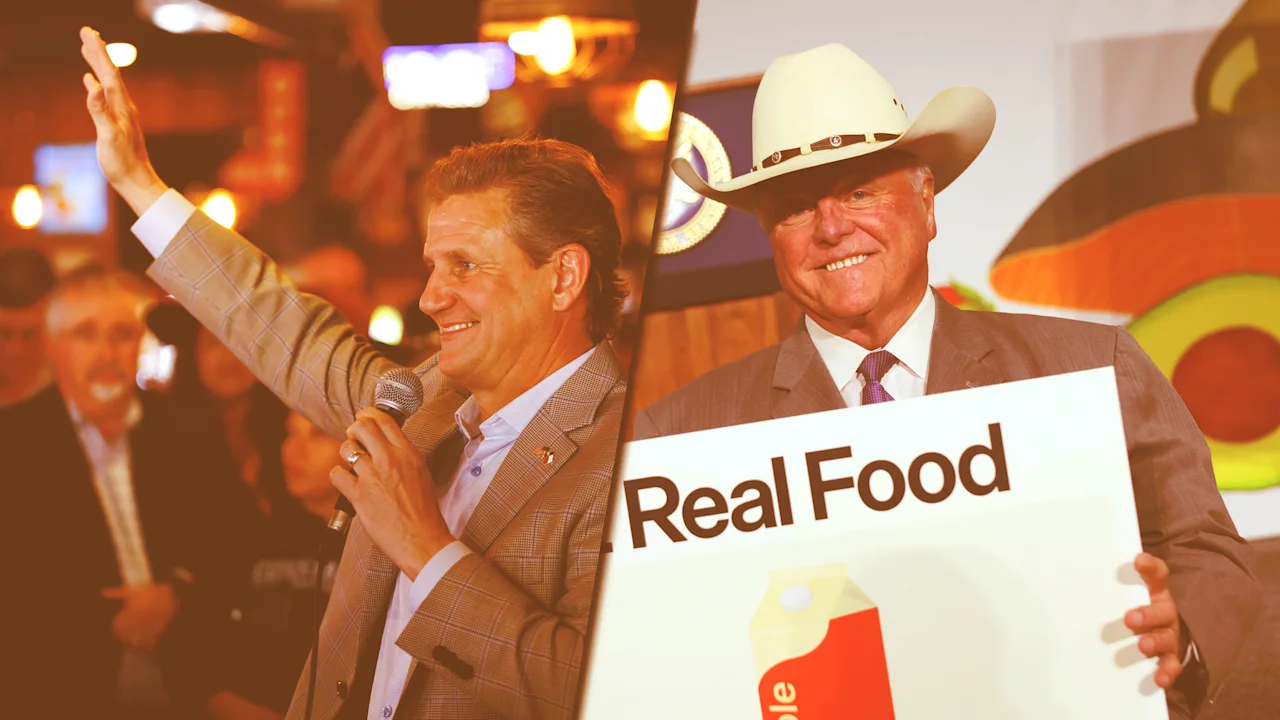
An agriculture commissioner race is probably not where you would expect the politics of AI to play out. Yet that’s exactly what happened in this week’s Republican primary in Texas. The state’s longtime incumbent, Sid Miller, spent much of his campaign warning about the spread of data centers across rural America. The server farms powering the AI boom, he argued, were swallowing farmland and draining already-overtaxed water supplies. In a state that prides itself on its cowboys and farmers, Miller framed the industry as an existential threat to ranch country.
On Tuesday, Republican voters rejected his message, handing the nomination to businessman Nate Sheets, a first-time candidate backed by Gov. Greg Abbott. The result suggested something unusual: Even in a state where agricultural identity runs deep, the economic and political momentum behind the AI boom may be stronger than appeals to protect farmland.
To be sure, Miller’s defeat had many causes unrelated to artificial intelligence. He had accumulated a long record of controversies during his eleven-plus years in office. He was fined after using public funds for travel, including a trip to receive a pain injection known as the “Jesus shot,” and his longtime political consultant later pleaded guilty to commercial bribery tied to hemp licenses regulated by Miller’s agency. Abbott seized on those scandals when endorsing Sheets, saying Texans deserved an agriculture commissioner with “zero tolerance for criminality.”
Still, the race stands out because Miller attempted something politically unusual: He tried to make AI infrastructure itself a campaign issue. It’s not hard to see why. Data centers require enormous tracts of land, vast amounts of electricity, and significant supplies of water for cooling. That combination makes rural counties especially attractive sites. But it also sets up a potential conflict between the physical infrastructure of the AI boom and the landscapes traditionally associated with American agriculture. More broadly, that tension increasingly cuts through Republican politics itself, pitting rural landowners and farmers against the AI expansion plans embraced by national GOP leaders, including President Donald Trump himself.
Estimates suggest data centers already consume roughly 25 billion gallons of water annually in Texas, about 0.4% of the state’s total water use, according to recent estimates. And according to the Lincoln Institute of Land Policy, a nonprofit think tank, the demand could rise as AI computing expands, reaching as much as 161 billion gallons per year by 2030, or nearly 3% of statewide water demand. A single large data center can consume up to 5 million gallons of water per day, roughly the daily needs of a town of 50,000 people. That said, agriculture still accounts for roughly half of Texas’s water use, meaning farms—not data centers—remain by far the thirstiest part of the state economy.
It’s no great mystery why tech companies increasingly look to rural areas when building new AI infrastructure. Farmland offers large contiguous parcels of relatively inexpensive land, access to high-voltage transmission lines, and distance from dense population centers (keeping costs lower and zoning headaches at a minimum). But the same qualities that make farmland attractive to developers also make these projects politically sensitive. Farmers worry about land prices, water consumption, and the industrialization of rural landscapes.
In Texas, Miller tried to turn those concerns into a political cause. He proposed creating “agriculture freedom zones,” which would steer data center development away from farmland through tax incentives and other policies. Without guardrails, he argued, server farms could “pop up wherever they want to” and consume agricultural land. It was an unusual argument coming from a Republican statewide official, especially at a moment when both parties increasingly frame AI as a national economic and security priority. (Sheets, for his part, didn’t talk much about data centers, focusing instead on his opponent’s alleged ethical shortcomings.)
For decades, American agricultural politics has focused on familiar threats: federal regulation, trade policy, environmental rules, and so on. Miller instead warned that Silicon Valley’s infrastructure boom could become the next challenge facing farmers and ranchers. “There’s no oversight, there’s no regulation, there’s no organization, there’s no guardrails of any kind,” Miller said in a recent interview with Politico, arguing that data centers could expand across farmland unchecked.
Republican voters were not ultimately persuaded. But Miller may not be the last politician to test the message. In Michigan’s 2026 gubernatorial race, Republican candidate Tom Leonard has warned that the rapid spread of data centers could overwhelm rural power grids and consume valuable farmland. In Pennsylvania, a Republican challenger to Rep. Scott Perry has criticized plans to replace agricultural land with sprawling server farms.
Even in a state that still romanticizes the cowboy, the next land rush may be for server farms.