
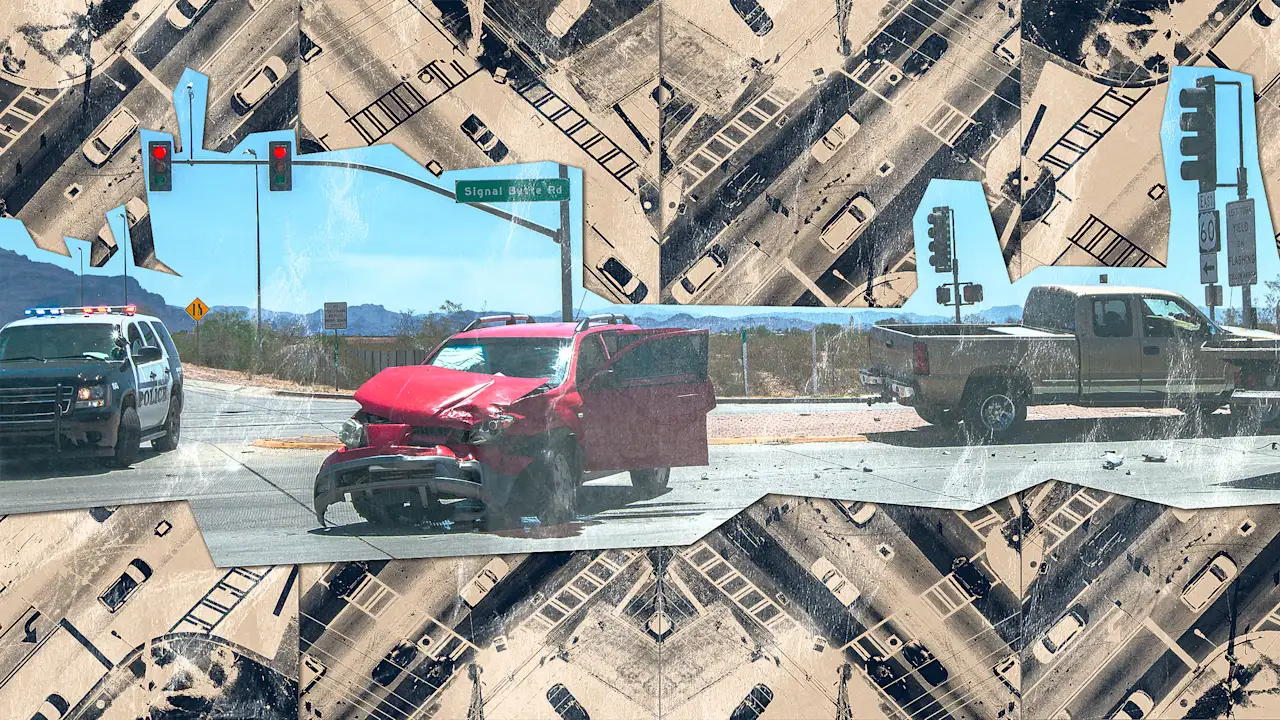
On average, 11 car crashes occur every minute in the U.S. By the time you finish reading this sentence, several vehicle collisions will have happened across the country, some of which were likely fatal.
In the world of aviation, the number of crashes involving a U.S. civilian aircraft is about 1,200 per year, and very few of those result in fatalities.
Despite the 5,500 American planes that are in the air at any given moment during peak times, collisions are rare, because airspace is designed for safety. Planes are required to communicate with one another and with ground control. No one gets to “opt out.”
Our roads are another story. More than 280 million registered vehicles share U.S. streets with trucks, cyclists, and pedestrians—largely without any systemic communication. This isn’t a failure of drivers or technology, but a failure of system design.
The real problem is infrastructure, not vehicle safety
Anyone who’s waited at a busy intersection understands how much uncertainty we accept as normal. Roadways are open systems with infinite variables—weather, pedestrians, distracted drivers, and aging infrastructure. Communication between vehicles is minimal, and infrastructure is largely silent—and in that gap lies the potential for deadly collisions.
When I was a child, I lost a close family member in a car crash. Sadly, that experience is not unique. Later in my career, that loss left me asking: why do we accept a level of loss on our streets that we would never tolerate in the skies?
Why aerospace is easier
In aerospace, safety is designed into the system from day one. During my research years at MIT, working on autonomous systems with NASA and the U.S. Navy, one thing was clear: no aircraft operates in isolation.
In both traditional air traffic control and newer systems designed to manage drones, safety isn’t something added later—it’s built on connectivity and constant information sharing. Aircraft continuously share their position and movement through standardized sensing and communication systems. Flight plans and operating rules allow ground systems to understand intent and predict where aircraft are headed next.
This creates a shared, real-time picture of the airspace. Humans and automated systems can spot conflicts early, coordinate decisions, and resolve risks long before paths intersect. That shared awareness is why near-misses in the air rarely turn into disasters.
Why infrastructure-first intelligence works
If we can engineer safety for aircraft moving at hundreds of miles per hour, we can do the same for streets moving at 30.
Most traffic systems today are built to react after something goes wrong. Predictive systems are designed to intervene before conflict turns into a crash. But for safety systems to work, intelligence must live in the environment itself—not just inside individual vehicles.
Roughly one quarter of crashes occur in intersections (which is unsurprising: we’ve all stood at intersections where everything looked calm until a car ran a red light or a cyclist swerved). These are prime locations for infrastructure-first intelligence.
An intelligent intersection works a lot like air traffic control on the ground. Sensors at signals and along the roadway detect what’s happening in real time, whether it’s a vehicle accelerating toward a red light, a pedestrian about to step off the curb, or a cyclist going the wrong way. Edge AI processes that information instantly, predicting potential conflicts. V2X communication, the digital equivalent of in-flight radios, then pushes alerts back out to road users, giving them time to react.
Essentially, it’s a loop: detection leads to prediction, which generates an alert and triggers an action, powered by continuously running AI models in the background.
The result isn’t perfect foresight, but a safety net that buys precious seconds. And on roads, seconds are what save lives.
We don’t need perfect tech to save lives today
Cities aren’t ignoring safety, but they often haven’t been given systems designed to manage it effectively. Those that have, have seen incredible results in a short period of time.
In Sarasota, Florida, a Smart City Initiative helped reduce crashes by 33 percent at targeted intersections in just one year by turning raw data into actionable insight. The technology gave city officials the clarity they needed to act quickly and deploy countermeasures where they mattered most.
The tools already exist. What’s missing is a willingness to treat intelligent intersections as infrastructure, not operational experiments. That means prioritizing high-crash corridors, requiring new signals to be V2X-ready, and investing in systems that deliver measurable outcomes.
The measure of success is straightforward: fewer crashes, fewer injuries, fewer deaths. The question is whether we continue to accept preventable harm on our streets or finally build roads as safe, reliable, and networked as the skies above us.