
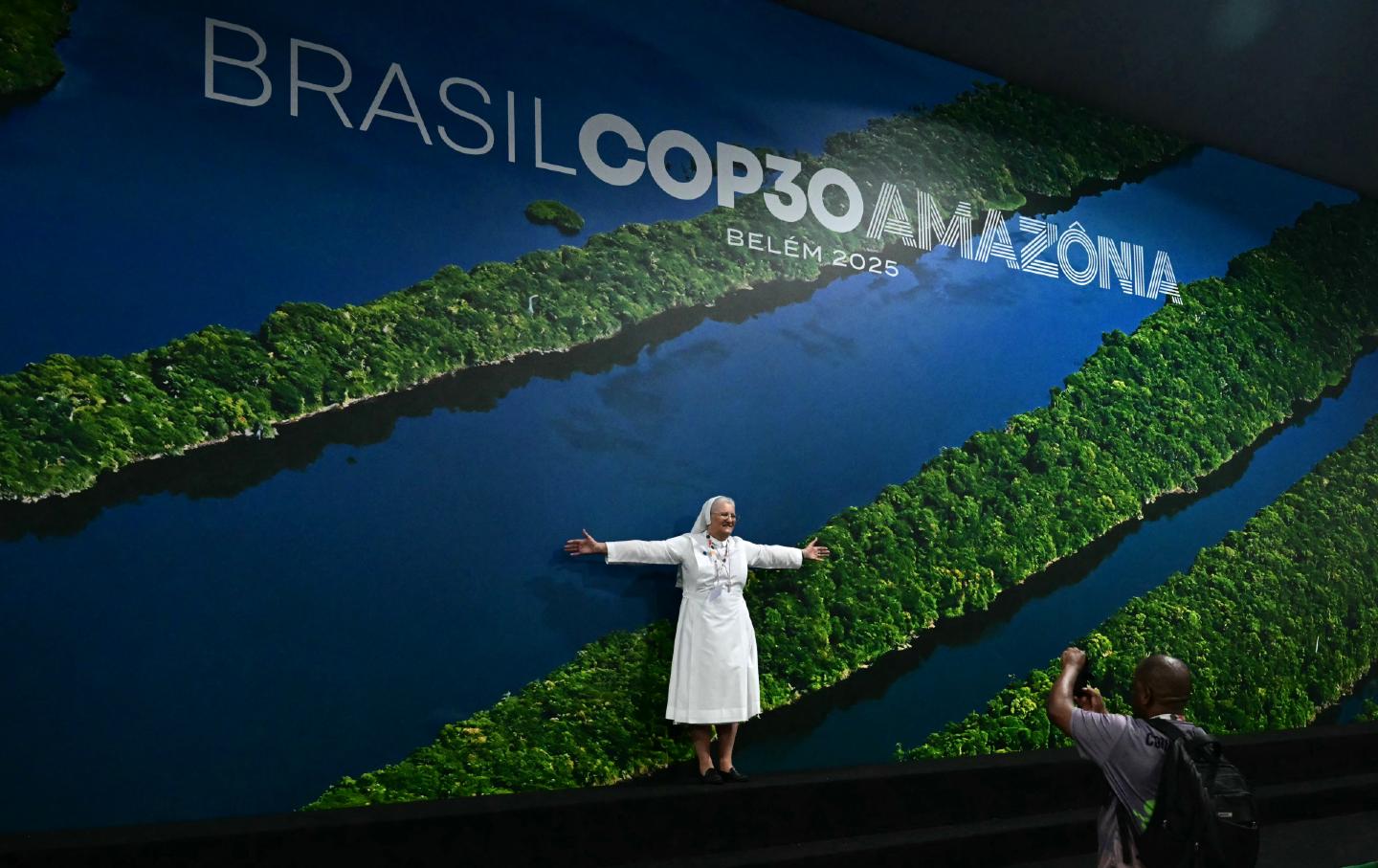
A fact all but ignored at COP30.
The COP30 summit continues on, shy one president. World leaders and diplomats, relieved by the Trump administration’s absence, have taken the opportunity to chastise Trump’s denial of the climate crisis and welcome more supportive state and local officials who are taking up the helm of US representation.
Their relief is mistaken. President Trump need not attend COP30 to degrade its potential. While the world gathers a decade after the Paris climate accords were first signed, the single largest institutional emitter of greenhouse gases—the US military—continues to expand its carbon footprint unchecked. The Department of War consumes tens of millions of barrels of oil a year, and its network of hundreds of domestic and international bases accounts for nearly 80 percent of the US government’s fuel consumption. Its carbon footprint surpasses that of nearly 140 countries.
Now once more at the helm of this military juggernaut, the Trump administration has stretched the US military’s annual budget across the trillion-dollar line. But he didn’t start the fire. The Costs of War Project at Brown University found that, since the Global War on Terror’s inception in 2001, the US military has produced more than 1.2 billion metric tons of greenhouse gas emissions—roughly equivalent to the annual emissions of 257 million passenger cars.
Though the US military leads the pack in cost and size, the defense industry’s intrinsic addiction to oil means that every country’s bases, aircrafts, and ships are a part of the problem. The Conflict and Environment Observatory and Scientists for Global Responsibility estimate that, combined, the world’s militaries constitute the fourth-largest emitter of greenhouse gases on the planet. When military expenditures increase, as they are now, they augment global emissions. Research conducted by Balázs Markó, a macroeconomist at Bocconi University suggests that for every percentage point increase in military spending, total emissions are estimated to increase about 1 to 2 percent. Far from insignificant, in 2024, 1 percent of global emissions equated to roughly 478,000,000 tons of carbon dioxide.
So the leaders of the world—minus one—coalesce in the heart of the Amazon for the espoused goal of advancing global efforts to cut emissions as their military expenditures swell. Not only has the US military’s annual budget crossed the trillion-dollar mark, but nations around the world are following suit.
China, Russia, India, and Saudi Arabia have beefed up their military budgets and 31 of NATO’s 32 member states recently agreed to raise their target defense spending from 2 to 5 percent of GDP.
Current Issue

Other countries are not blind to their militaries’ polluting nature. In 2024, the chief executive of the European Defence Agency, André Denk, noted, “The EU’s goal to become climate neutral by 2050 cannot be achieved without the engagement of the defense sector.” Yet environmental analysts warn that Europe’s plan to double its military budget by 2035 will likely result in the continent’s churning out an additional 200 million tons of emissions every year. This spending surge will further compromise Europe’s already watered-down emissions reduction goals.
Ten years ago, when the leaders of the world met in Paris to combat global warming and protect their countries against the worst impacts of climate change, they allowed a severely oil-dependent sector—the military—to obscure their environmental impacts from their own citizens and the United Nations. The reason? Intense lobbying by the United States.
At the behest of the US government, two key final sentences were tacked on to the 1997 Kyoto Protocol. The new sentences created a gaping reporting loophole. An exemption was added that prevented military emissions from counting toward a nation’s final tally. Any military activities that involved more than two countries, or included international transit would be omitted. This loophole made it possible for the majority of the world’s military operations to be wiped clean from their seemingly comprehensive emission reports. In the end, the United States never ratified the Kyoto Protocol and military emissions remained unrecorded for nearly two decades. In 2015, the Paris Agreement ended the exemption and provided the 194 nations party to the treaty with the option to report their military emissions. Few countries do, so data on military emissions is scarce.
Unlike other sources of a country’s greenhouse gas emissions, which contribute to feeding, housing, and caring for its population, war is a harbinger of death and destruction. Nothing compares to the loss of life war demands from its participants, but it harms us in many ways. War’s long-term side effects, like environmental degradation and intensified carbon emissions, torment the living long after the fighting ends.
As the world’s conflicts illustrate, war is a devastatingly pollutive enterprise. An assessment by the GHG Accounting of War found that emissions produced in the last three years of Russia’s invasion of Ukraine roughly equate to the annual emissions of Austria, Hungary, Czech Republic, and Slovakia combined. At least 25,000 tons of explosives have been dropped on Gaza, since the start of Israel’s genocidal war, decimating nearly all infrastructure and killing tens of thousands. Estimates suggest that the military activity during the first 120 days of the war in Gaza generated over 600,000 tons of CO2 emissions, more than the annual emissions of 26 countries combined. And in Sudan, conflict-related factors have destroyed over 6,000 hectares of vegetation and the ongoing crisis has reinforced a “widespread reliance” on charcoal, accelerating ongoing environmental degradation.
Historic analysis shows that military buildups often precede war. Long-term climate programs will be cut as the nation’s resources and manpower are thrown into defense while conflict-related emissions rise. The war in Ukraine demonstrates this cycle. As a commander in the Danish Defense Command explained, when Russia invaded Ukraine “at least the Danish defense side, everything has been focused on re-establishing combat power.… Then climate change simply just faded out into something which is just an appendix in the policy programs.”
Markó’s research also found that heightened defense spending can “crowd out” investments in renewables and, in some circumstances, hinder energy transitions. Examples of the phenomenon exist across Europe, as the continent plans to double its military budget over the next decade. In May 2025, for example, Germany terminated €4 billion in funding for climate adaptation meant to protect homes and farmlands, yet months later approved a €10 billion procurement package for air defense and drone systems.
Placing climate change on the back burner will not stop the world from warming. The 10 years since the signing of the Paris Agreement constitute the 10 hottest on record. If nations maintain their current policies, the global average temperature is projected to rise by 2.5 degrees Celsius to 2.9 degrees Celsius (4.5 degrees Fahrenheit to 5.2 degrees Fahrenheit) by the end of the century—nearly double the legally binding goal of 1.5 degrees Celsius. The effects of this rise in temperature will not be constrained by national borders. Analysis by Swiss Re predicts that if the world were too warm by 2 degrees Celsius, it might lose 11 percent of total GDP, and research estimates that the heat and humidity from this rise in temperature may diminish global labor capacity from 80 percent to about 70 percent.
More than that, at 2 degrees Celsius—far below our current projected realm of warmth—global agricultural yields will drastically diminish, nearly all coral reefs will be lost, fire seasons prolonged, and hundreds of millions of people in urban areas will suffer water shortages caused by severe droughts. Countless species will face extinction. To limit global warming to 1.5 degrees Celsius to 2 degrees Celsius, emissions must be halved by 2030. Yet, this year global military expenditures rose to a record $2.7 trillion.
The military emissions gap afforded by the Paris Agreement allows nations to promote achievements that are partial at best, since they hide the environmental impacts of their ballooning military budgets. The stark reality is that in order to limit global warming we must cut military spending. Researchers have found that reductions in defense spending significantly decrease emissions and energy usage more than increases in military spending raise them. The study’s coauthor, Professor Andrew Jorgenson, told Newsweek that their findings “suggests a pathway for meaningful decarbonization and climate mitigation, albeit a very difficult one given the Trump administration’s emphasis on increasing US military spending and its attacks on climate science and climate policy, and the growing pressure for other nations throughout the world to increase their military spending as well.”
Popular
“swipe left below to view more authors”Swipe →
Countries understand that their military emissions are hiding in plain sight. The European Parliament’s annual COP resolution reaffirmed the fact that “the defense sector must contribute to tackling climate change by reducing its emissions intensity while maintaining operational effectiveness.” The resolution further called on EU leaders to “formulate a proposal to increase the transparency of accounting of military emissions to the UNFCCC.” But given that it is swarmed by fossil fuel lobbyists and lacks the political will to mandate the kind of major change needed to address the climate crisis, COP30 is unlikely to produce a proposal along the lines being promoted by the European Parliament.
In this time of global rearmament, environmentalists and anti-militarists must remember that their fight is one and that the COP summit is not the only place where the voices of the people can be heard.
More from The Nation
Through executive orders, Congress, and a loyalist cabinet, the Trump administration has delivered big for enclaves of coal country like Colstrip, Montana. But how long can it las…
The news out of COP30 does not engender much hope, but China’s embrace of renewable energy shows that climate protection makes smart economic sense.

Indigenous people lead COP30 protests against agribusinesses that “want to take everything.”
Momentum behind decarbonizing the global economy has built to the point where it is inevitable—with or without the United States.
This is the worst-ever year for climate politics—but the struggle is far from over.
During this term, Brazil’s president has reduced deforestation but he is government is pushing projects that would open up the Amazon to extractivism.