
This is a column about a helpful trick that will radically improve your memory with minimal effort so you can learn faster. But before I get to the science behind the technique and how it can help you in business, indulge me for a minute in explaining why I was so thrilled to discover it.
Learning as an adult is hard.
For the past 10 years, I have lived abroad on a small Greek-speaking island. Therefore, I have been trying to learn modern Greek. This, dear reader, has felt roughly like beating my head against a brick wall for a decade.
I’ve gathered advice on how to speed up language learning, hired a tutor, made flashcards, tried apps, and embarrassed myself countless times flubbing my words in front of bemused locals. When my Greek remained passable at best, I consoled myself by reading up on just how hard it is to learn new skills as an adult, particularly new languages.
I am, in short, in desperate need of any method that will help me shove more grammar and vocabulary into my head and help it stay there.
As an entrepreneur, you might not be trying to master past perfect verb declensions. If you are, you have my sympathies. But perhaps you’re trying to learn to code, pass a professional exam, or just retain more of what you read. If so, let me introduce you to the 2-7-30 Rule.
The neuroscience of improving your memory.
The scientific underpinnings for this rule aren’t new. Neuroscientists have long understood that, when it comes to our brains, forgetting isn’t a bug. It’s a feature.
As University of California, Davis memory researcher and author of Why We Remember Charan Ranganath has explained, “Although we tend to believe that we can and should remember anything we want, the reality is we are designed to forget.”
We naturally forget older memories our brains deem less important in order to make room for newer, more valuable information. Memory is, essentially, a competitive process, according to Ranganath.
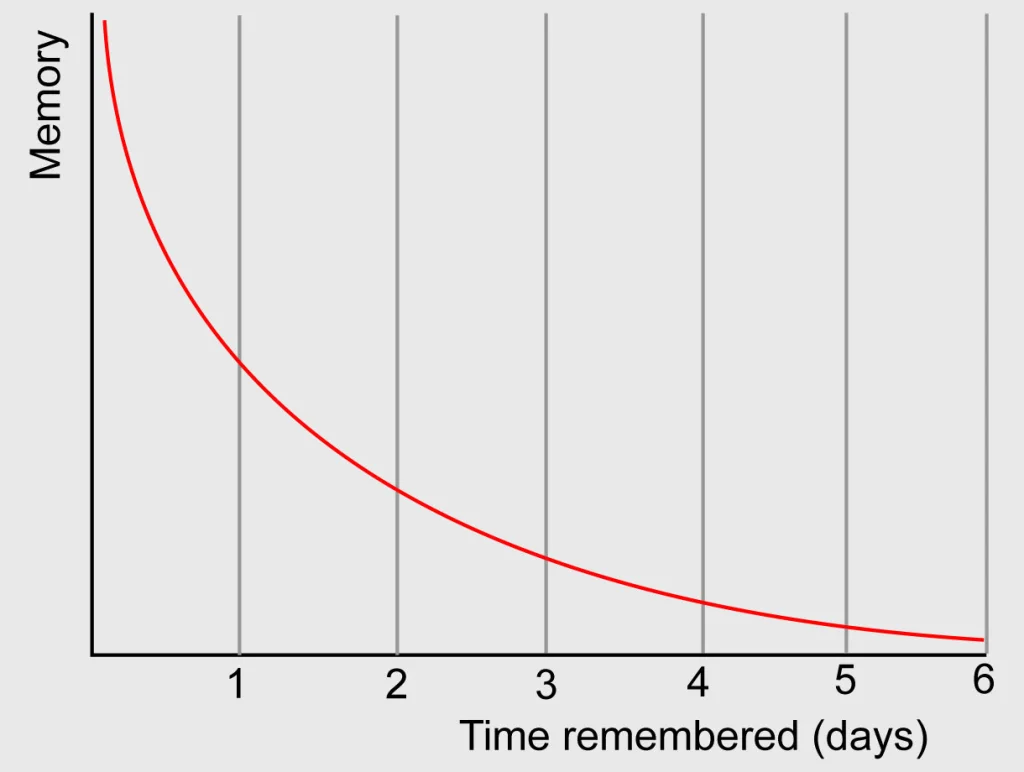
All the way back in the 1880s, German psychologist Hermann Ebbinghaus studied this propensity to forget and visualized the phenomenon with his “forgetting curve.” It falls steeply at first, showing that our retention of information plummets in the first few days after we learn it. Then rates of recall flatten out. After a month, people tend to remember only 20-30 percent of what they were first taught.
The power of spaced repetition.
So if our brains are naturally wired to refuse to remember the gender of Greek nouns, the shortcuts for that new software tool, or the exact wording of that key regulation, what can be done about it?
Ebbinghaus recommended something called spaced repetition. Recalling information tags it as more important in your brain, helping it win the competition for your limited memory space. That’s why your teachers back in high school nagged you to review material multiple times before tests and avoid a single cram session the night before.
Studying that’s spaced out vastly improves memory and recall.
Instantly improve your memory with the 2-7-30 Rule.
That’s the theory. How do you put it into practice? Writing on Medium recently, another adult language learner named Hillel suggested a fabulously simple trick to put Ebbinghaus’s insight to use. He calls it the 2-7-30 Rule.
Here’s the basic idea: When you’re trying to learn new material, test yourself by trying to recall it two, seven, and 30 days after you initially learn it.
“The intervals were based on the Ebbinghaus curve and my capacity for retaining information (discovered through trial and error),” he explains.
For Hillel, this meant making lists of Spanish vocabulary and then testing himself by translating them back and forth from English at the two-, seven-, and 30-day marks. But this technique isn’t limited to learning foreign languages.
“You can write a one-page summary after finishing the book and schedule review dates 2, 7, and 30 days in the future,” he suggests. Rewrite the summary without checking your notes and see how well you do.
Give yourself a memory upgrade.
I have to admit, my eyes lit up when I read about Hillel’s trick. One of the few techniques that has helped me remember more Greek is a similar procedure of quizzing myself on vocabulary over time, but I always did this in an ad hoc manner. Hillel’s method structures the idea into a clear procedure with a catchy acronym.
He even suggests setting yourself calendar reminders on the second, seventh and 30th day so you don’t miss a session.
If there’s something you’d like to remember, give the 2-7-30 method a try. Nearly 150 years of science (and the testimony of at least two frustrated language students) say it will radically improve your memory with a minimum of effort.
— By Jessica Stillman
This article originally appeared on Fast Company‘s sister publication, Inc.
Inc. is the voice of the American entrepreneur. We inspire, inform, and document the most fascinating people in business: the risk-takers, the innovators, and the ultra-driven go-getters that represent the most dynamic force in the American economy.