
Blowing up innocent fishermen hasn’t curbed the drug trade.
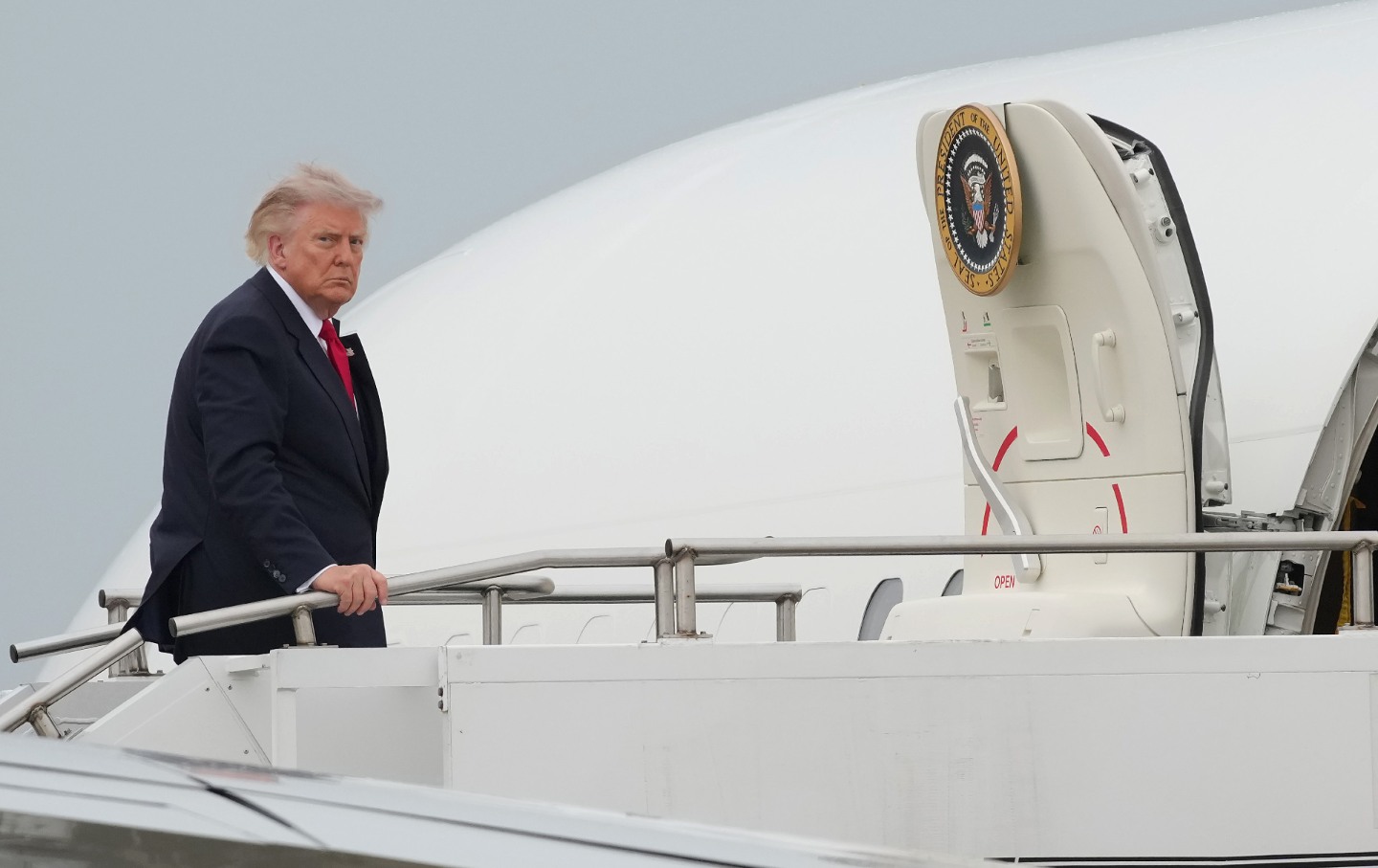
Donald Trump boards Air Force One on July 27, 2026.
(Andrew Harnik / Getty Images)
On January 19, Carlos Mero, the captain of an Ecuadoran fishing boat named La Fiorella, called his wife on an emergency line and expressed his alarm at seeing “American aircraft, two drones, and a blue patrol ship” nearby. Mero was right to be worried. Starting in the fall of 2025, the Trump administration, on the pretense of waging a war on drugs, had ramped up a military campaign to bomb supposed drug-running boats in the Caribbean and Pacific—often in concert with regional allies such as Ecuadoran President Daniel Noboa. Mero was baffled as to why his boat was seemingly under the gunsight of the US military, since La Fiorella had been inspected and cleared by a local coast guard.
As Drop Site News reported, witnesses saw La Fiorella explode the next day. Its eight crew members, including Mero, all disappeared. There is still no confirmation that the boat was targeted by the US military, but the facts of the case are in keeping with the more than 60 boats in the Caribbean that have been bombed, which have left at least 221 dead (a number that does include probable but unverified kills such as La Fiorella).
Other examples of US-sponsored extrajudicial killing were recently highlighted in a report by Human Rights Watch. According to the organization, the report documents
serious human rights violations in a rural community on the Colombia-Ecuador border, as well as attacks on and the disappearance of fishermen at sea near the Galápagos Islands. Each incident either clearly implicates the US-Ecuador security partnership or surfaces questions about responsibility. Ecuadorian forces tortured and arbitrarily detained four farm workers, and later burned and struck a dairy farm, during what the United States called a “partnered operation.” And drones of unknown origin attacked two fishing vessels, injuring several crew members. A third vessel remains missing.
Donald Trump is inordinately proud of his intensification of the war on drugs, which he’s touted as a great success. In a Truth Social post in April, Trump claimed, “98.2% of Drugs coming into the U.S. by Ocean or Sea have STOPPED!” Quoting Trump’s words, The Washington Post reports, “Trump has said at least 15 times, including as recently as last month, that the strikes have reduced maritime drug trafficking into the country by 97 or 98 percent.”
Any sentient creature will be skeptical of Trump’s claim since he has a long history of outrageous and completely divorced from reality lying. But it’s worth noting that even if Trump’s claims were true, they would not in fact justify the US killing spree. Smuggling drugs is a crime, not an act of war that merits summary execution. As I’ve noted before, Trump’s policy is a war crime, full stop.
But as it turns out, these war crimes are as ineffectual as they are vile. On Monday, the Post reported:
The Trump administration’s deadly military strikes on alleged drug trafficking boats have not reduced the amount of cocaine entering the United States, but they’re prompting criminal organizations to develop new strategies and tactics and undermining traditional investigative methods, according to a previously unreported assessment by the Drug Enforcement Administration, a closed-door congressional briefing and interviews with current and former U.S. and foreign officials.
In a recent assessment reviewed by The Washington Post, DEA analysts found the strikes had failed to affect the supply or price of cocaine in the United States and had led traffickers to diversify beyond go-fast boats and to avoid international waters, opting instead for larger boats and hemming close to coastlines, where U.S. forces are less likely to open fire. In a closed-door briefing last month, Pentagon officials told lawmakers the strikes in international waters off South and Central America had not reduced its purity.
Current Issue

This was an entirely predictable fiasco. The War on Drugs has been a bipartisan effort dating back to the Nixon administration. The simplest way to document its failure is to note that during this period, the price of drugs that are regarded as most dangerous has continued a long-term decline. In 2012, the price of cocaine was 80 percent less than in 1982. According to the Post, “Based on pricing, there might, in fact, now be more cocaine circulating in the United States. In Florida, cocaine is selling for $13,000 to $15,000 per kilogram, a senior DEA official said, a drop of roughly 50 percent over the last five years.”
The War on Drugs might in fact be the only effective anti-inflation policy the United States has ever developed. While nearly everything else, ranging from food to housing to transportation, gets more costly, it has never been cheaper to get high as a kite. This is true no matter how many innocent fishermen the United States military drops bombs on or how many Central and South American governments get trained in the dark art of torture. The drug issue is driven by supply more than demand. As long as people in the United States have an inordinate interest in drugs, drugs will be extremely profitable, which means that smugglers will find ever-more-ingenious ways to get their goods to the market.
Trump’s escalation of the War on Drugs is vile, but it reflects a deeper failure in the US political system. Trump isn’t the only one who has failed to learn that the War on Drugs is lost. On this issue, at least, he is merely building on a long and discredited tradition.