
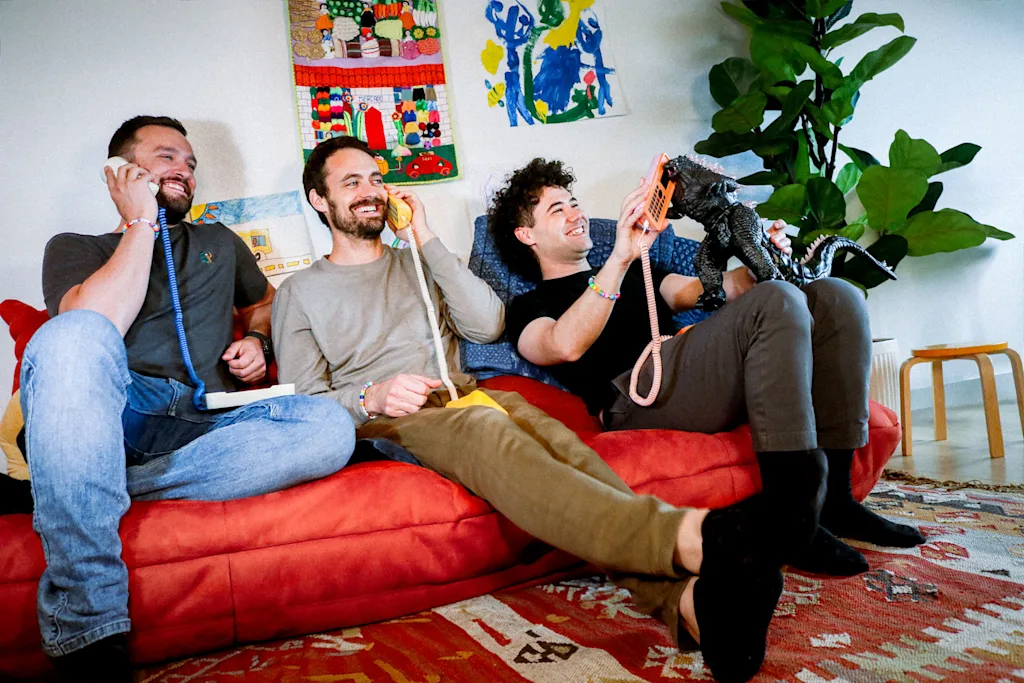
One hot new phone of 2025 has no screen, can’t send a text, and needs to be plugged into the wall. But to buyers of the Tin Can, that’s a definite plus.
The Tin Can, from a Seattle startup of the same name, grew out of conversations cofounder and CEO Chet Kittleson had with fellow parents about the challenges of enabling kids to connect with friends and relatives without giving them full-fledged cellphones. While children of the 20th century could pick up the house landline to call a grandparent or schedule a sleepover, today’s kids are often left dependent on parents for scheduling playdates and connecting with family until they’re old enough to carry their own smartphones.
“Our first social network was a landline, and our kids don’t have that,” Kittleson says. “We’re trying hard to keep them away from cellphones for as long as we can, but we’re not giving them anything in return, and so they’re sort of left in the lurch.”
Starting in 2024, Kittleson and his Tin Can cofounders started working on a prototype that would deliver some of the same features of the old-school house phone without actually requiring landline service from the local phone or cable company. The result, which quickly proved a viral hit among Kittleson’s network of parents and kids, is a phone complete with handheld receiver and curly cord that lets kids call, and receive calls and voicemails from, parent-approved numbers.
“It gives them the opportunity to be social and work out play dates without having to come to us and use our phone,” says Chelsea Miller, a Seattle parent of two whose family was quick to adopt the device.
Her two children—a 10-year-old daughter and a son about to turn 8—also use the phone to connect with their grandparents, she says.
The phones now come in two models. A white model called the Flashback is described by the company as “the phone of 80s childhood,” though it plugs via ethernet cable into a router instead of a wall-mounted phone jack. A second model, simply called the Tin Can, has an appropriately playful cylindrical design, and it only needs Wi-Fi to connect. But as a deliberate design choice backed by early user input, the phone lacks a battery and must be plugged into a power socket, meaning kids can only roam as far as the cord can reach.
“A majority of people felt strongly that it should not have a battery,” Kittleson says. “That it needed to be a stationary, plug-in-the-wall phone where a kid was actually focused on their conversation and not running around the house while they were talking.”

Kittleson declined to disclose how many phones the company has sold, though he says they’ve shipped the devices to all 50 states and “all across Canada.” The Flashback model is available for $75, and the Tin Can unit is available for preorder at the same price after a $25 discount, though the next batch won’t ship until around early February. Previous batches of the Tin Can phones quickly sold out.
The company this week announced a $12-million round of seed funding led by Greylock Partners and including participation from Lateralus Holdings, as well as existing backers. A previous pre-seed round raised another $3.5 million.
“In an age defined by digital noise, they’ve created a joyful alternative that redefines how we view modern connection,” says Mike Duboe, general partner at Greylock, in a statement. “We’re excited to support the team during this phase of incredible growth.”
Kittleson says the new funds will help the company scale up distribution of the phone and the VoIP network that enables the devices to connect. Currently, calls between Tin Can-powered phones are free—and other Tin Cans can be reached by dialing a special short code in lieu of a full phone number—while calls to other numbers in the U.S. and Canada are included in an optional $9.99 per month plan.
The phones have proven hits with kids as well as parents, with new users often making dozens of calls in their first weeks with the devices before tapering off to a more typical calling cadence.
“Typically, over the course of a month or so, it starts to level out,” Kittleson says. “And then it becomes a utility where they use it a couple times a day or even a few times a week, and that’s kind of the behavior we want.”
Of course, while the phones evoke the landline phones of the late 20th century, today’s kids are still growing up in a world of digital technology, so it’s likely many Tin Can kids will still want access to internet-enabled devices, video games, and social media as they get older. But Tin Can enables parents to limit screen time and internet access without leaving their children entirely unable to speak to friends and family.
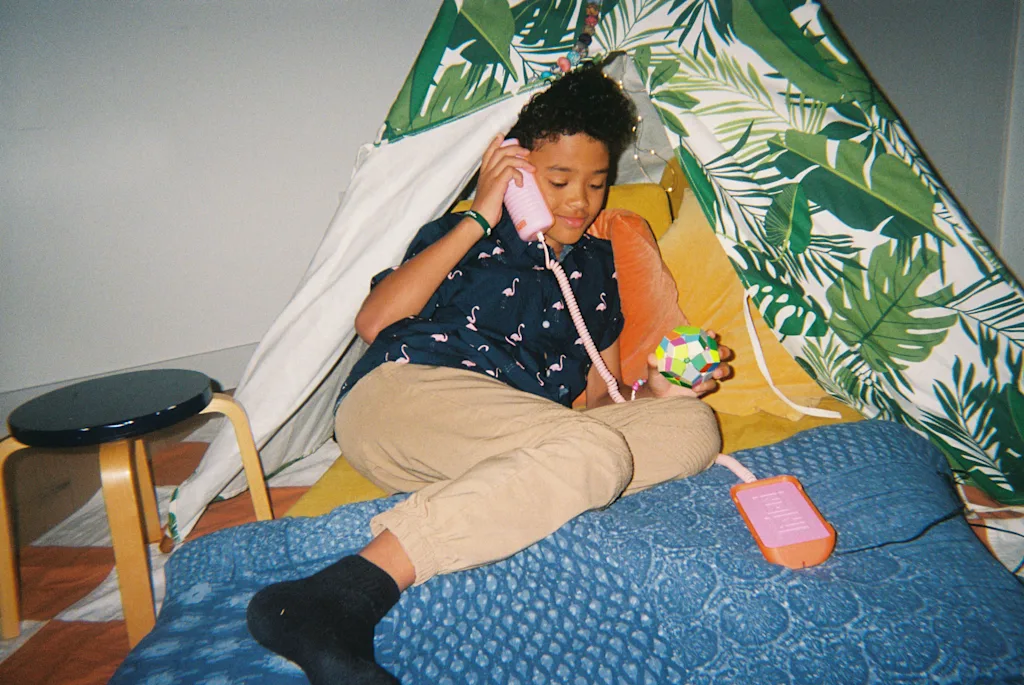
“I don’t want them to have internet or social media,” Miller says. “But I do want them to be socially connected.”
Even some adults have started using the Tin Can, enamored with the device’s simplicity and the fact that it doesn’t receive spam calls, since callers from nonapproved numbers simply get a recorded message saying they’re not authorized to connect. And parents like Kittleson say they also appreciate being able to call a house phone to reach the family when they’re away from the house.
While other companies offer kid-friendly cellphones, Kittleson says his company is essentially unique so far in offering a modern take on the house phone. And general-purpose VoIP phones are often more expensive and don’t have kid-friendly features built-in and easy to set up, he says.
Of course, most adults can’t ditch their smartphones entirely. Even for getting the Tin Can connected to Wi-Fi and updating the list of permitted numbers and hours where the phone enters do-not-disturb mode, parents use a smartphone app to access their accounts, much like with other connected home electronics. It beats an early system, Kittleson says, where users of the first prototypes texted him personally to add authorized numbers to the company’s database.
The devices and features may continue to evolve a bit in the future, but since Tin Can exists to encourage real-world communications and childhood hangouts unmediated by screens or digital games, Kittleson says customers shouldn’t expect a burst of new functionality.
“We don’t think this is going to be a feature factory where we’re launching new things all the time,” he says. “That’s sort of by design not what we’re trying to do.”