
For decades, fusion energy has seemed just out of reach. The technology, which could provide cheap clean energy around the clock, still isn’t proven. But companies are now betting that it’s ready to finally leave the lab.
Last month, the MIT spinout Commonwealth Fusion Systems (CFS) raised another $1 billion to help it begin to build its first power plant in Virginia, set to come online in the 2030s. (The company has raised $4 billion to date.) Google and the Rome-based oil and gas company Eni have both signed up as customers.
While the startup plans the project, it’s simultaneously finishing construction on a smaller demonstration of the essential technology—a donut-shaped device that uses powerful magnets to contain a superheated plasma where fusion can take place. Fast Company talked to Commonwealth Fusion’s CEO, Bob Mumgaard, about what it will take to bring the new power plant online.
You’re starting some work on your first power plant now even before you’ve finished your demo. Can you talk about why you felt confident moving forward at this point?
At SPARC [the demo], we’ve designed and constructed so much of it we’ve learned a lot already, and we’ve tested things as we’ve gone along. So we have high confidence in how it will work. We’re not really waiting for the final result of running everything that SPARC will ever do. We’ve also designed the plant so that we can accommodate late learnings, so there’s parts of the plant that we don’t actually have to start to build until SPARC is operating.
For people who have heard promises about fusion for years, what has changed in the last decade that makes things different now?
On the demonstration side, we had NIF, a facility in California, that made more power out than in from a fusion reaction for the first time. . . . It shows that we understand the science. Then we have the advances in computation and simulation that have gotten good enough to predict the current fleet of fusion experimental machines. And then we have advances in technology, like the very high-field magnets that we use that allow us to have a stronger ability to manipulate nature.
What will SPARC prove that we don’t know today?
It’ll have a plant that at the heart of it has a fusion plasma that is making more power out than in at commercially relevant amounts of power—so, large amounts of power—in a system that is end-to-end the types of pieces that you need in a power plant. It’ll give you a real snapshot of a power plant at a near full scale. . . . That’s super exciting because it shows that whole path. It won’t teach us exactly how long the power plant will last or how to do maintenance on it, but it takes all of the science and engineering that’s really fusion-specific of, “Can you even do this?” and puts it into practice in a facility that you can walk up and see.
When SPARC operates, we’ll have a really good picture of what ARC [the larger power plant technology] is. And so that’s one of the reasons that we can have confidence to go build ARC. ARC won’t be a breakthrough discovery type machine. It will be a commercial machine that is using the breakthrough in discoveries that have been done in the 10 years of the company scaling, leading up to it.
What stage is SPARC at now?
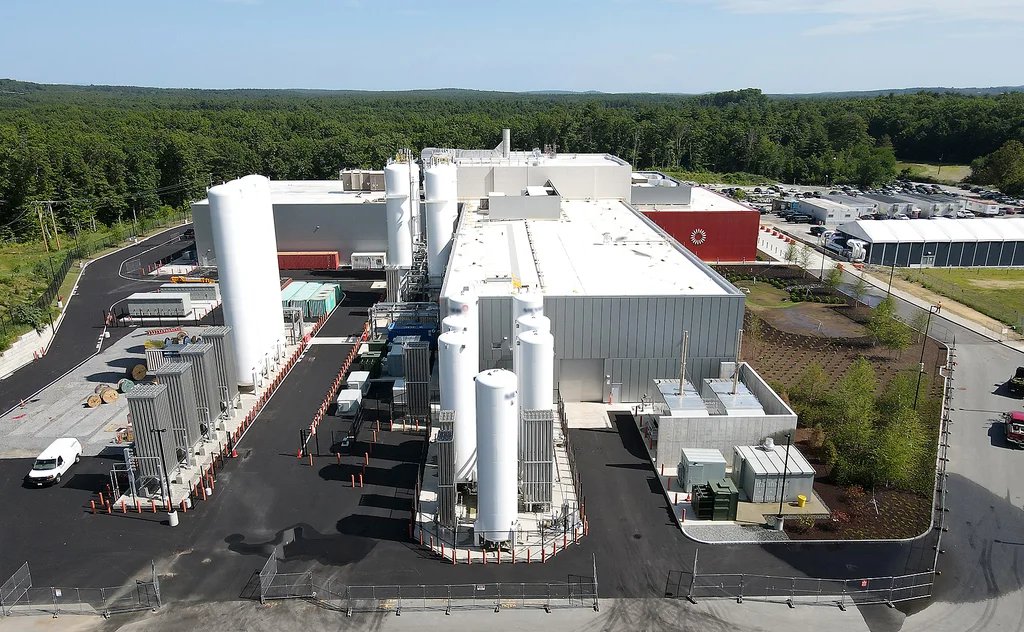
Most of the construction is done. The physical facility, the buildings, the piping, the industrial equipment—now that’s all starting to operate, just without the central tokamak. The tokamak, the fusion machine at the center of the facility, is under assembly. It’s like a really big, complicated Lego set. But all the pieces have been very well thought out in advance and have been made and now they’re being hooked together. There’s a team that’s running 24 hours a day, seven days a week that is a very experienced set of Lego builders, putting together the world’s shiniest and heaviest, but still very high-precision and well thought-out, set.
As you continue to work on SPARC, what steps are you taking now with the power plant?
Right now, ARC is in basically three parallel activities. One activity is the design of the whole plant itself. It’s going through iterations and getting more and more locked-in details. The second activity is getting the prototypes and all the prework done. Some prototypes are making things lower cost. There’s some supply chain work that is getting our suppliers retooled from SPARC to ARC. That’s much less fusion-specific and much more industrialization. And then there’s the permits and financing and regulatory and community aspects that are part of any power project. In Virginia, we’re working through the process with PJM, the large grid, about what it’s like to connect ARC to the grid.
You’re building on a site where Dominion, your utility partner, originally planned to build a gas plant, but the community pushed back about air pollution. Were you concerned that this project could face pushback, too?
You could look at the fact that the community has killed a gas plant as a negative or you could look at it as this is an opportunity to engage on an alternate energy source with an informed and organized public. And that’s really what we found. We found a community that understands energy, understands the pros and cons, and has thought deeply about it.
Since this is first of a kind, what do you tell people living nearby if they’re concerned about safety?
We don’t want to build anything somewhere that people don’t want it and don’t understand it. So there’s definitely an educational piece . . . in answering questions and bringing people up to Massachusetts to see SPARC. And that’s all been part of it. And fusion generally has an educational burden on it to get public acceptance. But it also has things going for it. There’s no uranium or plutonium, so this is not a nuclear power plant. There aren’t meltdown type scenarios, and that’s now been validated with multiple regulatory agencies around the world. It is novel and new, but there’s many things that are novel and new, including in Virginia. Then there’s the fact that it doesn’t have emissions, and it isn’t relying on coal being shipped through the community.
Is it too early to say when in the 2030s you’re hoping it will be built?
Yeah, it’s too early. Our intent is to move as quickly as we can. Previously there was a bit of a capital constraint, and there’s less of that now with this fundraising. Now the company can really start to push the gas pedal on ARC even more.
You’ve argued that the federal government needs to increase funding for fusion. What’s needed for this to scale more?
To make fusion into more than just the first plants, it has to be an industry and there’s multiple parts of that. There’s the job of developing the technologies that are the plant itself. That’s the job that CFS does. But there’s also the continued innovation of materials and ideas that are important for fusion and different subcomponents . . . that’s traditionally the realm of the federal programs, the universities, and national labs with test infrastructure. There are elements where first-of-a-kind power plants, or first-of-a-kind anything, are more expensive than when it’s a fully proven technology. Historically there’s been [federal] help in energy technologies or rockets or drugs to get first-of-a-kind things built. Fusion is at a stage where it makes sense to put those programs in place.
China is moving faster, right?
China has a very top-down-driven approach in most things they do and fusion is not an exception. The thing I think that is underappreciated is how much their stance has changed in the last three or so years. Where they have really put a lot of money, effort, and coordination into a strong push from a place where they have definitely started from behind. But the level of push is impressive. It’s part of their five-year priorities. Judging the dollar amount is somewhat difficult, but it is many times more than what the U.S. has done.
In the U.S., there’s not a strong coordinated push. You have strong pushes happening in Germany, Japan, and the U.K. Meanwhile, the U.S. has the entrepreneurial ecosystem, the capital ecosystem and the innovation ecosystem as evidenced by the concentration of companies. I’m excited to think about what happens if the public and private sides push together. It’s not quite there yet.