
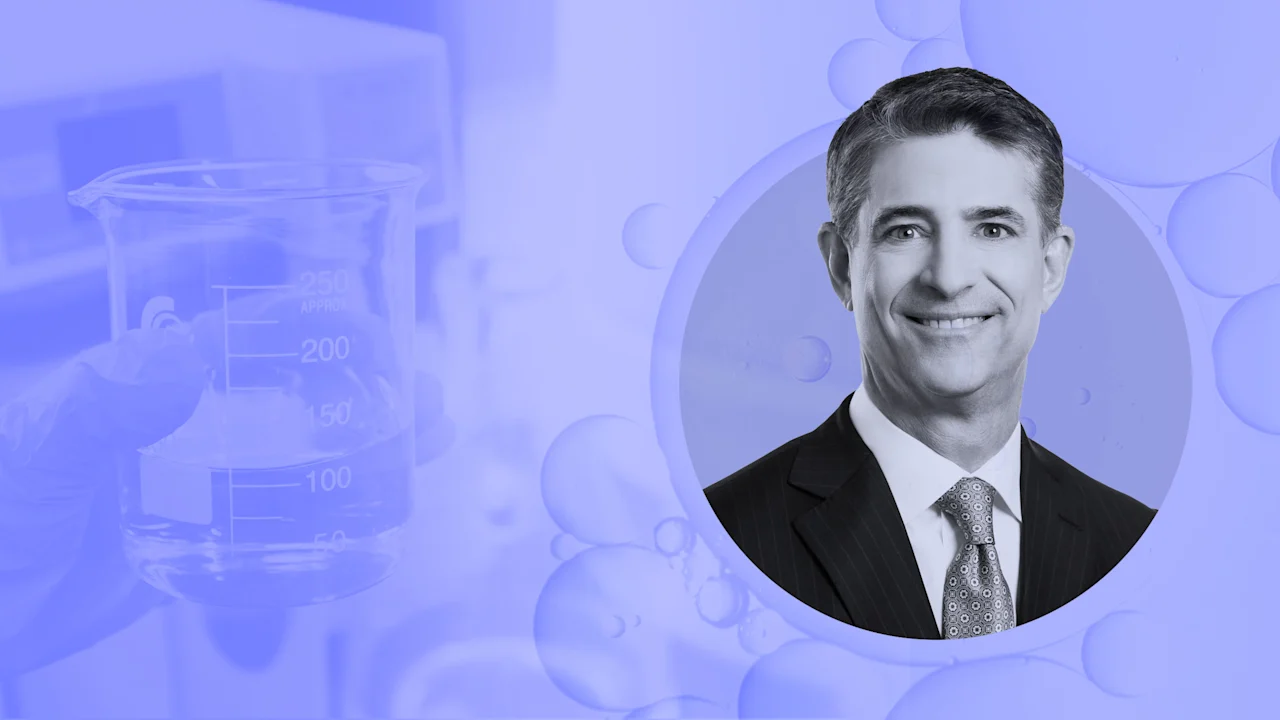
Hello and welcome to Modern CEO! I’m Stephanie Mehta, CEO and chief content officer of Mansueto Ventures. Each week this newsletter explores inclusive approaches to leadership drawn from conversations with executives and entrepreneurs, and from the pages of Inc. and Fast Company. If you received this newsletter from a friend, you can sign up to get it yourself every Monday morning.
Being a life sciences CEO is not for the faint of heart. Drug discovery and patent approvals are costly and time-consuming, and even if an executive can steer a company to clinical trials, there’s a very small chance the product will be commercialized. One study says that 90% of clinical drug development fails because the treatment didn’t have its intended impact, had the wrong formulations, or harmed patients. “You have a business challenge, a science challenge, a clinical trial challenge, and a regulatory challenge,” says Kevin Conroy, CEO of the colorectal cancer screening company Exact Sciences. “It’s like solving a complex puzzle, and there’s simply no guarantee of success.”
When companies do solve that puzzle, the rewards can be huge: As Modern CEO went to press, Exact Sciences announced it was selling to Abbott in a deal valued at $21 billion.
Still, biotech and health technology companies are now confronting an additional burden: simmering science skepticism. Pew Research Center found that in 2024, 76% of Americans believed that scientists act in the public’s best interest, up slightly from 2023 but down 10 points from pre-pandemic levels. A new survey from Pew shows that 24% of parents of school-age children question whether vaccines have undergone enough safety testing.
Rebuilding trust in science
Some lawmakers are fanning the flames. Health and Human Services secretary Robert F. Kennedy Jr. has called for changes in the ways vaccines are tested. The White House has cut budgets at the National Institutes of Health and the National Science Foundation, and moved to terminate federal funding to universities, all of which participate in the funding of medical and science research.
Conroy says the current environment is a call to action to the biosciences industry to help rebuild trust with the public and lawmakers. “How can we in this field show success that brings back a stronger belief in science, in data, in clinical studies, in evidence generation?” he asks. “I think it’s our responsibility to do that.”
According to Conroy, Exact Sciences isn’t facing any societal or political headwinds. It makes a colon cancer test (if you’re a certain age, you’ve probably been served ads for its Cologuard Kit) that will screen five million people for cancer this year. “Science skepticism hasn’t touched cancer screening,” he says. “People on the left and right are touched equally by cancer.”
Still, Exact Sciences and other science companies have benefited from an ecosystem of government-funded research, rigorous approvals, and endorsements that make the U.S. a biotech innovation powerhouse. Exact Sciences was founded in 1995 by an engineer who wanted to develop an alternative to colonoscopies, but the company struggled for years to develop a test. Conroy joined in 2009 after meeting with David Ahlquist, a Mayo Clinic physician who had spent 20 years researching noninvasive colon cancer detection—research funded by the National Institutes of Health, the National Cancer Institute, and the Mayo Clinic College of Medicine and Science.
Exact Sciences collaborated with Ahlquist on an approach that tests a patient’s stool for abnormal DNA or blood cells that might indicate the presence of colon cancer. Cologuard received FDA approval in 2014, after a huge clinical trial involving 10,000 patients; that same year the Centers for Medicare and Medicaid Services said it intended to cover the test, and the American Cancer Society included the test in its colon cancer screening guidelines—a key recommendation that helped build public trust in the at-home kit.
“Exact Sciences would not be here without federally funded research at the Mayo Clinic,” Conroy says.
Follow the data
Conroy notes that all businesses can gain from a scientific approach—running experiments, conceding when something doesn’t work (even if you’ve invested time and money in the research), and following the data. At Exact Sciences, such rigor extends beyond the lab. Before the company launched its kits, the team tested two different product designs for sample collection—a scoop and a container. The team thought consumers would favor the scoop, but research showed 85% of users preferred the container.
“We would have made a big mistake if we had trusted our gut,” Conroy says. “A lot of times you’re so passionate as a CEO, you skip all of those steps and just bulldoze your way toward the answer you’d like to see. I’m as guilty of that as the next CEO.”
I asked Conroy how biotech executives can help restore trust in science and rally support for the broader system of grants and research funding now under fire. He notes that he travels to Washington from Exact Sciences’ headquarters in Madison, Wisconsin, every quarter to meet with lawmakers, largely to advocate for early detection of diseases but also to talk about innovation and discovery. “Every CEO in this field should be doing the same thing. It’s too important for America’s competitiveness,” he says.
Deadline extended
We’re extending the deadline for Modern CEO of the Year nominations by a few days. If you or someone you know has had a standout 2025, please fill out this nomination form by November 28. We’ll name the Modern CEO of the Year on December 29.
Read more: science in focus
- This Sam Altman–backed CEO is using AI to get drugs to market faster
- The most innovative biotech companies of 2025
- Why Jennifer Doudna is one of the 10 most innovative people of the last 10 years