
Jon Wiener: From The Nation magazine, this is Start Making Sense. I’m Jon Wiener. Later in the hour: Colson Whtiehead won two Pulitzer prizes for his novels, and then wrote three crime stories about Harlem – the latest is Cool Machine, and it’s terrific. John Powers will comment–he’s critic at large for NPR’s Fresh Air with Terry Gross. But first: the Supremes, voting rights, the postal service, and Trump –David Cole will explain, in a minute.
[BREAK]
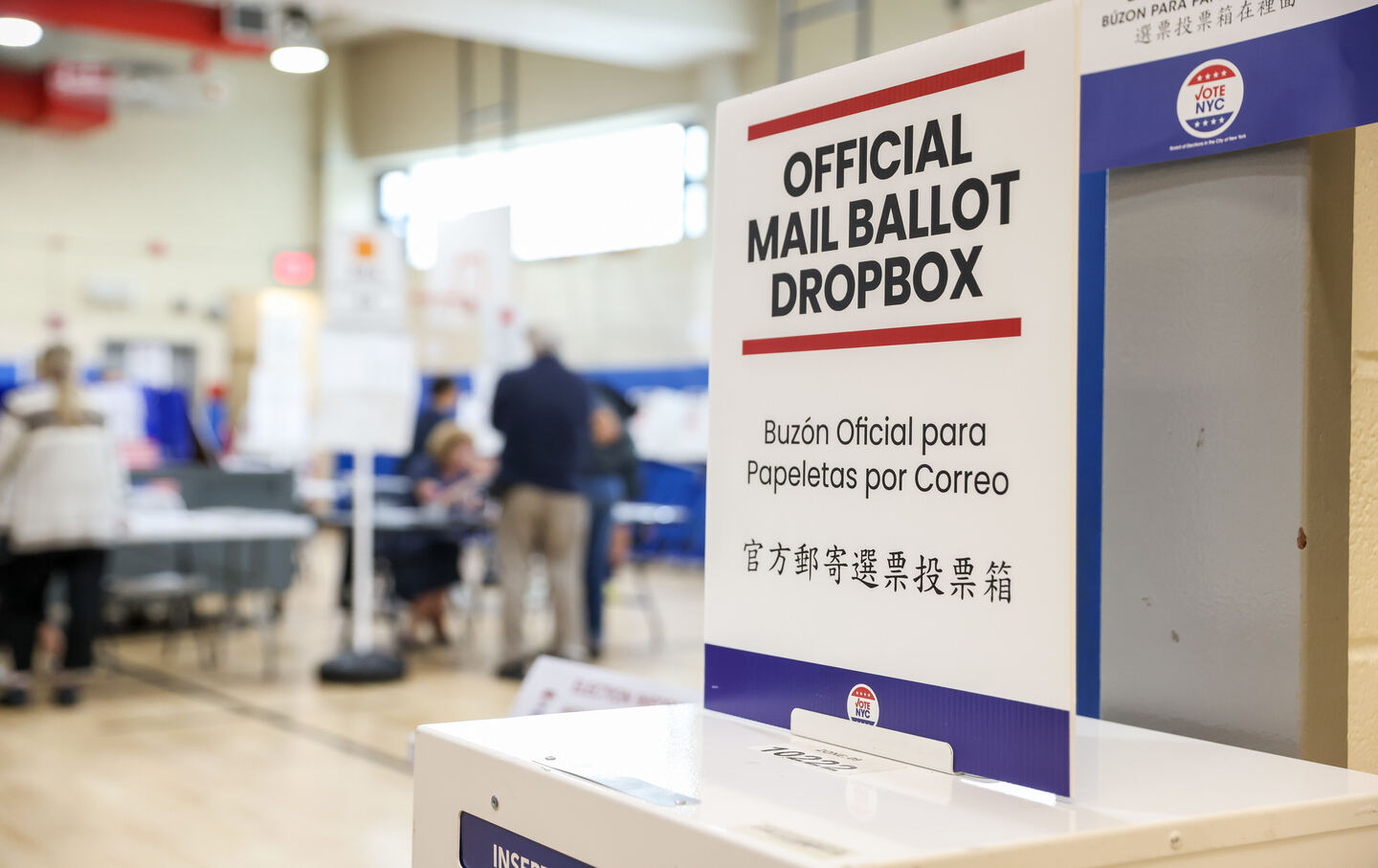
The Supreme Court is not a Trump court, at least not on several issues. But where do they stand on voting rights, as we prepare for the midterms in November? And what exactly did the court say on Monday, in its order about the Postal Service cooperating with Trump in his effort to restrict voting by mail? For comment, we turn to David Cole. He’s former national legal director of the ACLU, now teaches law at Georgetown. He also writes for The New York Times, The Washington Post, and The New York Review. And he’s The Nation’s legal affairs correspondent. David, welcome back.
David Cole: Thanks for having me, Jon.
JW: We’ll get to this week’s Supreme Court action on the Postal Service and voting by mail in a minute. But first, the big picture: a lot of our friends consider the current Supreme Court to be a Trump court. It has three Trump nominees. It has a six-to-three conservative majority. This is the court that granted him immunity from criminal prosecution. They permitted partisan gerrymandering. And yet you say this is not a Trump court. Please explain.
DC: Well, I think, just on the evidence of this past term, I don’t think one can say this is clearly a Trump court. You have to keep reassessing as you go along. But this term it delivered several blows to key Trump initiatives. Birthright citizenship: rejected. Probably his single most central kind of attack on the very notion of who we are, who among us are our true citizens. They rejected his position 6 to 3.
They rejected his position on the tariffs – his most important foreign policy initiative; brought in over $100 billion in revenue. They rejected it, said it’s beyond his authority.
His effort to fire Lisa Cook from the Federal Reserve. They rejected that.
His effort to put National Guard troops on the streets in cities like Chicago and Portland and Los Angeles. The court rejected that.
And if you look back more broadly, the court stopped him from using the Alien Enemies Act to deport people to Venezuela. They said, “No, you can’t do it until we take it up.” And now it looks like they may never take it up. And there may be no more such deportations.
So, I just don’t think you can write it off as a Trump court.
Did he lose every case? No. And you know, no president loses every case in the court. Biden didn’t lose every case in the court. And nor did Trump. But a number of the big ones were ones where the court had already, pre-Trump, indicated that it was moving in that direction, like in particular requiring that the president have the power to remove the heads of executive agencies without any kind of constraint by Congress – for that the writing was on the wall for that a long time ago. And the court has been moving in that direction for some time. They overturned precedent. I think it’s wrong. But it’s not a Trump decision, it is that the court has been moving in that direction for a very long time.
JW: And the other thing that was not a Trump decision – similar argument – is gutting the Voting Rights Act. This has been a long-standing goal of conservatives. I asked AI, ‘when did John Roberts begin working on gutting the Voting Rights Act, section two?’ and the answer is “1981.” His very first job at the Justice Department, he proposed gutting section two of the voting rights act. That was 45 years ago. So, this has been his project for a long time.
DC: Under Ronald Reagan. Yeah. It’s, again, a terrible decision. I think the worst decision the court issued all of last term. But not a decision that can be explained by ‘this is just a court that wants to do Trump’s bidding.’
JW: And what did Trump call the justices after he lost the tariffs case?
DC: “Fools and lapdogs.”
JW: That doesn’t seem like, if you’re going to go before them again, that that would be a good idea. But maybe I’m wrong about this.
DC: He’s not a Supreme Court strategist.
JW: We’re especially interested in voting rights and whether the court will block Trump from interfering with or sabotaging the midterms. The first relevant case here is one the court has already decided about the deadline for counting mail in ballots. Trump called this one “a tremendous loss.” Remind us, what that was about.
DC: Yeah. That was an argument that the Trump administration made that a federal law that requires that federal election be conducted on a certain day, precluded the counting of ballots, mail ballots that were voted upon before Election Day or on Election Day, postmarked by that date but received by the state afterwards. And Mississippi was one state among many that says, ‘if you get it postmarked by that date and we get it within’ I think it was a ten-day period or something like that, ‘we will count it because you voted by Election Day.’ And they were saying, ‘No, it has to be received by Election Day.’ And it was a clear effort to try to undermine mail-in ballots, which for whatever reason, Trump has had a vendetta against for a very long time, notwithstanding that he himself has voted by mail. And again, the court rejected it and said, ‘No, we read the statute to permit what Mississippi and many other states do. As long as the votes are all done by that date, they can be counted later.’
JW: And there’s a second, and in some ways, much more important case before the court as we speak. Friday, the Postal Service published new regulations that would restrict mail voting in the midterms. This is because Trump issued an executive order saying the Postal Service will not deliver mail ballots in any states that do not provide voter data to his administration. And two dozen states have gone to court saying they won’t do it. Tell us about this case and where we stand today.
DC: Yeah. So, this is another effort by Trump to mess with mail ballots. And sort of, by definition, a mail ballot is one that goes in the mail. So, he’s had the brilliant idea of, ‘well, I control the Postal Service. Maybe I can control and obstruct mail-in ballots through a postal regulation,’ essentially. So, he issued an executive order some time ago directing the Postal Service to do this. The Postal Service has now done it.
JW: They have issued a rule, which has been blocked.
DC: Right, right. So, even before they issued the rule, just on the basis of the executive order, 23 states and the District of Columbia went into court and said, ‘this executive order is illegal. The running of elections, including for federal office is a state matter subject to congressional revision, but not subject to unilateral presidential revision.’ And what essentially the president is trying to do here is do an end run around that, not by directly changing the rules about mail-in ballots at state level, but using the Postal Service to try to stop the ballots from even getting to the states where they are supposed to be assessed for whether they are valid or not. So, it’s a clear effort to kind of use the kind of contingent fact that the mail ballot is mailed, and that the federal government controls the mail, to try to interfere with how states run elections. And the lower court already said ‘No’, the lower court already rejected the president’s position and said, ‘No, you can’t do this. These are matters for the states and Congress, not for you, the president unilaterally. And the fact that you have a Postal Service doesn’t give you the right to do an end run.’
And now they’ve issued a rule. They have been seeking relief from the Supreme Court already. They’ve now said it’s even more urgent because the rule is there. He clearly thinks that Democrats vote by mail more than Republicans because he’s had a long standing kind of a partisan agenda against mail ballots. But thus far the courts have said, ‘No, no you don’t. This is an improper end run.’ We’ll see what the what the Supreme Court says. There are a host of procedural questions in the case about whether the court issued their orders too early, whether this rule that has now been promulgated changes anything. It’s not a simple case, but I do think the basic idea that you can’t exploit the fact that you run the mail service to try to monkey with the rules on mail-in ballots, when those are supposed to be set by the states and overseen by the states. And while Congress has the authority to override them, Congress has not done so. He’s tried to get Congress to pass laws to override what the states are doing. And so far, the Senate has refused to do his bidding. And so, Congress has also stopped him in his tracks.
JW: Yeah. I saw that 47 million people voted by mail in the most recent elections, 30% of voters. The Postal Service says in defense of their rule that if states don’t like the policy, they don’t have to use the U.S. mail to conduct elections. What do you think of that argument?
DC: That’s ridiculous. I mean, it’s true, you could go to UPS, I suppose, and you could have – each state could adopt its own, create its own, delivery service just for the mails. But that’s not the world we live in.
JW: On Monday morning, Trump’s lawyers filed a brief with the Supreme Court saying this is only about the design of the envelopes. This is not a big issue because the Post Office does have rules about things like mailing explosives. This is sort of like mailing explosives, they say.
DC: Yeah. Well, if people vote to send a message to President Trump, he might feel like it’s like explosives. But no, I mean, it’s – these rules are very Byzantine. They’re clearly not designed to serve some legitimate purpose of ensuring that the mail gets delivered properly. What do you need for the mail to be delivered properly? An address. That’s all you need. And they want information about the voter, which then they’re going to run against some kind of list that they’ve created of who they think are eligible voters.
JW: Yeah. We have to talk about this list question, because Trump’s idea here is to prepare his own list of approved voters and then have the post office enforce it. Now this has been litigated a lot. Remind us: this idea of reinforcing the state requiring that states hand in the voter rolls, the information about every registered voter, so that Trump can create a list of approved voters — Where do we stand on that proposal?
DC: So, he’s sent that request to, I think every state. So far, 21 courts have ruled on whether he has the authority to demand such lists. 21 of those courts have ruled against the president. Not a single court has said that the president has this power. And what is he trying to do? He’s trying to create a list. It’ll obviously and necessarily at this stage, be under-inclusive–and then use that list to basically throw in the waste bin eligible votes by people who are not on his list.
Again, that’s enforcing voting procedures, which is a role of the states. The states have their lists. The states are the ones who are supposed to enforce that. If Congress thinks the states are not doing a good job, Congress can create some separate set of procedures. But under the Constitution, it is the states and Congress that do this, not the president acting unilaterally.
And what the president is doing here, and both with the US Postal Service and with these requests to states for this data, so you can compile a list, is trying to enforce the voting law himself. And it makes sense not to give the president of the United States one person, one person of one party the power to make decisions about elections nationwide. Much better to have that authority diffused, so it can’t be concentrated by one self-interested individual. And Trump is the very definition of your self-interested individual who you would not trust to run an election.
JW: Now we have the latest on this story. Monday afternoon, the Supreme Court issued an emergency order that some of the media says gives the Supreme Court the green light to the Postal Service and the Trump administration to proceed with their plan to use the Post Office to undermine voting by mail. MNS NOW called it a “voter suppression win.” But is that really what happened?
DC: No, this is a purely procedural decision. What the court ruled was that the challenge that states had made was premature. And the reason for that was the states challenged the executive order that President Trump issued. The executive order itself didn’t have any legal effect. It directed other executive agencies, DHS, the Postal Service, to take certain actions consistent with law. But they hadn’t taken those actions yet. And so, the court said until they take those actions, there’s no dispute that’s “ripe” for us to decide.
But the Postal Service has now taken action pursuant to the executive order. It issued the rule on Friday. And that rule is before the same judge that found the executive order illegal. That judge is very likely to block the rule, and that will go back up to the Supreme Court. So, this is just a kind of a hiccup in the process. It says nothing about whether the president’s effort to exploit the power of the mail service to interfere with the way states govern their elections is permissible or not.
JW: And let me just underline that the court majority itself, in this order, said nothing here relates to the substantive constitutional objections to the president’s executive order raised by the plaintiffs. It remains to be decided whether the executive order is lawful. Is that correct?
DC: Exactly. When the court finds that it doesn’t have the jurisdiction to decide a dispute. Then, by definition, it is not making any decision about the merits of the dispute. This was purely the threshold question of, basically, did the court below act too early. And the court said it did. But it’s inevitable that it will come right back up to it, now that the dispute is concrete, because the Postal Service has taken action in response.
JW: I have a second question. There are actually two separate lawsuits in the same court in Massachusetts, and each one got an injunction. The first one is on the part of the blue states. In The second one the plaintiff is the League of Women Voters. The first one applies only to the states, which are parties to the lawsuits. But the League of Women Voters case is a national case. They’re national organizations with national membership. So, the question is whether the order of the Supreme Court issued refers only to the state plaintiffs, or to all the states — because some states have already submitted their voter lists, the red states.
DC: I think it refers only to the state decisions and the Postal Service. The Trump administration basically told the court on Monday that in the absence of a stay of both the decision in the state case and the decision in the related League of Women Voters case, the Postal Service cannot go forward. So, this is going back up, the court did not grant a stay of the League of Women Voters decision. And so, the Postal Service says it can’t proceed. The plaintiffs will have gone back before the district court judge in the wake of the Postal Service issuing its rule. And so, one way or another, this is going back up, and nothing will happen, I don’t think, until the court rules on the merits.
JW: And I believe the order also specifically said this governs only the creation of the lists in the executive order by the Department of Homeland Security. It doesn’t require that any states cooperate with the executive order.
DC: Well, that’s true of the executive order. The Postal Service rule may, as a practical matter, require the states to cooperate, because otherwise the mail won’t be delivered properly. But again, the court didn’t address that question, and it will now be addressed in due course, I think, probably quite possibly by the end of this week.
JW: Yes. Let’s talk about the schedule here a little bit: early voting and absentee ballots. Voting by mail begins early in September in several states. Can the Postal Service prepare the envelopes, and the county registrars of voters prepare the ballots, in time to for the midterm elections?
DC: You know, I think it’s – I don’t know your experience with the Postal Service. Mine is not that it is the most efficient institution known to mankind. And this is a massive task. Look, it was designed to mess with mail ballots. And if it creates a chaos, that’s what Trump wants. But I think the proper way forward here is to say, “look, the Postal Service doesn’t have a role to play in regulating elections, nor does the president.” That is a subject for the states, and for Congress if it chooses to act. But it has not chosen to act on this subject. And so we should just nullify this Postal Service order and proceed.
I will say that your point about the mail-in balloting starting soon may play against the challengers, because there’s a case called Purcell that says that courts should not intervene and change the rules at the last minute in advance of elections because of all the chaos that will create. It’s been applied very, very inconsistently and often with partisan looking – very partisan in its application. But that’s going to be an issue I think, when– and I don’t think it’s an “if,” but a “when” — when the judge enjoins the rule. I think one of the arguments that the Trump administration will make is that the court can’t intervene this late. The Postal Service can act, but the court can’t. And, we’ll have to see whether the court takes that seriously.
JW: So you think this we may have further action this week?
DC: I think we’re going to have further action from the lower court definitely this week. And it will go immediately up to the Supreme Court. And it will be on a fast track. And presumably they’re fairly familiar with the merits now because of the appeal that they already considered. And so, I do think, we could get a ruling this week. The problem is, as is often the case with election disputes, you’ve got to decide it promptly. And, we’re running up against the deadline.
JW: There is a separate issue here, which I’ve been wondering about. 16 states have agreed to submit their voter rolls, the red states. And the Trump people are approving and checking the names now. And apparently, they plan to go ahead and create federally approved voter lists for those 16 red states. Does this court ruling, which is before the Supreme Court now, apply to all the states, or just the 30 states that refused to submit their rolls?
DC: I don’t think the Postal Service case is going to resolve that question. So, because the running of federal elections is, under the Constitution, a state matter, states may have the prerogative to choose to enlist the help of the president, if you can call it that. In this regard, I mean, I think it’s deeply troubling because at the end of the day, what are they trying to do here? They are trying to make it hard for people to vote. And in a democracy, we should be making it easy for people to vote, not making it hard for people to vote. The only justification they’ve ever advanced for making it hard for people to vote is this concern about voter fraud by non-citizens, which no one has ever pointed to any significant number of non-citizens fraudulently voting anywhere. And for good reason. It’s a serious crime. You face substantial penalties. The likelihood that a single non-citizen vote is going to make any difference to anything is so small that it makes no sense for somebody to engage in that criminal conduct. And so, it hasn’t happened. But that has not stopped Trump or the Republicans from using it as a pretext to try to make it difficult for people to vote. Why? Because they don’t want to hear what the people think.
JW: Another way Trump could sabotage the elections that our friends are worried about is to send the National Guard to polling places in blue cities. He would claim he was protecting voting places from threats that he has learned about somehow. But the court has already ruled on sending the National Guard. That was to Chicago and the vote there was 6 to 3 against Trump, and Trump withdrew the Guard and did not appeal that ruling. So that stands right now. Is that relevant to Election Day?
DC: I think it is. There’s a long-standing tradition against using the military for domestic law enforcement purposes. Trump sought to get around that. And the Supreme Court rejected his ability to do so.
There is one statutory basis for doing so, and that is where there’s an insurrection. But a problem at the polls is not an insurrection. And so, I don’t think he has authority to do that. I think the Supreme Court decision against him on the Chicago case will make it very difficult for him to do so, and that federal judges will very likely stop him from doing so if he tries that.
JW: David Cole – his argument that this court is not a Trump court was published in The New York Review. David, thanks for talking with us today.
DC: Thanks for having me, Jon.
[BREAK]
Jon Wiener: Colson Whitehead has a terrific new novel out: it’s called Cool Machine. He’s best known for winning two Pulitzer Prizes in a row, the only novelist ever to do that – for The Underground Railroad and The Nickel Boys. Then he changed keys and wrote three crime novels centering on Harlem and the furniture store owner Ray Carney, who also works part time as a fence, dealing with stolen jewelry and watches out of his back room, but only when he needs to. For comment, we turn to John Powers. He’s critic at large for NPR’s Fresh Air with Terry Gross, where he has an audience of millions. Last time he was here, we talked about the Christopher Nolan film The Odyssey. John, welcome back.
John Powers: Happy to be here, Jon.
JW: The three volumes in Colson Whitehead’s Harlem trilogy cover the 60s, the 70s and the 80s. Harlem Shuffle, published in 2021, was set in 1959 to 1964, the Kennedy-Johnson years with John Lindsay as mayor of New York, when our hero is trying to make it as a businessman, as a family man, and sometimes as a crook. The second one, called Crook Manifesto, published in 2023, was set in 1971 to ‘76, the Nixon-Ford-Abe Beame years, when the city is a wreck, and Harlem is being burned down, tenement by tenement. And the new one, Cool Machine, is set in 1981 to ‘86, the Reagan era of greed and new high rises, with Ed Koch as mayor.
Let’s start with Ray Carney, Colson Whitehead’s Harlem furniture salesman and fence. He’s a crook part time, but he doesn’t really want to be one. He wants to be – what exactly?
JP: Well, what he wants to be, ideally, would be a respectable businessman that sells high class furniture through his furniture store. He has a very good eye for furniture. And can move, in the early books, with his wife to the actual place where she came from, an area called Strivers Row in Harlem, which are these particularly nice houses in the middle of things that aren’t so nice. And his ambition in the first book is to more-or-less get his wife, Elizabeth, and himself to Strivers Row along with their kids. And he can’t do it without occasionally dipping into crime. And this is problematic, partly because you could go to jail for it, partly because it’s dangerous, but also partly because his father, Big Mike, was just a hardened, nasty criminal who was never nice to him. And so he sometimes wonders whether he has inherited some of his father’s criminal genes.
JW: At the opening of Cool Machine, our man Ray is named Furniture Dealer of the Month for the northeast region. How does he feel about that?
JP: He loves it. I think intellectuals seldom realize that these awards mean a lot to people, and it means a lot to him, in particular because he’s African American. And so, therefore, he would have to struggle harder to ever get that. And then, of course, he then has to worry also, once he gets it, whether people will think he got it because he was Black. And so it’s a form of tokenism. So even something that should just be unalloyed pleasure actually has a side to it. As with everything in this book, there’s always another side to everything, because nothing is just one thing in these books.
JW: A lot of all three of these novels center on Ray’s relationship with a man called Pepper. He comes out of the violent criminal underworld of Ray’s father, Big Mike. Tell us about the Pepper of Cool Machine — of course, he’s older this time.
JP: He seemed like a cross between Mouse in the Walter Mosley novels, who is the slightly dangerous person who does all the dirty work that Easy Rawlins doesn’t do. And maybe like a boxer like Sonny Liston, because people talk about how they see his face and he’s got this look on his face. Often, they just start talking. He doesn’t even have to beat them because, in fact, they know he’s a tough guy. He’s been a tough guy. And who has a complicated relationship to Ray because he feels that Ray used him at one point. He doesn’t like it. But gradually they become almost familial by this book.
However, Pepper is an older man. He’s changed his life. He’s fallen in love. He needs some money. But in fact, he’s no longer the thuggish guy that he’d been before. And even if he wanted to be, he couldn’t be — because his back is seizing up. He’s got bad guts. So he’s now a more decrepit version of the person who you would always think of – probably, it’s like, switching in other terms, if you were to have cast Clint Eastwood as Dirty Harry when he was 80, you would have a sense, oh, this isn’t the guy he was before.
And over the course of the books, he becomes this exceedingly lovable figure, partly because Colson Whitehead is smart enough to put us in his head, and we realize that he has his reasons. And in fact, the second book, Crook Manifesto, is his thought. He has a crook manifesto. So, he has principles that he lives by, even if they aren’t the principles that straight America lives by.
JW: What is the crook manifesto? I found the quote: “A man has a hierarchy of crime, of what is morally acceptable, and what is not.” That’s the crook manifesto. “And those who subscribe to lesser codes are cockroaches.”
JP: Yes. It’s true. I mean, I remember once reading an article during a peak of the drug epidemic here in LA, where they were interviewing guys on death row. And the guys on death row were talking about how the young kids these days didn’t have any values, how they’d kill somebody for $50. They were thinking, “no, it was a serious thing to kill people.” They thought you wouldn’t do it for a minor crime. That was part of the crook manifesto.
JW: Exactly. Cool Machine has a great moment: The plot in the middle section of the book involves searching for a stolen African mask. And Pepper is on the case. And he finally finds it. And he puts it on because he understands its power. Colson Whitehead writes, “you put it on and become something different. You see things differently through it.” Now, Whitehead never tells us what it is that Pepper sees when he puts on the mask, but it is a powerful moment and gives us yet another side of Pepper.
JP: Yes. And in fact, as a literary point, there is nothing you could write that he sees that would be good enough. Because Pepper has been the most empirical of men. So, to suddenly have him do something almost like have a vision, to see something clearly and understand it — our mind explodes with the possibilities of it. It’s a great thing, that entire thing is great.
One of my favorite things, as an old professor, is where Pepper is working with a young woman and she talks about going to her school and watching movies. And he thinks to himself, “these kids go to college to watch movies. That’s why I’ll never give money to the United Negro College Fund.”
JW:[LAUGHTER] John Powers is a well-known professor of film studies in Los Angeles.
JP: Yes, I’ve taught film. Yes.
JW: The biggest thing about this series that I think some critics miss is that they are funny. They are really funny. Parts are as good as Elmore Leonard, I think.
JP: Oh, I mean, I have all sorts of things I marked. I was almost tempted to read one to you because I just thought it was so funny. You know, he’s great at one-liners. He’s great at riffs, he’s great at little things that pay off. And then also the scenes and situations are often funny. It’s such a fun trilogy. You can see how, having come off the grimness of Underground Railroad and Nickel Boys, that you might actually want something more fun, partly for yourself, because your mind is someplace else. Partly because his first books were fun. I think he’s a person who likes being funny and his models for writing, I mean, the Thomas Pynchon influence of all the books is so evident. Pynchon makes a million jokes, and Whitehead does too, and then does funny pop culture riffs like his thing on the racial component of Alfred Hitchcock’s movie The Birds is just really great. And they’re good jokes and just the ideas are funny.
JW: The jokes are great, and it goes beyond the jokes. I mean, the whole thing about the furniture salesman, there’s a lot of really funny stuff here about furniture, because when Carney meets people, he evaluates them, not in terms of their clothes or their face. He evaluates them in terms of the furniture in their rooms, and he knows the brand names of the recliners and the dinette sets. And that’s actually a big part of his character, which kind of makes us smile. But it’s also a serious thing, too.
JP: Oh, it is. Well, it’s his business. And the thing is, you also then, because one of the other things we’ve talked about is that part of what makes the trilogy great, is that it is a really smart, fun, potted history of New York over a 30-year period. And part of that history would be the different styles of furniture that turn up. So, in each volume, Ray is selling different furniture to people because the styles have changed. And in every new volume, you’re reading about different furniture in his showroom.
JW: Yeah. Somebody called it “a social history disguised as a crime caper” – the whole series. As a historian, I have to say, I think that’s going a little too far. But there is a lot of historical awareness in here.
JP: Well, there is a lot of historical awareness, but with the surreal edge. Pynchon is the obvious touchstone where you actually are like going under the city to see the hidden lines of power that nobody knows about, is very much Crying of lot 49 Pynchon, but anchored in very specific details of Harlem or what particular streets look like. He’s a very good describer without being – what I always found unbearable about someone like John Updike was, I just wanted him to stop describing everything, because it was like it was like showing off how well he was noticing everything. I just wanted him to stop. And I never felt that with Whitehead. It’s partly because it’s fun, but also, he doesn’t linger on it in fetishistic ways.
JW: You compare this to Pynchon; another critic called the writing style here “pop art Marxist noir.” I wonder what you think about that.
JP: Well, it’s very pop. Whitehead loves pop. He’s written a zombie novel and all the rest. And he’s working a crime novel, and he clearly knows his crime novels. It seems inconceivable to me that Pepper isn’t derived from Mouse in the Walter Mosley. Yeah. And there’s a great tradition of the moral hero having to have the sidekick to do the bad stuff that needs to be done so that the audience doesn’t turn against the moral hero. Yeah. In a tragedy, Ray Carney, the furniture salesman, does the bad stuff. Okay. In a comedy, he’s got Pepper to do it. So he’s very much steeped in pop culture. And people are driven by economics. The base is driving the superstructure in in all of these novels.
JW: The way Ray Carney explains this is it’s all about “the envelopes.” The envelopes explain the whole machine. Ray tells us the envelopes are full of cash that are the payoffs, the graft, the corruption. His point is, there are little crooks like himself who deliver envelopes to the corrupt cops on the take, but the really big crooks are also delivering and receiving envelopes. The Board of Estimates of New York and the elected officials there collecting their envelopes, too.
JP: Yes. And it’s interesting that because it doesn’t take place in the imaginary New York of, say, Batman, it takes place in an actual New York where Ed Koch is going around saying, “how am I doing?”
JW: yes.
JP: And that various aldermen are in fact genuine. Historically, real aldermen have killed themselves because they’ve been caught in corruption things. So Ray and Pepper, they’re all interacting with people, connecting with actual people in the city. And of course, then you get imaginary crooks.
The other part in it, which is almost the motto for the series, is “churn, baby, churn.” Great! And that New York is constantly churning, which then makes you think or, since we’re talking, what was it? Neo-marxist noir?
JW: Yes.
JP: Or pop-Marxist noir, is you think of both Marshall Berman and the Marx thing, “all that is solid melts into air.” What Carney sees is that – is that what? Everything that seems so fixed keeps changing. Maybe the schist that underlies the city is there, but almost everything else is constantly churning. Even if in many ways stays the same.
JW: Let’s talk about where the Harlem trilogy fits into Colson Whitehead’s trajectory. You mentioned the previous two novels, The Underground Railroad and The Nickel Boys, which came right before the Harlem trilogy. The Underground Railroad, just to remind listeners, this is set in the slave South where an enslaved young woman makes a desperate bid for freedom by escaping on a literally subterranean railway system while being pursued by a relentless slave catcher. And in Nickel Boys, two Black teenagers struggle to survive horrific abuse in a segregated reform school in Florida in the 1960s. These were big books. These were serious books about the oppression and suffering and resilience and the strength of Black people. And the new ones are fast and fun.
JP: Yeah, it’s interesting because when he started off, he actually was doing stuff that was about race often. But the books were brainy, funny. They were very pop. And many people thought there wasn’t enough feeling in them, I think was the objection if you read what people were saying. Even the one that was the autobiographical one called Sag Harbor, which was kind of based on his own life as a rich Black kid, one I really liked.
JW: I like that one, too.
JP: There was, I think, more feeling in that one. And then something happened, and it’s hard to know. I think probably even he doesn’t know. It is the complicated fact that maybe if you have been a rich, privileged Black guy all your life, you realize that there’s part of this experience that you aren’t really tackling. It’s partly if you’re a really good writer, you’re thinking, ‘how can I say something that in a way, that isn’t just the same old thing?’ Because you don’t need more slavery porn, say, or Jim Crow, where you just watch endless suffering.
And I think he found a way of doing it. The interesting thing is, I think it’s simultaneously these seem like the two least Colson Whitehead books of his career. These are the two that stand out. They’re the two that are most praised and most admired. But they’re the ones also that seem in some ways least like my sense of him, in any case.
But I then feel these last three books bring a certain kind of depth to the pop fun things that he didn’t quite have before. So, I think maybe he had to go through the actual darkness and the seriousness of the other two in order to like, somehow sort of bring it along with him, because I think there’s more feeling, I think, in this than in some of the earlier books, the trilogy.
And then it’s a question of which ones you like best. I know that there is a way in which our culture always rewards books about suffering, in the way that Hollywood just can’t stop wanting to give Oscars to Holocaust movies. And some literary awards often go to African American suffering. When you consider the number of really wonderful, funny, good African American writers who are just writing about a different part of Black experience, you think of the fun books of Percival Everett, who then gets his most praise ever for one of his more serious books, James.
JW: More serious, and the least imaginative.
JP: “Most serious” in quotation marks. And once again, the least like him, interestingly. There’s a challenge in doing that. I remember in The Book of Daniel, where the imaginary son of the Rosenbergs near the end of the book says, “can I do it? Should I do it? Am I going to be able to do it? Can I describe . . . the execution?” His parents being electrocuted. And it’s like, ‘can I get it together to do that?’
And I can sort of imagine if you are an African American writer, and certainly if you’re Colson Whitehead, who’s just incredibly gifted. You’re thinking, ‘can I do this? Can I actually go to this place and come up with something that I’m satisfied with?’ Because I think it would be easy for someone as talented as him to come up with something that the public would be satisfied with, whereas I think he actually was satisfied with them. Everything I’ve read makes me think, so what would you not like about two best-selling Pulitzer Prize winners? Yet I still feel like when he swings back to who he enjoys being, he enjoys being the writer of the Harlem trilogy.
JW: John Powers of NPR’s Fresh Air with Terry Gross. John, thanks for talking with us today.
JP: My pleasure.