
Trump’s order limiting mail-in voting is patently unconstitutional—but that didn’t stop the court from giving it the green light.
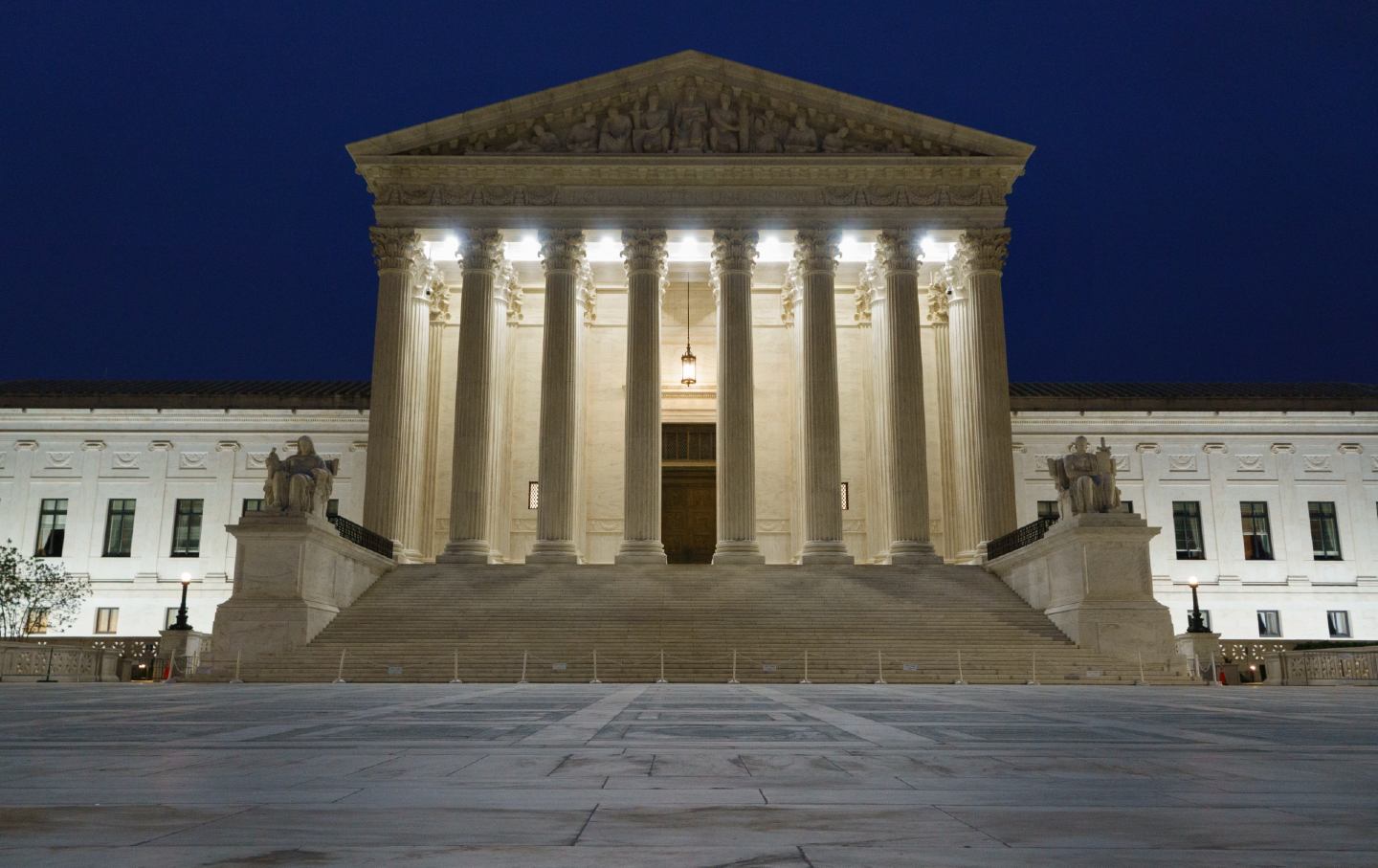
The US Supreme Court at dusk.
(Kevin Carter / Getty Images)
There’s a scene in The Shawshank Redemption where the wrongly convicted prisoner, Andy Dufresne, is trying to convince Warden Norton to act on new evidence that could exonerate him. The warden, who is using Dufresne’s accounting skills to hide his own illegal dealings, offers a bunch of reasons for ignoring the new evidence. Dufresne exclaims, “How can you be so obtuse?” The line sends the warden into a rage, and he throws Dufresne into solitary confinement.
The warden, of course, is not being obtuse. He understands the implications of what Dufresne is saying perfectly well. He just doesn’t want to lose his bookkeeper, and certainly doesn’t want to risk Dufresne’s exposing his illegal operation. The warden is not dense; he is evil.
So it is with our Supreme Court, which ruled on Monday to allow Donald Trump to move forward with one of his own illegal schemes. In an emergency decision, issued through the shadow docket, the Republican supermajority gave Trump permission to limit voting by mail in the upcoming midterm elections. In doing this, the six GOP justices understand that the president is trying to give himself the ability to manipulate the vote. They’re not confused by his plan. They’re not being obtuse. They’re simply aiding and abetting Trump’s assault on democratic self-government.
The origin of this particular assault is an executive order, issued in March, titled “Ensuring Citizenship Verification and Integrity in Federal Elections.” It does three things:
- Instructs the Department of Homeland Security to come up with a list of US citizens it thinks are eligible to vote. The list would be independent of state voter rolls, yet sent to the states to supersede their own voter registration lists.
- Instructs the Department of Justice to investigate and prosecute state and local officials who provide ballots to those who are “not eligible” to vote.
- Prohibits the US Postal Service from delivering mail-in ballots to those the administration deems not eligible to vote.
The entire executive order is unconstitutional. Voter registration and the maintenance of voter rolls is handled on the state level, not the federal level. The Trump administration has no constitutional authority to tell the states whom can be sent a ballot. It has no constitutional authority to tell the Postal Service whom it can deliver mail to. It has no legal authority to prosecute state officials who follow their own state’s procedures for producing that mail.
Current Issue
A group of 23 states sued the Trump administration and, in July, US District Judge Indira Talwani blocked Trump’s unconstitutional executive order. But then Trump appealed to his Supreme Court—and, on Monday, the Republican supermajority dutifully stayed the district court order and allowed Trump to proceed with his election-rigging plans.
The unsigned Republican majority opinion says that Trump’s order is not “ripe” for judicial review. Ripe is a legal term that means an issue cannot be adjudicated because it has yet to produce harm. The court is saying that the states haven’t (yet) been hurt by Trump’s executive order, so they can’t sue to stop him.
That argument is every bit as preposterous as it sounds. State election officials are being harmed, right now, by the threat of prosecution should they follow their state’s procedures for issuing mail-in ballots. Voters in those states are being harmed, right now, by the confusion Trump is causing over whether they can expect to receive a ballot. Either the court thinks that such harms can be stopped at some point in the future or, more likely, they think that Trump’s attempts to suppress the vote and rig the election aren’t “harms” at all.
Moreover, the executive order violates a critical Supreme Court precedent: the Purcell Principle. This doctrine holds that changes to the administration of any election cannot be made “too close” to an election. Reasonable people can debate how close is “too close,” but we should be able to agree that late August is (or should be) too close to an early-November election to change which government agency gets to determine who is eligible to vote by mail.
Ironically, the fact that we’re still in August, coupled with the fact that the Republicans have rested their decision on ripeness, does give the Supreme Court time to reverse course. It is possible that over the next few weeks, once the Trump administration orders the states to use the list of voters Homeland Security provides, that the court will find a “harm” to the states. Should two of the Republican justices allow themselves to see the harm, it’s possible that they will also see that the harm is unconstitutional.
But even a late-game restoration of mail-in voting will allow Trump and the Republican justices to accomplish their central aim: to sow confusion, uncertainty, and distrust in mail-in voting. We are just over two months away from the election and a mere six or seven weeks away from the start of early voting in some states. The fact that I cannot tell you how mail-in voting will work accomplishes much of what Trump wants.
And we can assume that this executive order is only the first shot across the bow. The Supreme Court has emboldened Trump (as if he needed any more emboldening). Even if the court eventually rules on the merits that this EO is unconstitutional, Trump will simply issue another one, and then another one. If he’s not allowed to prevent the post office from sending mail-in ballots to voters, his next move will be to order the USPS not to return the ballots from people who are not on his preapproved list of voters. Then he’ll order elections officials to not count the ballots once they’re received and threaten them with lawsuits if they do. Every one of those executive orders will be challenged by states, but the Supreme Court has given Trump every reason to believe that one of these unconstitutional, antidemocratic orders will hold up in court and that he can keep muddying the procedures for running elections—potentially right up to Election Day.
In a 23-page dissent, Justice Ketanji Brown Jackson said as much:
This suspect scenario appears tailor-made to weaponize this case as a means of destabilizing the nation’s vote-by-mail systems through court-assisted procedural maneuvers.… Rather than swallow the Government’s gamesmanship whole, the Court should have given this empty, strategic, and bad-faith stay bid the swift rejection it deserves.
Justice Jackson is right about this. She is wrong, however, about something else. She writes:
In the end, though, what makes today’s ruling so off-base is the Court’s lack of situational awareness regarding this equitable judgment. It treats the Government’s stay application as if the whole point is merely to demonstrate that the Plaintiff States’ claims are not justiciable. Taking its eye off the ball, the majority misses the Government’s actual objective: to secure our imprimatur for its effort to foment chaos ahead of the November elections.
The Republican justices are not taking their eye off the ball. Again, they know exactly what Trump is doing. They are helping him do it, on purpose, with a full and complete understanding of the likely results. They are situationally aware, and they support the situation Trump is causing.
The only people being obtuse in this moment are those who insist that the Supreme Court is a reasonable actor, committed to maintaining American-style democracy against the threats posed by the Trump administration.
If you don’t believe me, just do what Mr. Rogers told all of us of a certain age to do: “Look for the helpers.” The Republicans on the Supreme Court are the helpers. They’re just helping evil.
More from The Nation

More important than fixing production methods is fixing our ill-advised foreign policy.
A unique new messaging study underscores the supremacy of economic populism in rural America and beyond.
The Trump administration’s “Donroe” Doctrine promotes a flawed and failed policy of US intervention in the hemisphere.
Democrats need a fighter, but the congressional leader is addicted to illusory comity.