
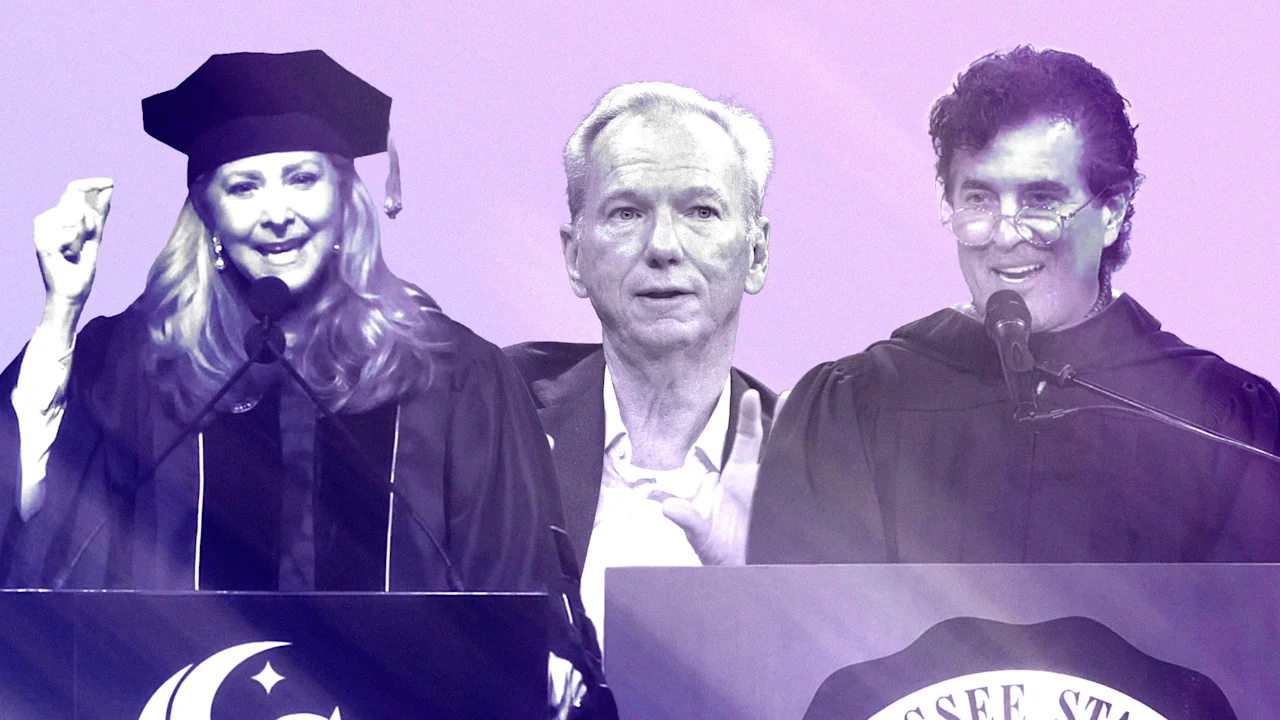
It’s graduation week, which means the emissaries of the nation’s elite are now descending onto college campuses to deliver the much-discussed and, they hope, indelibly quotable college commencement address.
These speeches are their own sort of literary genre. The celebrities, politicians, and titans of industry invited to give these keynotes must seem intelligent enough, but not bore—or worse, antagonize—their audience. Typically, this involves a speaker integrating a clever life story, select nuggets of eternal wisdom, a few trite asides to campus lore, and well-placed references to current affairs into one propulsive and affecting speech. The problem this year, however, is that the news of the day is artificial intelligence, and students just don’t want to hear it.
In the past week or so, at least three graduation speakers have brought up artificial intelligence in their remarks, only to incur jeers from graduates. This includes Gloria Caulfield, a real estate developer who called AI the next “industrial revolution” while speaking to students at the University of Central Florida. Former Google CEO Eric Schmidt, who delivered his address last week at the University of Arizona, hedged and acknowledged fears about the technology before encouraging students to help shape its future anyway. He, too, was derided by the crowd.
Music executive Scott Borchetta offered, perhaps, the most off-putting AI commentary of the bunch, and almost taunted the boisterous, disapproving students he encountered at Middle Tennessee State University. “It’s a tool,” he sneered at attendees, “You can hear me now or pay me later.” (Though not a speech, AI also attracted scorn at Glendale Community College, in Arizona, after a school official bashfully revealed that they’d use the technology to read students’ names aloud, only for the system to malfunction during the ceremony.)
AI has become a hobgoblin of bad graduation addresses, landing somewhere between cringe, out-of-touch, and offensive. It’s not hard to guess where this animosity might be coming from. AI executives market their technology by touting its ability to take over white-collar work, and the rise of AI also seems to have eradicated whole classes of entry-level jobs. Graduating into an abyss of warnings about total economic transformation is, no doubt, a heavy weight to bear.
Still, the outrage from students has struck some observers as specious, given that students are one of AI’s most active user constituencies. Universities have mostly failed to clamp down on the proliferation of large language models. Professors report being overrun by AI-assigned and cheating in their classrooms, and token usage trackers, at least from last year, seem to show that models do experience an overall ‘bump’ during the school year. Even the nation’s most prestigious institutions have had to change course. Princeton University—where students have long followed an academic honor code—is now moving to require proctored exams for the first time in a century, largely because of AI.
Graduates’ derision of AI is a reminder that its opposition isn’t coming from people who don’t use the technology, or even from people who don’t find it highly useful, despite a movement to label concerned people as Luddites or AI deniers. Young people, including college graduates, use AI plenty, and they’re also the most likely to think it’s bad. Polls of Americans also suggest that even as AI usage is going up, people’s views on the technology are souring.
This is the latest reminder that winning people over on AI comes with many worthwhile applications is nowhere near enough to woo people into thinking that it’s actually good for them when they ponder—like, at a graduation ceremony—a broader view of their lives, or society on the whole. Even more concerningly, it raises the prospect that the two might be inversely related. At least for now, we do still distinguish between user experience and societal welfare, and awing people with the former is doing little to abate concerns about the latter.