
Nobody who’s remotely familiar with John Wilson’s funny, angsty HBO series How To with John Wilson will be surprised to discover that his debut feature documentary, The History of Concrete, is not really about concrete. Wilson introduces us to a guy who removes tattoos from corpses and mounts the dead inked skin as mementos for loved ones. He interviews a New York park official who details how to purge poops from public swimming pools. When the film touches on the subject of concrete, Wilson quickly pivots to another. He’ll do anything not to dwell on his nominal topic. He never wrestles with concrete’s mass, omnipresence, or effects on the lives of nearly everyone on the planet. The topic is too big for comfort, too demanding of his very modern quick, jump-cutting attention deficits.
If the point is that concrete defies sustained attention, it’s a good one.
Advertently or not, by the end of the film, Wilson reveals two of the most astonishing facts about the world’s most-used material: Concrete is largely unseen, and its invisibility endangers us all. Not because concrete itself is villainous, but because our lazy, distracted, often nonexistent engagement with it invites disaster.
The everywhere material
The world produces 30 billion tons of concrete a year. The same material we rely on to protect us is also a major contributor to the climate crisis. Cement, the chemical binder that is one of concrete’s key ingredients, is tied to 8% of climate-warming carbon emissions, but concrete is essential for seawalls and other structures we will need to forestall damage from climate change. The yearly production of concrete tops all other building materials combined. Most of the world’s new concrete is used outside the U.S. and Europe, in China, India and other countries on the make.
Wilson interviews some subjects who know their concrete facts. Just as they seem about to offer a bit of gobsmacking concrete information, the film cuts to something else, like the painting of a bubble-butted woman’s rear he spies on the back of a truck. Civilization may not hang on that, but it may fall due to our distraction.
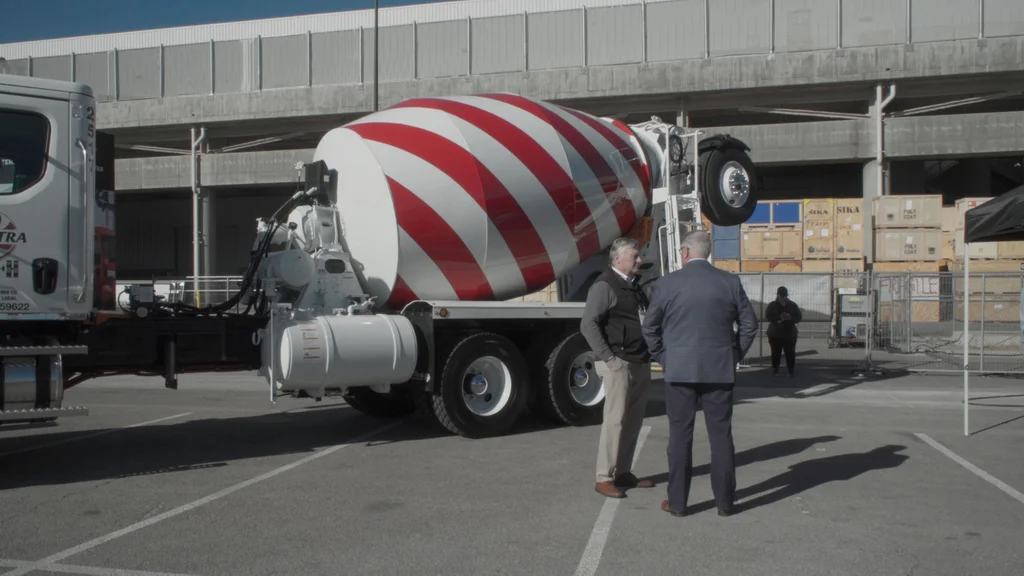
In reporting on concrete, I repeatedly meet people in the industry who cannot fathom why most people care so little about the material. In the U.S., construction, nearly all of which happens with concrete, is the fourth-largest sector in the economy. So what? It’s still boring, right? The cool kids don’t hover around concrete guys at parties anxious to hear about advances in concrete that make 167-story buildings possible or how new concrete mixes could absorb carbon dioxide from the atmosphere, not emit it.
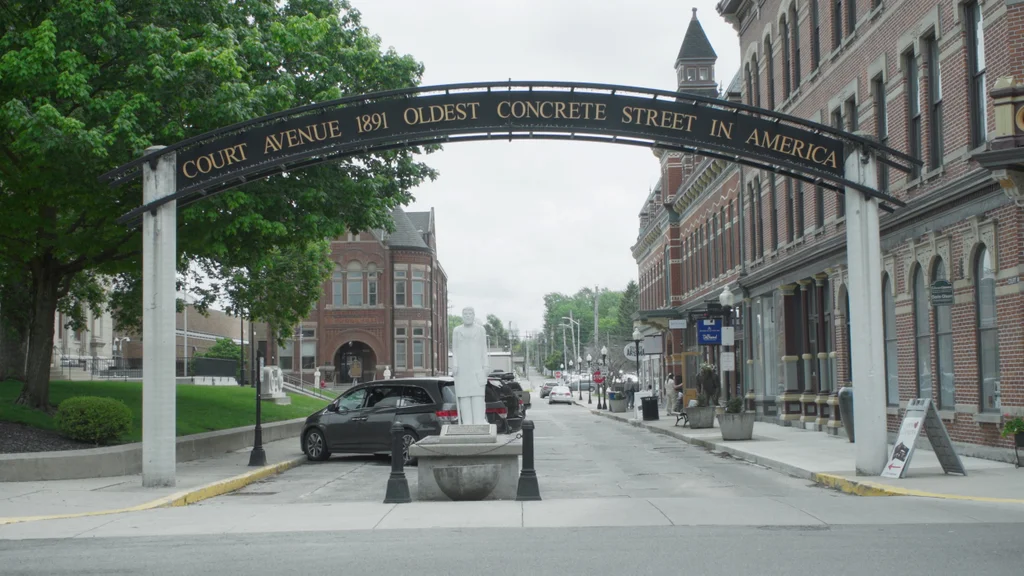
“Concrete is (almost) everywhere,” writes Julie Soleil Archambault, an anthropologist at Concordia University in Montreal. “It often passes unnoticed—too ubiquitous, too mundane, to warrant much attention. Sometimes, however, it does quite the opposite, especially when it fails to meet the expectations of durability invested in it, when it cracks and crumbles.”
In one segment, Wilson interviews a former New York City traffic commissioner. It’s “Gridlock Sam” Schwartz (uncredited), who coined the term “gridlock.” He paces under the Brooklyn-Queens Expressway in Brooklyn Heights. Schwartz runs a finger along a “fossil,” an empty groove where some once-formidable rebar rusted out and vanished. Schwartz warns that such conditions cause big structures to collapse. “If something catastrophic happens in this area in the next few years,” he declares, “I wouldn’t be surprised.”
The American Society of Civil Engineers grades civil infrastructure based on its structural integrity. The biggest concrete things, such as roads, dams and schools, get D+, meaning they are “poor” and “at risk.” It would take around $9 trillion to raise the country to a passable B. By not seeing concrete, we don’t see the vast world of deferred maintenance. Wilson moves on before Schwartz paints the bigger, scarier picture. Who likes to linger on a big and scary picture?
Invisible ubiquity
There is a kind of blindness Wilson doesn’t touch on: concrete’s incalculable benefits. The history of concrete is also the history of modern industrial modernity. Want electricity? Clean water free of disease? Waste and storm water removal that prevents disease? Factories that do not burn down or shake too much? Fireproof schools and hospitals? Road with bridges? Ports? Trains above and subways below? Airports? Networks and data centers for the digital economy? Hardened defenses in battle zones or outside buildings vulnerable to attack? Concrete must get there first. By not seeing the magnitude of concrete, we don’t see the magnitude of the problems concrete successfully addresses. Or the problems it can no longer address if it fails due to negligence.
Wilson’s detachment serves his narrative purpose in creating an entertaining film. Is his refusal to take concrete seriously frivolous, even negligent? He has said that he often cries over his subjects, meaning he sees more keenly than he lets on. The way concrete pulls the world together, makes the production of modern goods possible, and solves some of the world’s biggest challenges is, if one sees it, awesome to behold. So are its out-of-scale imperfections, most importantly its impact on our climate. That problem is already solvable, if we, as users and inhabitants of this everywhere material see concrete as plainly as we see poop in a pool. For all its arch blindness and distraction, the film may egg us to focus on a material that, like air and water, is all around and in need of care.
One eventual hazard of really seeing concrete’s imprint everywhere isn’t that you crave distraction but that you can’t shut up about it. Concrete’s history, present and future, is our history, present and future. Post-production, Wilson may be getting there. When Jimmy Kimmel asked him why he focuses on weird stuff so far afield from the actual history of concrete, the filmmaker smiled and contradicted him. With concrete, he said, “you can do anything.”