
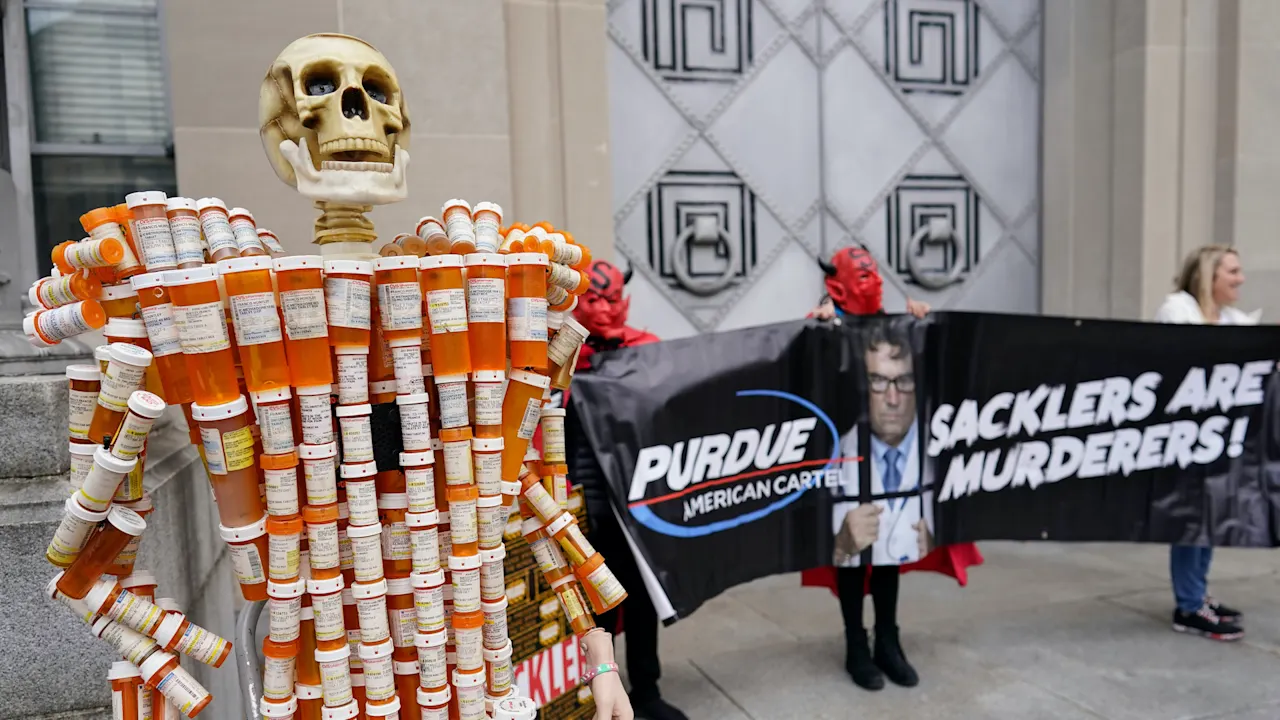
Members of the Sackler family who own OxyContin maker Purdue Pharma must pay billions of dollars to settle a flood of lawsuits over the harms of opioids, under a new deal that was formally approved by a federal bankruptcy judge on Tuesday.
The Sackler family must contribute up to $7 billion over 15 years. Most of the money is to go to government entities to fight the opioid crisis, which has been linked to 900,000 deaths in the U.S. since 1999.
Thousands of victims of the opioid epidemic could be paid thousands of dollars each, with a portion of the money distributed next year to some people who had OxyContin prescriptions and their survivors.
“This plan is not perfect,” U.S. Bankruptcy Judge Sean Lane said as he laid out his reasoning for approving the settlements. “The court wishes it could do more to ease the suffering of the opioid crisis.”
But he said it is fair, equitable, and in the best interest of the parties involved, and had the overwhelming support of most of the groups that had claims against Purdue.
The new agreement replaces one that the U.S. Supreme Court rejected last year, finding it would have improperly protected members of the family against future lawsuits. Under the current agreement, entities that do not opt into the payments can still sue members of the family.
The deal, which the judge said he would accept last week, is among the largest in a series of opioid settlements brought by state and local governments against drugmakers, wholesalers, and pharmacies that totaled about $50 billion.
Why the judge said he approved the deal
Lane said the deal maximizes the settlement’s value and came from years of investigations, mediation, and negotiations.
He also said that an alternative to the settlement—suing Sackler family members instead of accepting the deal—would take years, “and success is not ensured,” in part because the family has consistently said they would fight claims against them.
He also noted it could be hard to collect if the family lost lawsuits. Much of their assets are in offshore trusts.
Lane said that the states and individuals can get more than they would have if Purdue had been liquidated instead.
In that case, he said, there would have been only $3.4 billion available—and $2 billion of that would have gone to the federal government as part of a criminal plea deal the company entered. Under that agreement, most of the federal penalties were to be waived if a broader settlement could be reached.
Money will go to governments and some individuals
Sackler family members were collectively paid more than $10 billion by Purdue in the decade before they stopped involvement with the company in 2018, and they used about half of that for taxes. They’ve agreed to pay up to $7 billion over 15 years, providing most of the cash involved in the settlement.
The funds distributed to state and local governments and Native American tribes are to be used mostly to address the opioid crisis, as has been the case with other opioid settlements.
About $850 million of that is to go to individual victims, including children born with opioid withdrawal.
People with addiction and survivors of those who died must prove they were prescribed OxyContin to participate. They could provide medical records or photos of prescription bottle labels—although many people don’t have such things dating back decades.
Those who do prove it could get payments of around $8,000, or around $16,000, depending on how long they received the drug and how many other people qualify. The money for individual victims is to be distributed next year.
Not only money is at stake
Members of the Sackler family are agreeing to give up ownership of Purdue.
For them, that won’t be a major change since no family member has served on Purdue’s board or received money from the company since 2018. The plan calls for Purdue to be replaced with a new company, Knoa Pharma, to be controlled by a board appointed by the states and with a mission of benefiting the public.
Sackler family members are also agreeing not to have their name put on institutions in exchange for contributions—something they’ve done often in the past, although many institutions have cut ties with them.
The company has also agreed to make public a trove of internal documents that could shed additional light on how the company promoted and monitored opioids.
One feature that won’t be repeated under this new deal that was in a previous one: forcing members of the Sackler family to hear directly from people harmed by OxyContin.
A long legal saga could be wrapping up
Purdue filed for bankruptcy protection in 2019 when it was facing thousands of opioid-related lawsuits from state and local governments and others.
A judge approved a settlement two years later. But the U.S. Supreme Court later rejected that plan because it gave members of the Sackler family protection from lawsuits over opioids even though they were not personally declaring bankruptcy.
The latest plan allows lawsuits against Sackler family members by those who don’t opt into the deal. That change was a key to getting the new version approved in the aftermath of the high court’s ruling.
This time, few parties objected to the settlement, although some people who represented themselves and who were addicted to opioids—or had loved ones who were—raised concerns during the three-day confirmation hearing last week.
One of those self-represented people told Lane during the virtual hearing Tuesday that she planned to appeal.
—By Geoff Mulvihill, Associated Press