
This article is republished with permission from Laser Wars, a newsletter about military laser weapons and other futuristic defense technology.
The U.S. Navy has a unusual proposition for the U.S. defense industry: take your high-energy laser weapons and break them into pieces.
In a draft request for solutions (RFS) published on August 12 through the National Security Technology Accelerator (NSTXL), the Office of Naval Research (ONR) detailed plans to explore the development of “distributed” laser weapons, where a system’s laser source and the beam director that actually delivers effects on target are not bolted together in the same apparatus, but instead connected through a specialized optical fiber spooled across a ship, base, or battlefield. For this particular project, dubbed the ‘Universal Optical Transport for Distributed Laser Weapons’ and valued at $10.25 million, ONR is seeking prototype connectors and fiber capable of transmitting 10 kilowatts over 10 kilometers with minimal power loss and high beam quality.
“The shift to distributed laser weapons allows for significantly expanded geographic coverage and multi-sector force protection” in support of expeditionary airbase defense and counter-drone missions ashore, the draft document says, a departure from the service’s past focus on shipboard directed energy systems operating on the high seas.
Distributed laser weapons have obvious appeal. Such systems could allow U.S. and allied forces to keep a power-hungry, heat-generating laser source in a fortified position while deploying a comparatively lightweight and agile beam director around the perimeter of a base or formation. With the right fiber connection, a single source could plausibly feed multiple directors that simultaneously engage incoming targets. Indeed, the ONR document describes U.S. Marines exposed to drone attacks and rocket, artillery, and mortar fire while seizing forward airfields under the service’s Expeditionary Advanced Base Operations (EABO) concept as a potential real-world application.
But ONR’s vision of chopping up laser weapons into distributed components also appears to stand in contrast with the Navy’s current approach to laser weapons, which essentially involves bundling critical laser components up into a single container that can be rolled on and off a warship with relative ease.
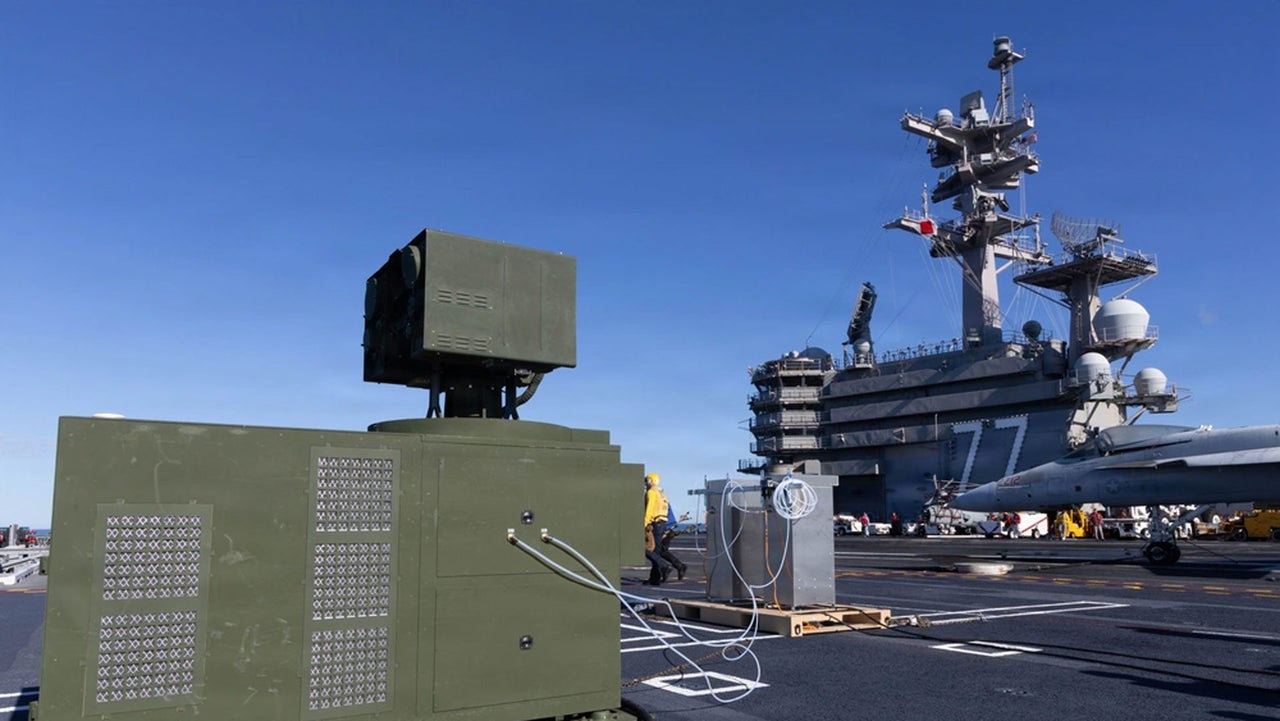
As I previously reported, Chief of Naval Operations Adm. Daryl Caudle spent the better part of 2026 pushing the service toward what he calls the Containerized Capability Campaign (C³), a doctrine built around cramming novel capabilities into standardized containers that can be swapped across platforms and fielded “at the speed of relevance—not the speed of platform-centric acquisition.” It’s the same logic that led the Navy to conduct live-fire testing of the U.S. Army’s Palletized High Energy Laser (P-HEL) system off the flight deck of the USS George H.W. Bush in October 2025. Congress is now trying to extend that logic to the Navy’s lone 60 kilowatt High Energy Laser with Integrated Optical Dazzler and Surveillance (HELIOS) with a $5 million funding addition for a containerized version of the long-suffering shipboard laser system.
ONR’s distributed architecture and Caudle’s containerization campaign both appear to be responses to the same recurring problem: trying to bolt exquisite laser weapons onto platforms that were never designed to carry them in the first place, whether a Stryker infantry carrier vehicle or Arleigh Burke-class guided missile destroyer, has consistently yielded significant power, cooling, and integration challenges. Distribution is primarily a physics and technical standards challenge that, if solved, could allow the Navy to mix and match laser sources and beam directors from different vendors through an open photonic interface.
By comparison, containerization is as much an acquisition strategy as an engineering one, enabling the service to circumvent bespoke integrations for every new capability it needs to rapidly field on a warship. And these two approaches are not mutually exclusive: a containerized laser source could potentially feed fiber out to multiple modular beam directors that are themselves swappable across various sites, ship or shore.
The two approaches are unlikely to converge anytime soon. ONR’s current performance targets for distributed laser prototypes (transmit 10 kw over 10 km) suggest the initiative is still an early-stage engineering bet on enabling technologies that are years away from producing anything a surface combatant or Marine detachment can actually deploy in the field. Besides, there isn’t an extraordinary amount of cash available for the effort at the moment: $10.25 million is a relatively meager amount of funding compared to the roughly $350 million the Navy has sunk into HELIOS since awarding Lockheed Martin a contract for the system in early 2018.
Whether the ONR’s experiment ends up validating the promise of distributed laser weapons or simply yielding the same integration headaches remains to be seen. But the fact that the Navy is pursuing the technology alongside containerization suggests the service is still unsure whether the best fix for its laser woes is a better box or no box at all.
This article is republished with permission from Laser Wars, a newsletter about military laser weapons and other futuristic defense technology.