
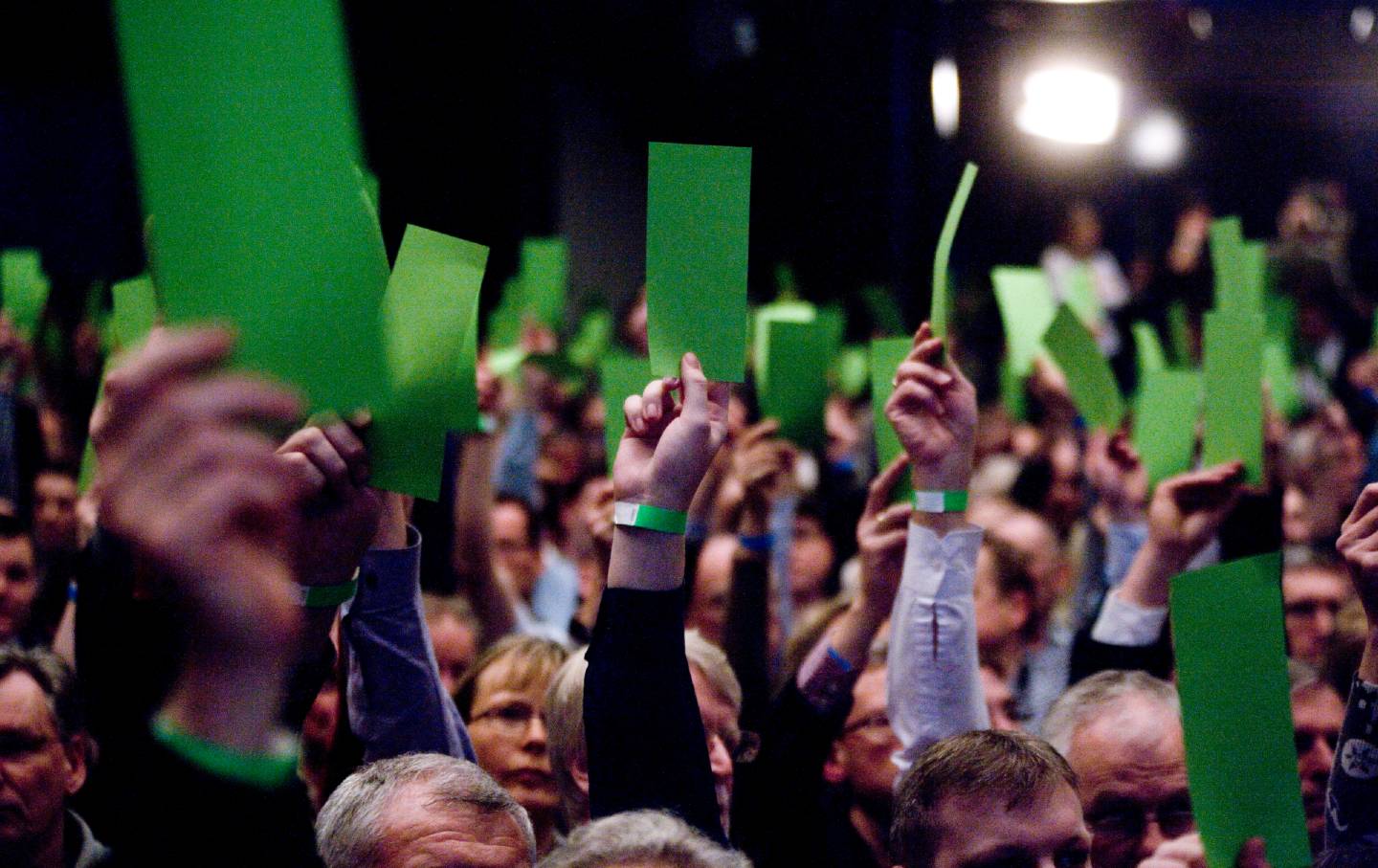
The Alternative für Deutschland has a stable national poll lead, including in the former West Germany. Its rise owes to much more than Eastern grievances.
When the Alternative für Deutschland (AfD) won the Saxony-Anhalt state election on September 6, many pundits saw proof of Germany’s unending internal divide. More than three decades since reunification, we are told, the former East Germany is still a different country politically. Not only did the AfD take 44 percent in Saxony-Anhalt but in this Sunday’s Mecklenburg-Vorpommern election it soared to 38 percent, its third win in a row in the so-called “new states” that joined the Federal Republic in 1990. These results are, by now, unsurprising to anyone. The AfD is widely considered the party of the east.
Martin Sonneborn, who represents the satirical outfit Die Partei in the European Parliament, noted the irony. The border wall erected by East German authorities in 1961, nominally meant to keep out Western reactionaries, was officially called the Anti-Fascist Protective Rampart. On the day of the Saxony-Anhalt vote, Sonneborn issued a mock appeal to rebuild the wall—this time to protect western democrats from the marauding Nazis in the east. His post was obviously absurdist. Yet it reflected widespread assumptions about the new political gulf along the former inner-German border, and ungenerous attitudes toward easterners.
Progressive-minded Germans on X pleaded with foreign observers not to over-generalize from the Saxony-Anhalt result: Such a small, poorer eastern state, some suggested, is no more a barometer of German opinion than Wyoming would be for the United States. Many analyses centered on local psychodramas, explaining that easterners, or Ossis, never learned to use democratic freedoms wisely, that they have a culture of inflated grievance, or that the East’s communist rulers never forced them to atone for the Nazi past. Others blamed the fallout of reunification: because of deindustrialization, or because Ossis feel like second-class citizens even in a country that welcomes new immigrants.
Yet all these accounts of easterners’ refusal to catch up with modern, democratic, cosmopolitan Germany all sidestepped a rather bigger problem. How come the far-right AfD has started topping the polls in the former West Germany?
True: Even from up here on the 10th floor of our eastern Berlin prefab block, I can see that our area is much more an AfD target than western parts of the city. Still, the east-west split little explains the party’s overall rise. Only one in six Germans live in the former East and yet the AfD is the biggest force across the Federal Republic: It polls close to 30 percent nationally, almost 10 points ahead of Chancellor Friedrich Merz’s conservative Christian Democrats (CDU). The AfD has since April topped every federal-level poll: It has repeatedly ranked first-placed in the west, at around 25–26 percent, as well as in the east, at 35–40 percent.
Political maps like this one, showing the biggest party by area in last year’s national election, show Germany split in two: the east AfD blue, the west CDU black. Yet the picture is changing rapidly, especially in federal polling. In rural areas and small towns, and among young and middle-aged men, the AfD is piling on votes even in western areas where it has little past organization. In the 2021 local elections in Lower Saxony, in northwestern Germany, the AfD scored 5.4 percent, but in the same races this month it took 16 percent. Far from a residual eastern force, it is gaining millions of new voters in the largest western states, such as North-Rhine Westphalia (where it averages around 17 percent) and Bavaria (around 20 percent; one poll shows it at 42 percent among under-30s).
Current Issue
Beyond the Polls
Still, while the AfD would like to present itself as the natural home of ordinary Germans, it isn’t winning everywhere. Polls aren’t real votes, and where the AfD is the largest single party it rarely has majority support. Even after its win in Saxony-Anhalt, it isn’t clear that it can form a government. Headlines about its Mecklenburg-Vorpommern breakthrough shouldn’t blind us to the resistance it faces there or the fact that long–Social Democratic areas—for instance more urbanized districts with stabler economic circumstances and higher educational levels—have not fallen to the AfD so quickly.
This is further reason to distrust claims that the AfD represents eastern peculiarities. Much media coverage has focused on the culture of the ex–German Democratic Republic (GDR), suggesting that its former citizens have never really identified with the Federal Republic. Sometimes this centers on signs of GDR nostalgia, for instance AfD candidate Ulrich Siegmund’s riding a GDR-era Simson moped, or talk of easterners’ pro-Russian attitudes. The liberal media routinely pathologizes far-right authoritarianism as an Ossi problem: Easterners didn’t confront the Nazi past as the West did, or learn to be democrats.
Yet this analysis has a basic flaw: The AfD vote peaks not among eastern pensioners but among men in their 40s. An Ossi who was 10 years old at the moment of unification is far more likely to vote AfD than someone who was an adult in the GDR. More sophisticated explanation thus focuses on post-reunification ills: For instance, in rural areas where GDR-era industries were shuttered, many people—especially men heading into middle age—may resent neighbors who headed off for economic opportunities in the West, or to universities in Dresden, Leipzig, or Rostock.
Though AfD voters often tell pollsters they are struggling economically, their vote takes the form not of socialist nostalgia but of resentment against the undeserving poor. Sociologist Oliver Nachtwey has examined many Germans’ sense of feeling that social mobility is blocked—or better, they have to race ever faster just to keep their existing position. It resembles the pattern explained by Arlie Hochschild, when, faced with the broken promise of the American Dream, resentment is directed against those accused of “cutting in line”—immigrants and minorities—and the elites said to favor them.
This is also why it’s exaggerated to think that the AfD’s appeal to blue-collar workers owes to the marginal welfarist elements of its program. Its appeal lies elsewhere, and in the broader cultural shift represented by the chanting of Ausländer raus! (“Foreigners out!”) at nightclubs, at football matches, and even at a tennis club in the poshest part of western Berlin. It offers a grim frisson of rebellion: because it is shocking, because it humiliates migrants, and because it annoys fellow citizens who think their openminded values or credentials matter. Dressed up in irony, the chant is proud, defiant, and exuberantly antagonistic to the political left.
Alternative to the Alternative
The AfD’s ideas aren’t new, yet it benefits from deep-seated hostility toward mainstream politics and media, and alienation from the social compromise on which the major postwar parties built support. Given that in the 1990s and 2000s most Ossis did apparently want to join this compromise, routinely voting for the SPD and CDU, any explanation of AfD support has to focus on the failures of this promise. Yet this story isn’t only about the east. For reunification had its fallout in the west, too, wrapped up with the model of work and welfare that Germany adopted in the era of globalization and the Eurozone.
The labor reforms pioneered by the establishment center-left, and the wider pressure on lower-income Germans’ wages, rents, and fuel bills, did not directly push them toward the AfD. In the 2000s, the left was the main electoral beneficiary, with the formation of Die Linke by disappointed Social Democrats and post-Communists in 2007. This party’s opposition to SPD-led labor reforms made it a sizable force in this period, and helped to make these issues central to national political debate. It thrived in many of the regions where the AfD is today strongest.
Popular
“swipe left below to view more authors”Swipe →
Yet in the post-2008-crisis period its challenge wilted. Like many left-populist forces around Europe, it represented an uneasy alliance between parts of an old Communist party, trade unionists, and a more movementist wing; it could not displace the center-left, and often became its junior partner in state governments. More socially conservative, older parts of its base—including in eastern states, where it had a more gradualist outlook—also jarred with its more radical elements. This would eventually produce a long and messy split, culminating in 2023 with the departure of leading figure Sahra Wagenknecht. Die Linke seemed to have missed its chance to capitalize on voters’ alienation from the major parties.
In Lichtenberg, the part of eastern Berlin where my partner and I live, forecasts for the 2025 federal election promised easy victory for the AfD’s Beatrix von Storch. The aristocratic Von Storch is a granddaughter of Adolf Hitler’s finance minister; her main opponent here was Die Linke’s Ines Schwerdtner, my former Jacobin colleague. This is a relatively low-income district, with privatized GDR-era housing blocks and semidetached starter homes built where public amenities used to be; it has less of a reputation of harboring neo-Nazis than neighboring Marzahn and has long elected leftist or SPD representatives. Yet the AfD has made huge gains here and its supporters no longer conceal their views.
Yet Schwerdtner emerged the winner—and around the German capital the party gained a new lease on life. If the 2025 election looked like the death-knell for Die Linke, instead it electrified the party, whose willingness to confront both the AfD and Olaf Scholz’s center-left government helped it to rally first-time voters and a wave of new members. This Sunday, Die Linke made a further breakthrough as it won Berlin’s state election for the first time, taking 26 percent support thanks to a campaign focused on rents and the cost of living. In my corner of Berlin, both Die Linke and the AfD rose sharply, with the left-wing party ahead by 30 points to 23.
This result was not gifted to Die Linke by demographic destiny. In this vote it scored around 50 percent among young women and in some of Berlin’s most diverse areas—yet these were new developments in city politics. In fact, while some post-election reactions cast the capital as inherently woke, its politics are not consistently left-wing: The outgoing mayor was a conservative; in most recent Berlin elections, even the combined forces of Die Linke, Greens, and Social Democrats are only around half the electorate. Die Linke’s success owed to hard work knocking on doors, resisting the AfD’s identity politics but also focusing squarely on cost-of-living issues.
This also means speaking to different kinds of voters. As Loren Balhorn pointed out on France24, the left had already scored similar vote shares in Berlin back in the 1990s, but with a difference: It has now emerged from its elderly, post-Communist, more eastern niche to rally a more diverse base more representative of Berliners in general. What’s less clear is if it can do the same elsewhere.
In Berlin, rents have in the last decade become a central issue, which most voters cite among their reasons for picking Die Linke. Yet, while just over half of Germans rent their homes, the housing issue—and the call for the state to buy back privatized housing stock from big landlords—is not everywhere the natural focus of pocketbook politics. Moreover, while Die Linke has also built its ground game outside Berlin, notably in Leipzig, this picture is patchy overall. The party can today again claim around 12 percent of the vote nationally, and has attracted other progressive voters since last year’s federal election. Winning back AfD voters will be much harder.
Calls for an “anti-fascist economics” (Isabella Weber) or a populist-spirited “alternative to the Alternative” (Adam Tooze) push in the right direction. Such calls do not preach despair or commitment to a declining status quo but propose to defeat the AfD by mobilizing voters for something better. In this sense, essentializing the AfD as a voice for eastern grievances both exaggerates its strength and overlooks the danger it poses: both because most easterners don’t support this party, and because this analysis ignores the AfD’s rise in the west. The growth of resentful nationalism is not a regional quirk but a global trend across Europe, India, and the Americas: There was no reason to expect that the Federal Republic was uniquely immune.
The AfD is not yet at the gates of power, and even in its strongest states it doesn’t have the majorities to rule alone. Yet it seems unlikely that mainstream parties can keep getting their own voters to turn out—expecting them to swallow higher living costs, a later retirement age, and more medical bills—simply by warning that the AfD is worse. This is the approach Merz proposed in his televised response to Sunday evening’s vote, as he promised to push on with his “reforms.” The risk is that the far right ends up looking like the only non–status quo option. In Berlin, at least, there’s some hope of showing another way forward.
Between the reemergence of right-wing red-baiting and Donald Trump’s use of the chilling National Security Presidential Memorandum–7 to criminalize left political organizing, we’re seeing McCarthyism reborn before our eyes.
This assault on democracy cannot be ignored or wished away. Resisting it requires bravery in the face of threats and repression, a steadfast commitment to the truth, and the unwavering belief that we can—and will—overcome this darkness.
We must have an independent media that sets the record straight, unearths corruption and abuses of power, and advances a politics of justice and dignity for all if we’re to win this fight.
That’s why I’m writing to you today. This September, The Nation needs to add 100 monthly donors to sustain our progressive journalism. Your contribution makes the next investigative report, the next truth-speaking column, and the next pathbreaking essay all possible.
I hope you’ll support our work with a recurring donation today. If you donate $10 or more a month, we’ll send you a brand new “Hands Off the Free Press!” sticker to recognise your commitment to our cause. Please, donate today.
Onward,
Katrina vanden Heuvel
Editor and Publisher, The Nation
More from The Nation
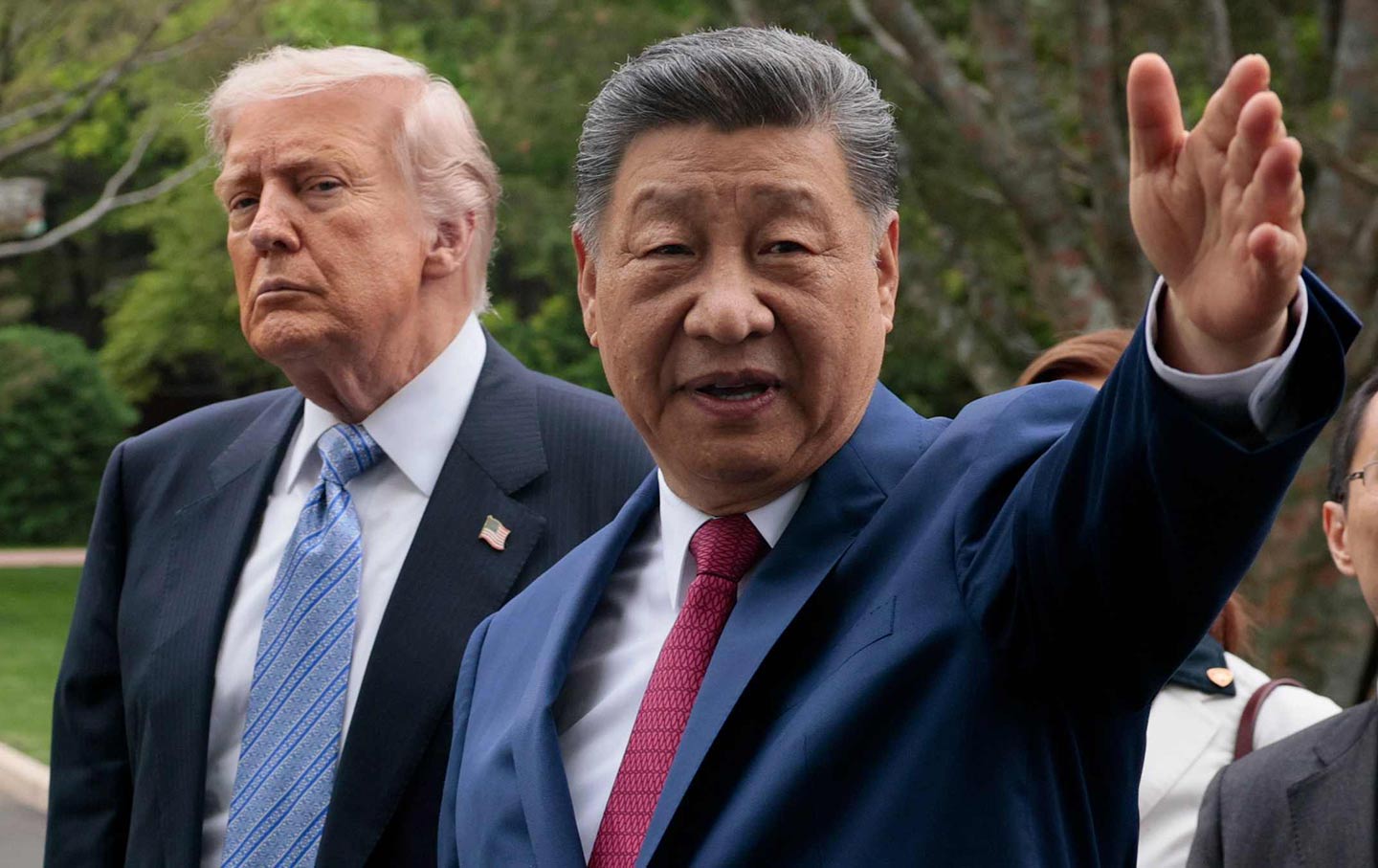
The prospects for Xi Jinping’s visit are dim because American leaders are blaming China for the failures of globalization.
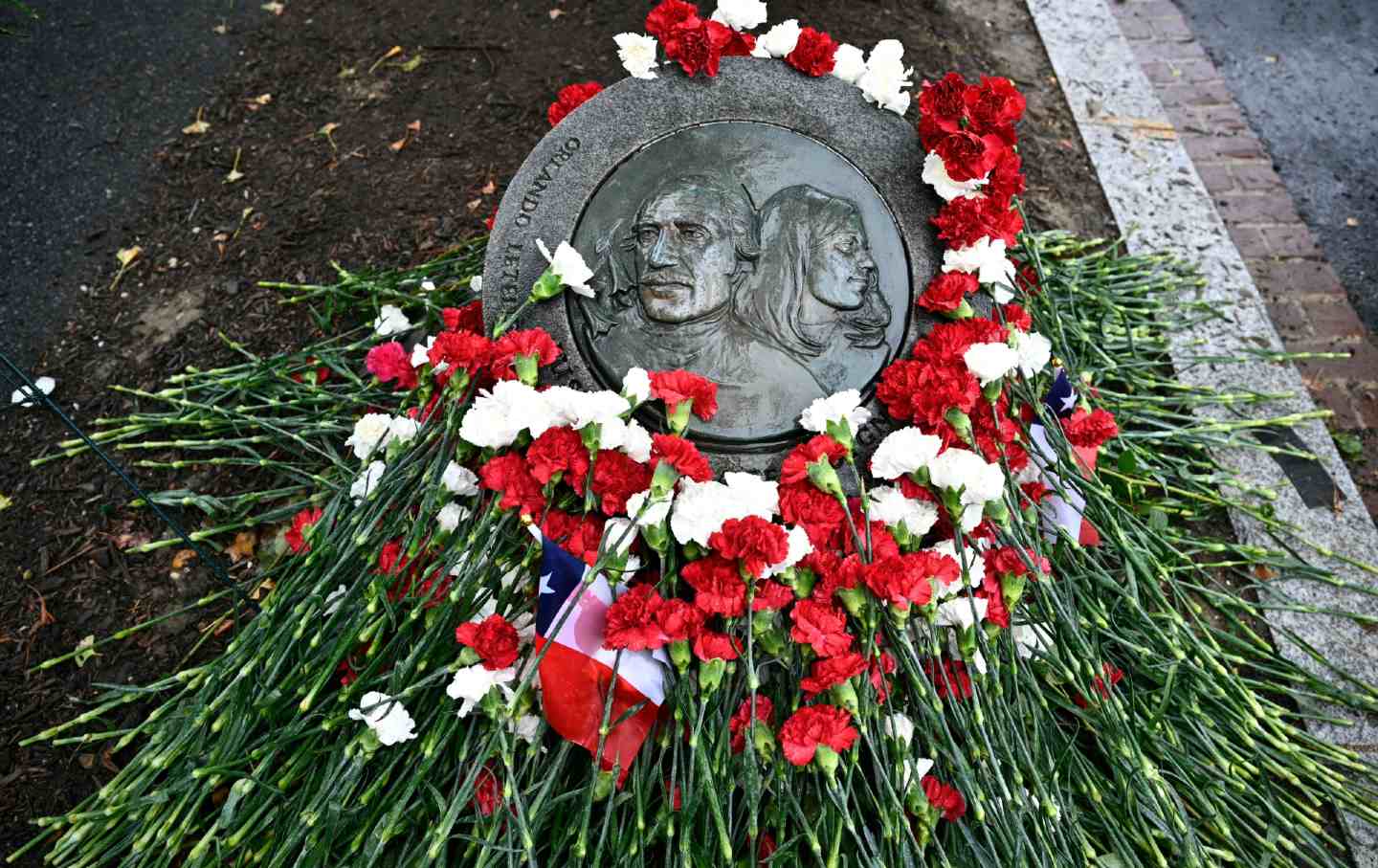
An act of international terrorism on the streets of Washington, DC, still reverberates 50 years later.
As long as we have nuclear weapons, the job of ending humanity will continue to be as easy as the push of a button—or an AI agent hacking into a nuclear command-and-control system…
Princeton undergraduates are helping the organization develop standards for post-mortem digital privacy and death in custody.
Trump is trapped in a war that has already been lost, a reality that he will never allow himself to admit.