
Close Menu
    Facebook X (Twitter) Instagram
    TRENDING :
    • Steve Jobs Taught Kevin O’Leary This Simple Work Strategy
    • Fishers and HSE Battle in Mudsock Rivalry Game
    • Saudi Oil Production Collapses – This Is How The War Screws Everyone
    • This McDonald’s Franchisee Just Hit 50 Years With the Company
    • St. Thomas Aquinas Edges North in Tight Contest
    • How a Client Turned Her $30K Investment Into 6 Figures a Month
    • The Dating Recession: Why Romance Is Declining
    • The Best Marketing Strategy in 2026? Leading With Value.
    Populist Bulletin
    • Home
    • US Politics
    • World Politics
    • Economy
    • Business
    • Headline News
    Populist Bulletin
    Home»Business»The 25 housing markets where home prices went parabolic over the past 40 years
    Business 3 Mins Read

    The 25 housing markets where home prices went parabolic over the past 40 years

    Business 3 Mins Read
    Share Facebook Twitter Pinterest LinkedIn Tumblr Telegram Email Copy Link
    Follow Us
    Google News Flipboard
    Share
    Facebook Twitter LinkedIn Pinterest Email


    Want more housing market stories from Lance Lambert’s ResiClub in your inbox? Subscribe to the ResiClub newsletter.

    Single-family home prices have risen dramatically across the United States over the past four decades. But the gains haven’t been even across the board.

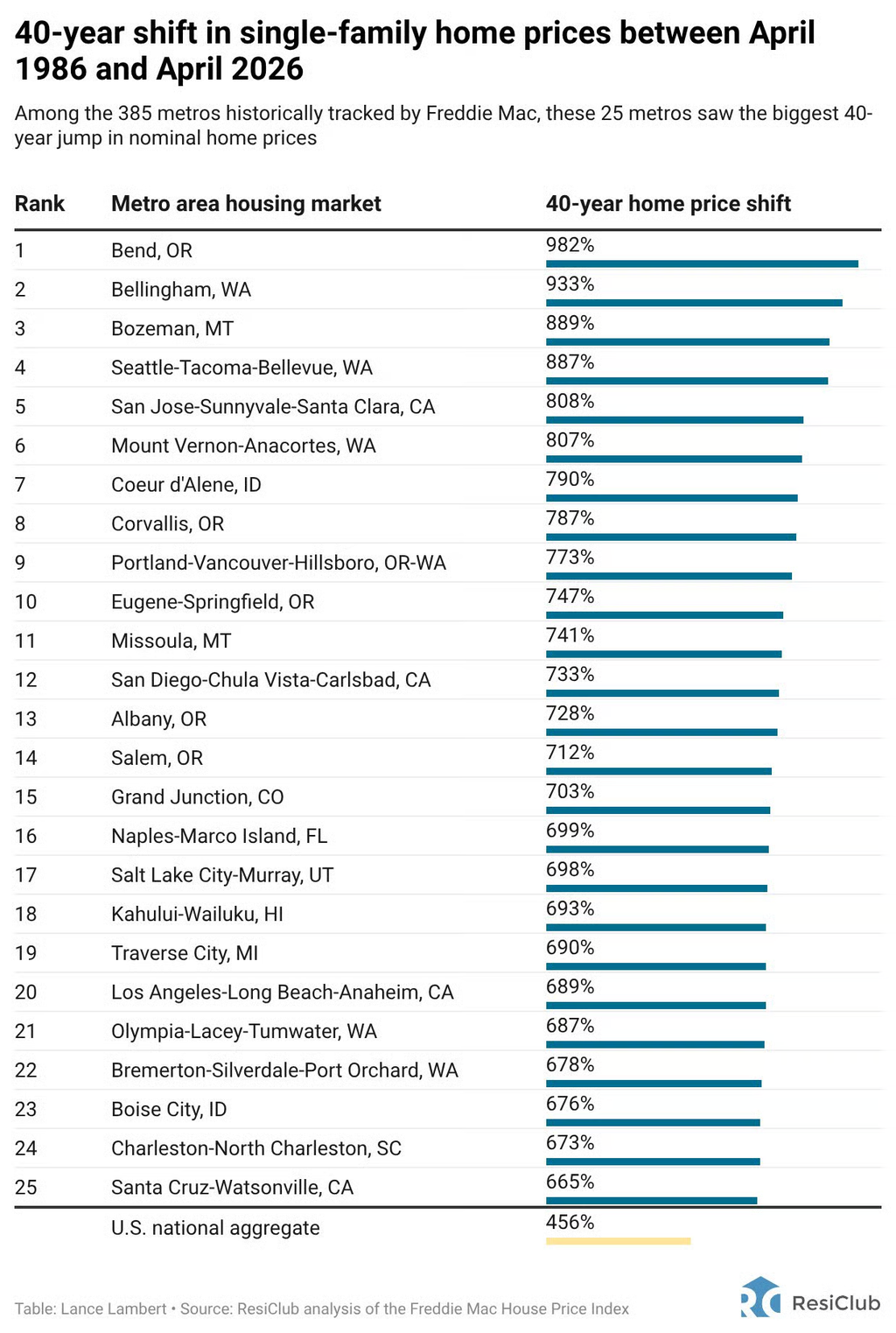
    The map below highlights the 25 metro areas that have seen the biggest increase in single-family home prices over the past 40 years.

    (function(){function e(){window.addEventListener(`message`,function(e){if(e.data[`datawrapper-height`]!==void 0){var t=document.querySelectorAll(`iframe`);for(var n in e.data[`datawrapper-height`])for(var r=0,i;i=t[r];r++)if(i.contentWindow===e.source){var a=e.data[`datawrapper-height`][n]+`px`;i.style.height=a}}})}e()})();

    At the top of the list are:

    1. Bend, Oregon (+982%)
    2. Bellingham, Washington (+933%)
    3. Bozeman, Montana (+889%)
    4. Seattle-Tacoma (+887%)
    5. San Jose (+808%)

    Generally speaking, the nation’s biggest home price gains over the past 40 years have occurred in desirable Western metros, particularly across the Pacific Northwest and Northern California. 

    Overall, 22 of the 25 metro areas are located west of the Mississippi River. That pattern isn’t a coincidence.

    Over the past several decades, many of these markets experienced stronger-than-average wage growth as high-paying industries—including technology, finance, and professional services—expanded. Higher incomes gave households greater purchasing power, allowing buyers to bid home prices higher over time.

    The importance of local income growth becomes clear when comparing markets with very different economic trajectories.

    Let’s consider the Youngstown, Ohio, and Seattle-Tacoma metro areas. Since April 1986, single-family home prices have increased 297% in Youngstown, compared to 887% in Seattle. Over that same period, national home prices have risen 456%.

    While both metros experienced the same national housing cycles—from the inflationary boom of the late 1970s to the housing crash and the pandemic-era surge—their long-term economic stories diverged dramatically.

    Seattle-Tacoma benefited from decades of robust wage growth as the region emerged as one of the nation’s leading technology and innovation hubs, anchored by companies like Microsoft and Amazon. Higher-paying jobs attracted workers from across the country and around the world, giving households greater purchasing power to bid up home prices.

    Youngstown experienced the opposite trajectory. As manufacturing employment declined during the era of deindustrialization, the region saw much slower income growth and weaker population trends. With less purchasing power flowing into the local housing market, home prices appreciated at a much more modest pace.

    Demand is only one side of the equation. The pace of home price appreciation also depends on how quickly housing supply can respond. Many Western markets face natural geographic constraints—from coastlines and mountains to protected public lands—that limit where homes can be built. 

    In many cases, including in housing markets like Seattle, those physical barriers have been compounded by stricter land-use regulations and slower homebuilding. Those constraints have made it harder to build enough homes to keep up with demand.

    Of course, long-term winners don’t always lead in the short run. Several Pacific Northwest housing markets have recently entered a period of cyclical cooling as inventory has increased and price growth has moderated.

    Big picture: Over multiple decades, the housing markets that paired strong income growth with persistent housing supply constraints have consistently generated the nation’s largest home price gains.


    Source link

    Share. Facebook Twitter Pinterest LinkedIn Tumblr Email

    Related Posts

    Steve Jobs Taught Kevin O’Leary This Simple Work Strategy

    September 11, 2026

    This McDonald’s Franchisee Just Hit 50 Years With the Company

    September 11, 2026

    How a Client Turned Her $30K Investment Into 6 Figures a Month

    September 11, 2026
    Top News
    World Politics 2 Mins Read

    Ilhan Omar Loses It After President Trump Calls Her “Garbage” (VIDEO) | The Gateway Pundit

    World Politics 2 Mins Read

    Democrat Rep. Ilhan Omar went off on President Trump after he called her and the…

    There Are Surprising Health Benefits to Travel, Vacation: Research

    August 29, 2026

    Alphabet beats third-quarter revenue estimates on cloud demand and advertising

    October 30, 2025

    Google CEO Sundar Pichai says 75% of the company’s code is AI-generated

    April 24, 2026
    Top Trending
    Business 4 Mins Read

    Steve Jobs Taught Kevin O’Leary This Simple Work Strategy

    Business 4 Mins Read

    Key Takeaways ‘Shark Tank’ star Kevin O’Leary learned an important lesson from…

    World Politics 1 Min Read

    Fishers and HSE Battle in Mudsock Rivalry Game

    World Politics 1 Min Read

    The annual Mudsock rivalry game between Fishers and Hamilton Southeastern High School…

    Economy 6 Mins Read

    Saudi Oil Production Collapses – This Is How The War Screws Everyone

    Economy 6 Mins Read

    Saudi Arabia just reported something that should scare the hell out of…

    Categories
    • Business
    • Economy
    • Headline News
    • Top News
    • US Politics
    • World Politics
    About us

    The Populist Bulletin was founded with a fervent commitment to inform, inspire, empower and spark meaningful conversations about the economy, business, politics, government accountability, globalization, and the preservation of American cultural heritage.

    We are devoted to delivering straightforward, unfiltered, compelling, relatable stories that resonate with the majority of the American public, while boldly challenging false mainstream narratives that seem to only serve entrenched elitists, and foreign interests.

    Top Picks

    Steve Jobs Taught Kevin O’Leary This Simple Work Strategy

    September 11, 2026

    Fishers and HSE Battle in Mudsock Rivalry Game

    September 11, 2026

    Saudi Oil Production Collapses – This Is How The War Screws Everyone

    September 11, 2026
    Categories
    • Business
    • Economy
    • Headline News
    • Top News
    • US Politics
    • World Politics
    Copyright © 2025 Populist Bulletin. All Rights Reserved.

    Type above and press Enter to search. Press Esc to cancel.