
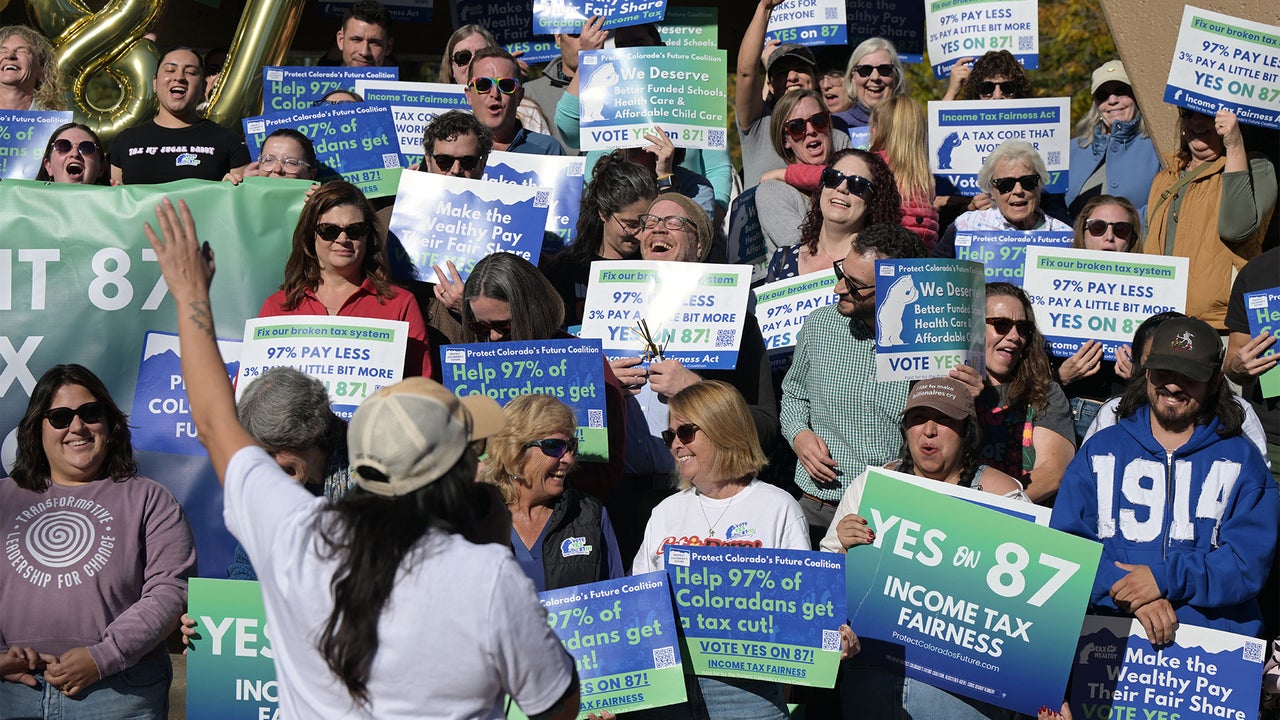
State efforts to tax the rich did relatively well in the 2026 midterm elections, following a series of state legislative moves in that direction in recent years.
That might come as a surprise because a majority of voters rejected California’s Proposition 40. The much-publicized ballot initiative would have imposed a one-time 5% tax on the net worth of the state’s roughly 200 billionaires. Google cofounder Sergey Brin and several other billionaires spent nearly $400 million trying to persuade voters to reject it.
Emmanuel Saez, a University of California, Berkeley, economist who studies inequality and helped design Proposition 40, lamented the loss, saying: “Today oligarchy has won.”
As a law professor who recently wrote a book about wealth inequality, I have been monitoring the results of these efforts aimed at taxing the rich. Despite Proposition 40’s failure, I think it’s important to observe that many Americans expressed support during the midterms for hiking income taxes on the rich, and to a lesser extent, taxes on the second—or third or fourth—homes the very wealthy possess.
Taxing the rich at the ballot box
Taxing income is proving a more successful strategy than taxing wealth.
Major changes to income taxes were up for a vote in five states during the midterms. Three of those ballot initiatives were proposals that sought to boost income tax rates on the rich or maintain those rates. All three prevailed.
In Washington state, for example, voters backed a measure that will preserve its new 9.9% income tax on household income above $1 million. This “millionaire’s tax,” signed into law earlier in 2026, is the state’s first personal income tax.
Meanwhile, Colorado voters rejected Proposition 136, which would have capped the state’s income tax rate at 4.4%. They also approved Amendment 87, a new graduated income tax that raises rates on households and businesses with incomes over $500,000.
And even though California’s voters rejected Proposition 40, they did approve Proposition 3. That measure makes permanent the income tax rates enacted in 2012 for the state’s highest earners, which were set to expire in 2031. The surcharges, adjusted annually for inflation, start at 10.3% for incomes of $360,000 and go up to a 12.3% surcharge for taxpayers earning over $721,000.
And in August 2026, Missouri voters overwhelmingly rejected a measure that would have required the state’s lawmakers to eliminate its income tax. This would have meant losing $8.5 billion in revenue annually. The change would have let rich income taxpayers off the hook and replaced lost revenue through an increased sales tax that would have hit low-income taxpayers hardest.
The two losses were in North Carolina and Iowa. Neither state voted directly on a tax to be levied on the rich. But both approved constitutional amendments that will make it harder for the state legislatures to enact these kinds of taxes in the future. North Carolina’s governor, Josh Stein, called the amendment in his state a “millionaire protection cap.”
State legislatures raising income tax rates on high earners
Ahead of the midterms, new taxes on the rich introduced via state legislatures, rather than ballot initiatives, also emerged.
In Maine, legislators voted in April 2026 for a tax surcharge of 1% on income over $1 million. The following month, Hawaiian lawmakers created a new 13% income bracket for single taxpayers earning above $500,000 or couples filing jointly who make over $1 million. This change is paired with a reduction in rates for lower-income brackets.
And one month after that, Rhode Island enacted a surcharge for millionaires’ income to be phased in over the next three years, reaching a maximum 3% rate.
In 2009, New York became one of the first states to pass one of these high-earner income taxes. Washington, D.C., Massachusetts, and Maryland also enacted these “millionaire taxes” in 2022, 2023, and 2025, respectively.
Taxing additional homes
Another way that state and local governments are boosting the tax revenue they get from wealthy constituents is by levying special taxes on pricey homes that aren’t the owners’ primary residences. These initiatives have succeeded both in state legislatures and voting booths.
Montana lawmakers, in April 2025, approved a new tiered property tax system, which took effect on January 1, 2026. It raised property tax rates on vacation homes and short-term rentals to 1.9%, while primary residences and qualifying long-term rentals pay lower, tiered homestead rates.
New York City rolled out its “pied-à-terre tax” in July. The new tax imposes an annual surcharge of 0.8% to 1.3% on single-family homes valued at $5 million or more, and 4% to 6.5% on condos and co-ops valued at $1 million or more. The surcharge only applies to homes that are not a primary residence.
Rhode Island has a similar property tax that took effect at the same time as New York City’s. It’s an annual surcharge of $2.50 for every $500 of assessed value above $1 million that applies to non-primary residences.
And on November 3, voters in Boulder, Colorado, approved a residential vacancy tax on homes that sit empty more than half the year. The surcharge, which goes into effect in 2028, will be roughly $4,000 a year for each vacant property. It applies across the board, but homes that aren’t primary residences are the clear target.
However, just west of Boulder in Crested Butte, Colorado, a second-home tax failed. So did an effort to levy a similar surcharge in San Diego, California.
Why income taxes are attractive to voters and lawmakers
There is a good reason why taxing the income of rich people is easier to pull off than taxing their wealth: Income taxes are much easier to calculate.
Income taxes can be based on annual income tax filings, whether state or federal. It requires no extra work to value someone’s net worth. There are no such filings for wealth, except after death, if a large estate is left behind.
Wealth taxes also require the annual valuation of businesses, farmland, artwork, intellectual property, and other assets—many of which are hard to estimate.
The downside of taxing income instead of wealth is that it limits how much revenue can be raised from the people most able to pay taxes. Most wealthy people convert little of their wealth into income. One common exception occurs when they sell some of their stock.
Property taxes, like income taxes, are an exception to this rule. Calculating how much tax on real estate someone owes is easy for the authorities to do using annual municipal assessments.
What might happen next?
Despite Proposition 40’s defeat, it looks like Americans are generally open to taxing wealthy people more—at least when the states do it.
In Illinois, where a billionaire governor, JB Pritzker, easily won a third term, another interesting ballot initiative prevailed.
More than 75% of voters in Cook County, which includes Chicago and several of its suburbs, approved a nonbinding, advisory referendum asking if Illinois should adopt the “millionaire amendment for property tax relief and education.” It would levy a new surcharge of 3% on incomes over $1 million. While this win did not authorize a new tax, it revealed that support for one would be strong—at least in Chicago and Evanston.
Even billionaire Bill Gates has said he believes a “billionaire’s tax” will be necessary. The question is: What kind?
Allison Anna Tait is a professor of law at the University of Richmond.
This article is republished from The Conversation under a Creative Commons license. Read the original article.