
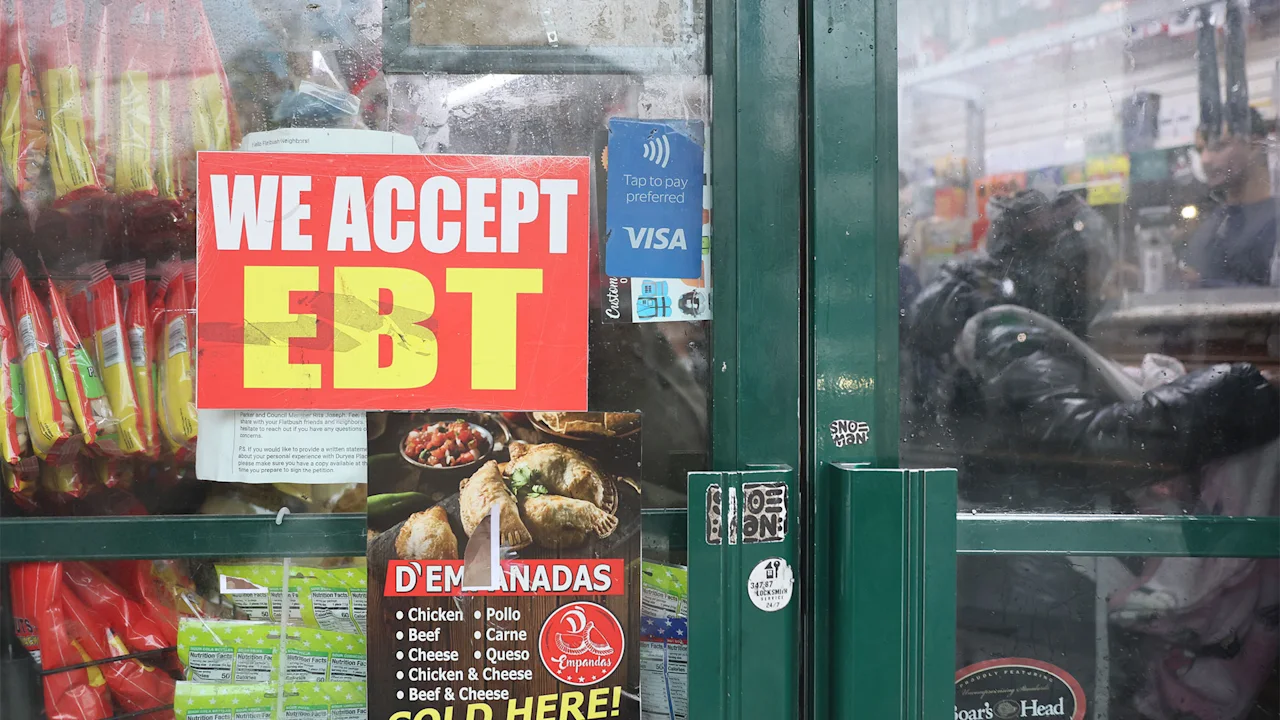
Over the past several days, millions of low-income Americans who use SNAP, the nation’s biggest food aid program, have been left wondering how they will pay for basic necessities this month amidst the ongoing government shutdown. Today, they have an update: In a court filing submitted on November 3, the Trump administration said that it would pay just 50% of recipients’ normal allotments this month.
Last year, the Supplemental Nutrition Assistance Program helped 41 million people (or about 1 in 8 Americans) buy their groceries, nearly two-thirds of whom were families with children. To qualify for SNAP in 2025, a family of four’s net income can’t exceed the federal poverty line of around $31,000 per year. Normally, the debit cards that SNAP recipients use to buy food at participating stores are loaded each month by the federal government. But amidst the ongoing government shutdown, the U.S. Department of Agriculture (USDA) planned to freeze payments to SNAP on November 1, citing a lack of funding.
However, just a day prior to the freeze, two federal judges in Massachusetts and Rhode Island ruled that the government had to extend the funding, offering the Trump administration some leeway on whether to offer full or partial funding in November. Now, the Trump administration says it will use money from an Agriculture Department contingency fund to offer partial payments for November—though the exact timeline of the funds’ distribution remains uncertain. Here’s what to know:
Why were SNAP benefits about to freeze?
This new announcement follows an ongoing back-and-forth over whether the federal government had a legal obligation to continue providing SNAP funding despite the government shutdown, which has been in effect since October 1.
On one side, the Trump administration said it wasn’t allowed to use a USDA contingency fund with about $5 billion in it for the program, which reversed a USDA plan from before the shutdown that said money would be tapped to keep SNAP running. On the other, Democratic state attorneys general or governors from 25 states said that money from the contingency fund could—and must—be used, arguing in a legal finding on October 28 that the USDA could also tap into another appropriated fund worth about $23 billion for the cause.
Ultimately, two federal courts came down in favor of using contingency funding for SNAP. In Providence, Rhode Island, U.S. District Judge John J. McConnell ruled that the government must use emergency reserves to backfill SNAP benefits, requiring an update from the administration by November 3.
“There is no doubt, and it is beyond argument, that irreparable harm will begin to occur—if it hasn’t already occurred—in the terror it has caused some people about the availability of funding for food for their family,” McConnell said during the hearing, according to ABC News.
In the Boston, Massachusetts case, U.S. District Judge Indira Talwani called the SNAP suspension “unlawful,” similarly calling for contingency funds to be used for the program.
What’s happening now?
In response to these rulings, the Trump administration said in its own filing that it plans to use the $5 billion contingency fund to pay “50% of eligible households’ current allotments,” adding that the expenditure will mean “no funds will remain for new SNAP applicants certified in November, disaster assistance, or as a cushion against the potential catastrophic consequences of shutting down SNAP entirely.” The administration opted against tapping into the additional funds identified by Democrats to pay the monthly benefits in full. Normally, the USDA spends $8 billion per month on the program.
So far, it’s unclear when SNAP recipients will have access to the half funding. In an interview with CNN on Sunday, Scott Bessent, the Treasury secretary, said of the distribution, “There’s a process that has to be followed. So, we got to figure out what the process is. President Trump wants to make sure that people get their food benefits.”
Meanwhile, local food banks, shelters, and state governments have been scrambling to prepare for an influx of hungry people. States including Louisiana, New Mexico, Vermont, New York, and Nevada have all acted to provide emergency funding for residents in need, while smaller organizations like food pantries are working overtime to get ready.
“When you take SNAP away, the implications are cataclysmic,” Claire Babineaux-Fontenot, CEO of the nationwide food bank network Feeding America, told the AP last week. “I assume people are assuming that somebody’s going to stop it before it gets too bad. Well, it’s already too bad. And it’s getting worse.”