
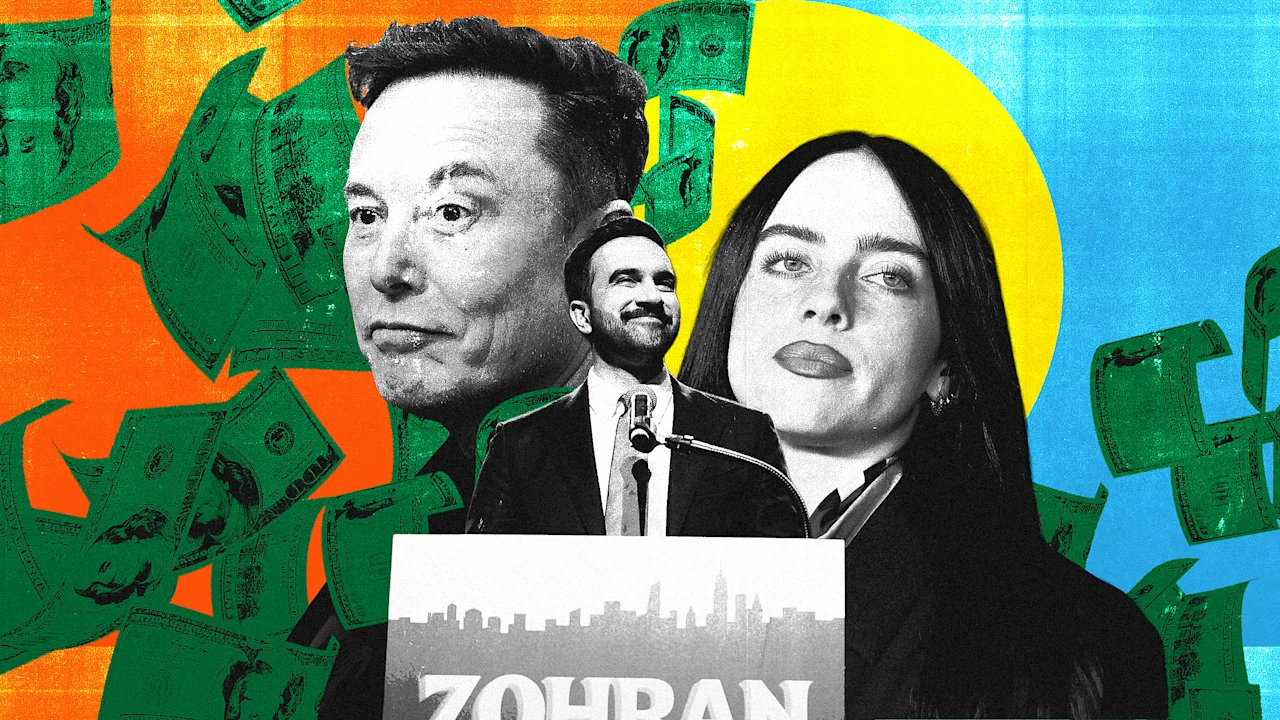
Americans have long ogled the rich, but the country’s widening wealth gap—and the billionaires fueling it—have been facing growing scrutiny.
The news that Elon Musk is on track to be the world’s first trillionaire came the same week that a judge ordered the Trump administration to fully fund food stamps, as 42 million Americans were left without the benefits they need to buy food. (The Trump administration appealed that ruling.)
New York City Mayor-elect Zohran Mamdani, a Democratic Socialist, made national headlines throughout his campaign for highlighting the affordability crisis in the city. Mamdani received support from figures like former labor secretary Robert Reich and Senator Bernie Sanders of Vermont, who have frequently criticized billionaires.
Even singer Billie Eilish called out the ultra wealthy recently. “If you’re a billionaire, why are you a billionaire?” she said while announcing an $11.5 million donation (about 23% of her net worth), before urging billionaires to give away their money.
A new Harris Poll shared exclusively with Fast Company highlights how everyday Americans are paying more attention to this inequality—and how they oscillate between admiring and admonishing the wealthy.
An economic system that works best for the rich
In the Americans & Billionaires survey, now in its third year, only 28% of respondents said that the current U.S. economic system works well for most people.
Instead, 35% said it prioritizes the ultra-wealthy, and 36% said it offers opportunity—but not equally. Nearly three-quarters of Americans say wealth inequality is a serious national issue.
Americans are also directly blaming billionaires for the financial struggles they face. Sixty-seven percent said billionaires are “creating more of an unfair society,” an eight-point increase from the 2024 survey.
That sentiment was also higher among Gen Z and millennials, 72% of whom agreed with the statement compared to 62% of Gen X and baby boomers.
Fifty-five percent of Americans said that billionaires “make it harder to achieve my American dream;” for Gen Z and millennials, the share was 65%.
And they’re also generally over seeing extreme wealth on display: 74% of respondents say that billionaires are over-celebrated in U.S. culture.
‘The era of the untouchable billionaire is over’
When calling out inequality, people often point to the ways billionaires could help the rest of the world.
Mamdani ran in part on taxing the wealthy in order to pay for free childcare and buses; others have noted how taxing the rich could fund universal healthcare, end world hunger, and address climate change.
Americans broadly believe that the more wealth someone has, the more responsibility they have to the world, the Harris Poll found.
Seventy-two percent of Americans agreed that billionaires have an “ethical responsibility” to address the world’s humanitarian crises—up 4 points from the year prior—and 69% said billionaires have a responsibility to better society, and should give back.
Across all age groups, Harris Poll saw an increase in the percent of Americans who want a limit on wealth accumulation, compared to 2024.
“The era of the untouchable billionaire is over,” Libby Rodney, chief strategy officer and futurist at The Harris Poll, says in a statement. “Americans want wealth to work harder, for society, not just for shareholders.”
Still, they don’t seem to have much hope that billionaires will do so; 76% of respondents agreed with the statement that billionaires “are more concerned about protecting themselves than helping others.”
One area billionaires are wading into, though, is politics. Billionaires like Bill Ackman spent millions opposing Mamdani’s race for mayor, and Musk notoriously enmeshed himself in the federal government this year.
Americans are growing wary of that trend: 7 in 10 wish billionaires played a smaller role in U.S. politics.
Americans want wealth for security
These sentiments toward the rich don’t completely preclude people from wanting to join their ranks.
Even though 76% of Americans admit that billionaires benefit from a broken system, six in ten still said that they want to become a billionaire one day.
But it’s also clear that Americans aspire to wealth because it seems like one of the only ways to survive our continuous, mounting economic shocks.
Two-thirds of Gen Z and millennials said that they aspire for extreme wealth not for success, but for security in an increasingly unstable economy. Overall, 52% of Americans agreed with the statement that “If I was a billionaire, then all my problems would be solved.”
“Gen Z doesn’t want to be billionaires for bragging rights, they want safety in an uncertain economy,” Rodney says. “They’re rewriting the rules of ambition, turning wealth into a survival strategy, not a status symbol.”