
Saudi Arabia is doing precisely what governments do when they understand that the world is no longer stable: buying protection, influence, and time. Washington likes to pretend that Riyadh is suddenly a loyal ally because it is investing in the United States, helping Ukraine, and quietly aligning against Iran. Saudi Arabia is not acting out of friendship. It is acting out of self-interest, and that is exactly how nations survive when the world moves into a war cycle.
The money alone tells you this is not a symbolic relationship. The White House said in November that Saudi Arabia’s investment commitment into U.S. infrastructure, technology, and industry had risen to nearly $1 trillion, up from the $600 billion first announced in May 2025. At the same time, Treasury and the Saudi finance ministry signed frameworks on financial and economic partnership and capital-markets collaboration. Washington also packaged this together with civil nuclear cooperation, critical minerals, AI, and defense deals, including future F-35 deliveries and an agreement for Saudi Arabia to purchase nearly 300 American tanks. Riyadh is tying itself to the American industrial base, the American financial system, and American defense production because that is how you secure leverage in Washington.
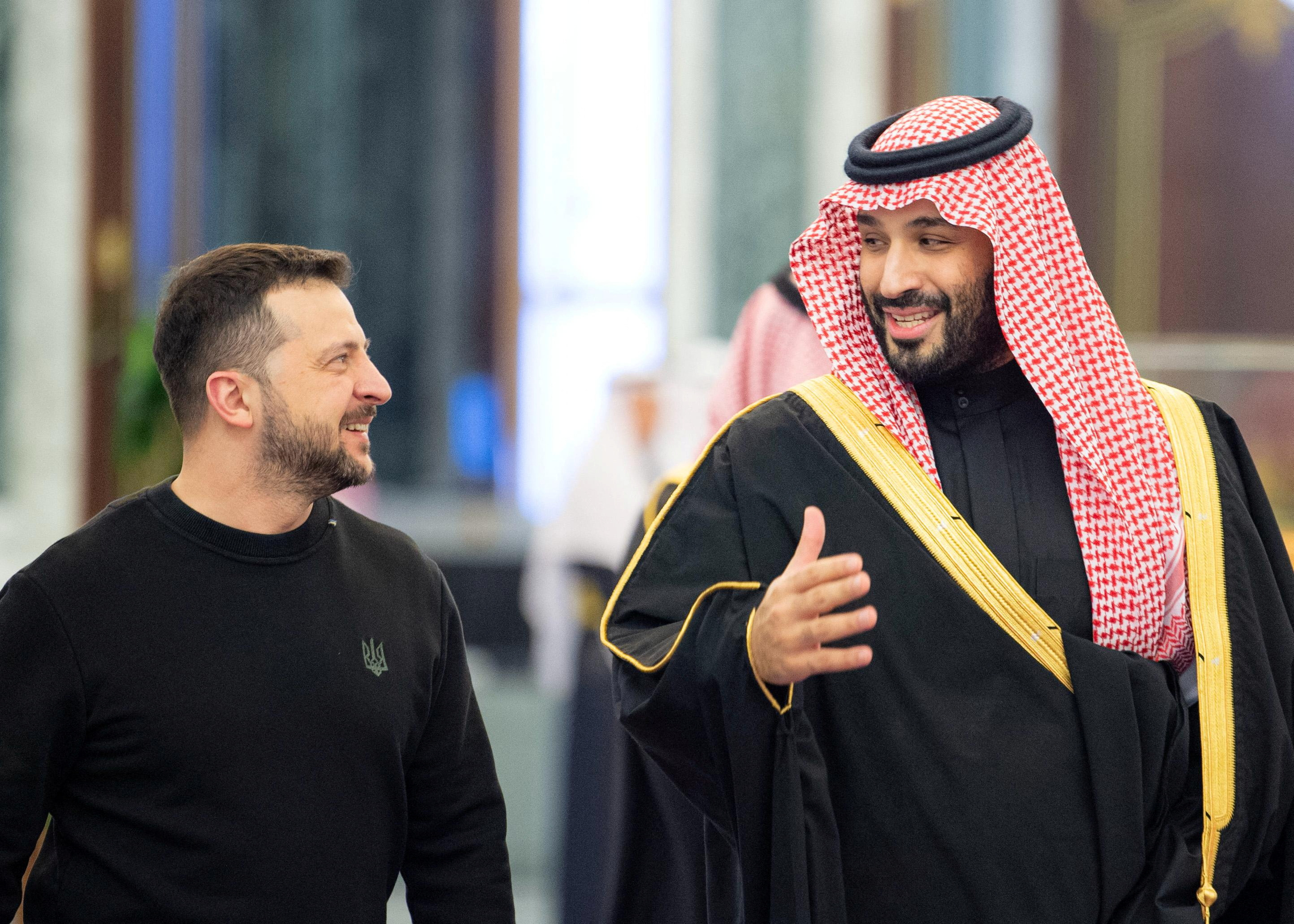
At the same time, Saudi Arabia is now moving on the Ukrainian side in a way that would have been unthinkable a few years ago. According to the Kyiv Independent, a Saudi arms company has signed a deal to buy Ukrainian-made interceptor missiles, and Ukrainian industry sources said Riyadh and Kyiv were negotiating a separate “huge deal” for arms that could be finalized this week. Zelensky also said he had offered Crown Prince Mohammed bin Salman Ukrainian help in intercepting Iranian Shahed drones, arguing that no country has more practical experience against them than Ukraine. Saudi Arabia is looking at the Gulf and seeing the same Iranian drone threat Ukraine has been dealing with for years. Riyadh is shopping for battlefield-tested systems because it believes the drone era is now on its doorstep. The one caveat is that the weapons-deal reporting rests on anonymous defense-industry sources, so the broad direction is clear even if the final size of the package is not yet publicly verified.
This also explains why Saudi Arabia is helping the United States against Iran while still trying to avoid being publicly dragged into a regional inferno. Reuters reported that after Iranian missile and drone strikes hit Gulf states hosting U.S. bases, including an attack targeting the U.S. embassy in Riyadh, the Saudi cabinet said it would take all necessary measures to defend its security and protect its territory, citizens, and residents. That is the language of a country that understands neutrality has limits. Saudi Arabia wants to contain Iran, and make sure Washington keeps treating the kingdom as indispensable.
The International Energy Agency says the Strait of Hormuz carried an average of 20 million barrels per day of crude oil and oil products in 2025, roughly 25% of the world’s seaborne oil trade. Of that, Saudi Arabia alone accounted for about 6.23 million barrels per day transiting Hormuz in 2025. Yes, Saudi Arabia has the East-West pipeline to Yanbu on the Red Sea, and the IEA estimates that only Saudi Arabia and the UAE have operational crude pipelines that can meaningfully bypass the Strait, with a combined 3.5 to 5.5 million barrels per day of alternative capacity. But that is the key point: the bypass capacity is limited compared with the scale of what normally moves through Hormuz. Riyadh can reroute some oil, but it cannot magically make the chokepoint disappear.
Saudi Arabia strengthens its position as the world’s oil central bank.
Aramco announces East-West pipeline enables export rerouting up to ~7mb/d capacity. “We ramped up production through the East-West pipeline, which has a capacity up to 7 mb/d. Approximately 2 mb/d will be… pic.twitter.com/Gbha1eZyiL
— Daniel Lacalle (@dlacalle_IA) March 10, 2026
That is why oil is the real story here. Reuters reported that OPEC+ agreed on March 1 to raise output by 206,000 barrels per day for April, even as war with Iran disrupted Gulf shipments, and that Saudi Arabia had already been increasing production and exports by around 500,000 barrels per day in preparation for U.S. strikes. Yet the IEA also notes that the world’s spare crude production capacity was running at just over 4 million barrels per day in late 2025 and that this spare capacity is primarily held by Saudi Arabia. In other words, Saudi Arabia remains the swing producer, but the market is now being reminded that swing capacity is useless if export routes are threatened. Spare barrels in the ground do not calm a market when the shipping lanes are in question.
Aramco’s own numbers show why Saudi Arabia is still the central energy power in the region. The company reported adjusted net income of $104.7 billion for full-year 2025, operating cash flow of $136.2 billion, free cash flow of $85.4 billion, and capital investment of $52.2 billion in 2025, with 2026 capital spending guidance of $50 billion to $55 billion. That is not a weak state oil company limping along. That is a cash machine financing the kingdom’s geopolitical flexibility. But even Aramco has warned about the economic consequences if this war drags on, and reports today indicate the company is racing to redirect exports via Yanbu, which can handle around 5 million barrels per day versus the roughly 7 million barrels per day Saudi Arabia normally exports.
Saudi Arabia understands something Washington still refuses to admit. This is not a transitory war, and these are not transitory prices. Saudi Arabia is investing in the United States because capital always runs to the power center it believes can still protect it. It is buying Ukrainian anti-drone technology because the Iranian threat is no longer theoretical. It is helping the United States against Iran because if Tehran can intimidate the Gulf monarchies, the entire regional balance of power changes. And it is guarding its oil with extreme caution because oil is not merely revenue for Saudi Arabia. Oil is the kingdom’s strategic sovereignty.