
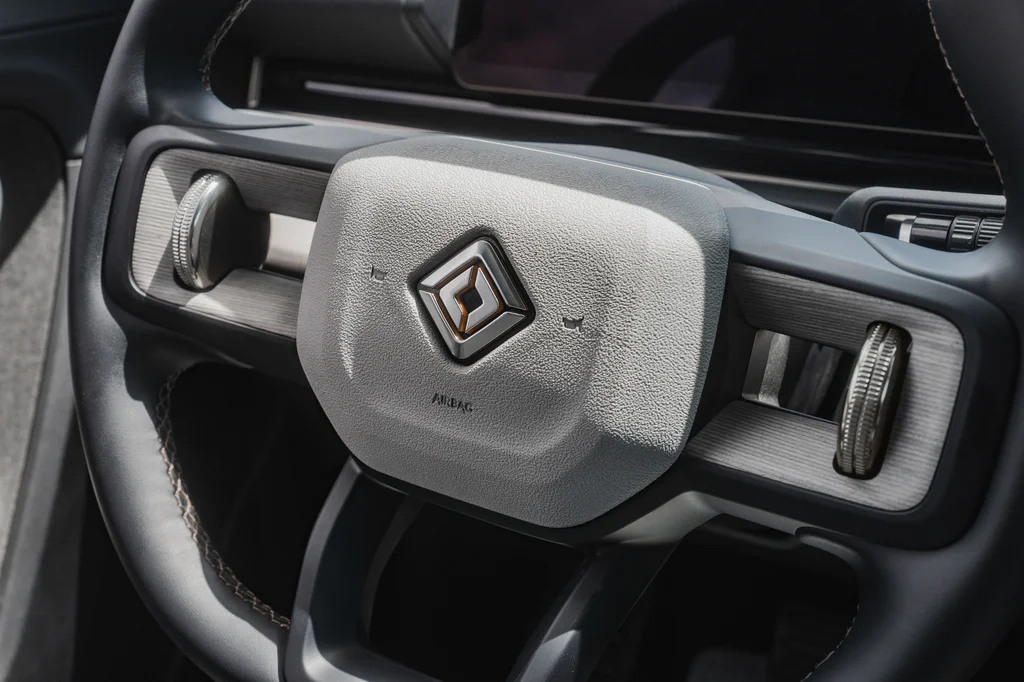
For the last week, I tried driving Rivian’s new R2. One of the first things I noticed was a feature that nearly didn’t make it into the car.
The haptic “Halo” controls on either side of the steering wheel are Rivian’s answer to a common complaint about modern cars: Drivers miss physical knobs and buttons. But they also added cost to a vehicle designed to be as affordable as possible. (The two circular dials, which control everything from temperature and fan speed to the stereo, also come with a learning curve; more on that below.) In the end, Rivian kept them because they were a direct response to customer feedback. They’re one example of the balancing act behind the R2, improving the experience while finding ways to make the vehicle cheaper to build.
The Halo controls were “one of those areas where we decided to spend more money,” says Jeff Hammoud, Rivian’s chief design officer. “That was one I fought for—it was an increase in cost, but from a user experience standpoint, from a differentiation standpoint, it was really important.”
The high-end Performance version of the R2 starts at $57,990, about $25,000 less than Rivian’s original SUV, the R1S. The Standard model, due in early 2027, will start at $44,990. After driving the launch version over the past week, I’m convinced Rivian has figured out how to produce a more affordable EV without making it feel cheaper.
It’s arriving at a strange moment for the industry. As gas prices have spiked, sales of used EVs have been growing. But sales of new EVs dropped steeply this year after federal tax credits went away. (Last month, there was a slight month-over-month uptick.) Rivian, which was founded in 2009 and posted its first gross profit last year—after raising $13.7 billion in a blockbuster IPO in 2021—also faces high stakes as it continues to burn cash. The R2 is the kind of EV that might help convince more drivers to leave gas behind simply because it’s a better car to drive.
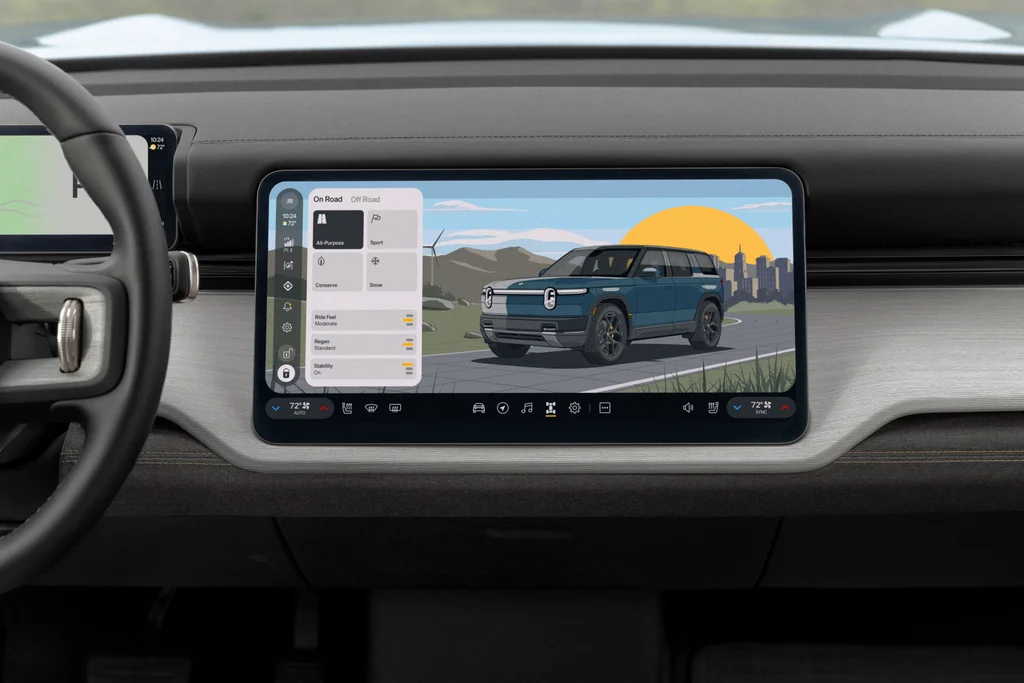
Rivian obsessed over the details
The SUV felt nimble on the road, thanks in no small part to the fact that it weighed some 1,800 pounds less than its predecessor. The designers looked for ways to reduce material without sacrificing performance. For example, Rivian cut 2.3 miles of wiring from the R2 by switching to a “zonal” architecture. To put it more plainly, rather than running wires from components all over the vehicle back to a handful of central control units, Rivian uses smaller controllers around the vehicle to handle nearby electronics.
While it shrinks weight, the zonal design also makes the software faster than the previous, more expensive R1S. “It’s one of those things that’s a complete win-win because you’re getting better capability and better performance, but you’re also reducing cost through all of the wiring being simplified,” says Hammoud.
Throughout the car, the team reconsidered each detail, from the fact that the top of the battery pack could double as a structural element, adding rigidity while reducing weight and cost, to the number of fasteners that attach the wheel liner. “It’s one of those areas that I wanted to make look better, but it also costs less money and takes weight out. . . . We’re really trying to find every millimeter or gram of weight that you can get out of the car,” Hammoud says.
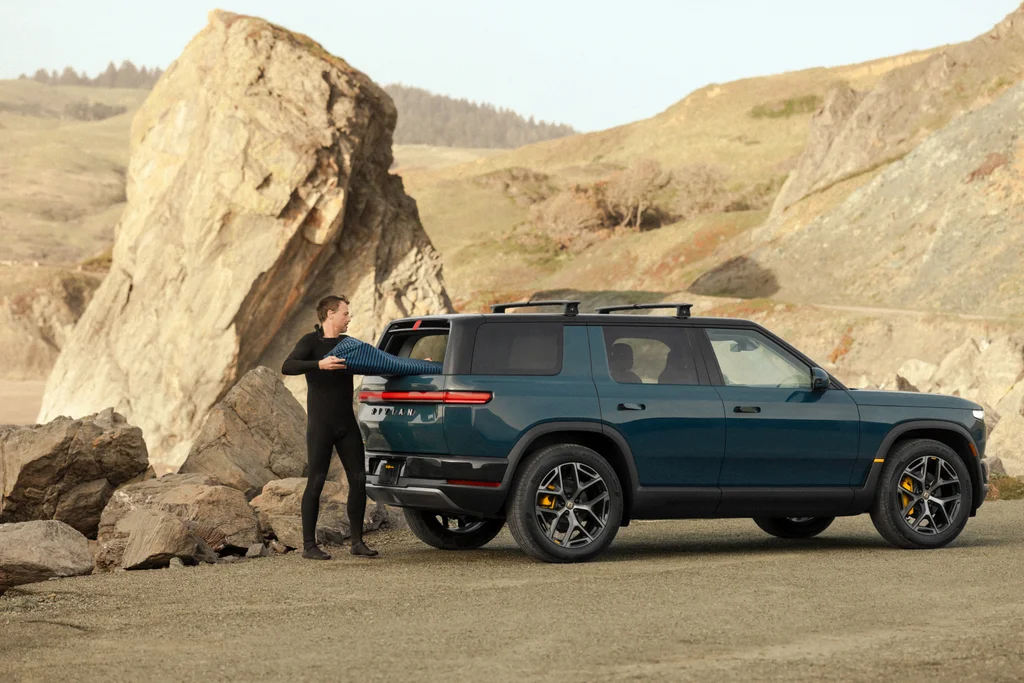
As the design team removed components, it also considered each feature that might not be necessary but makes the car fun—like the fact that the rear window rolls all the way down. Making that possible, and affordable, required some complicated engineering. The team positioned the front seats and structural pillars to make it possible to remove a separate side window, freeing up space for the back window to go down.
“We could have chosen not to have full glass drop, but being an adventure vehicle, we thought that was really important,” Hammoud says. A button on the ceiling lowers all five windows at once; as soon as I tried it, on a quiet back road on a perfect summer day, I left them down for the rest of the drive.
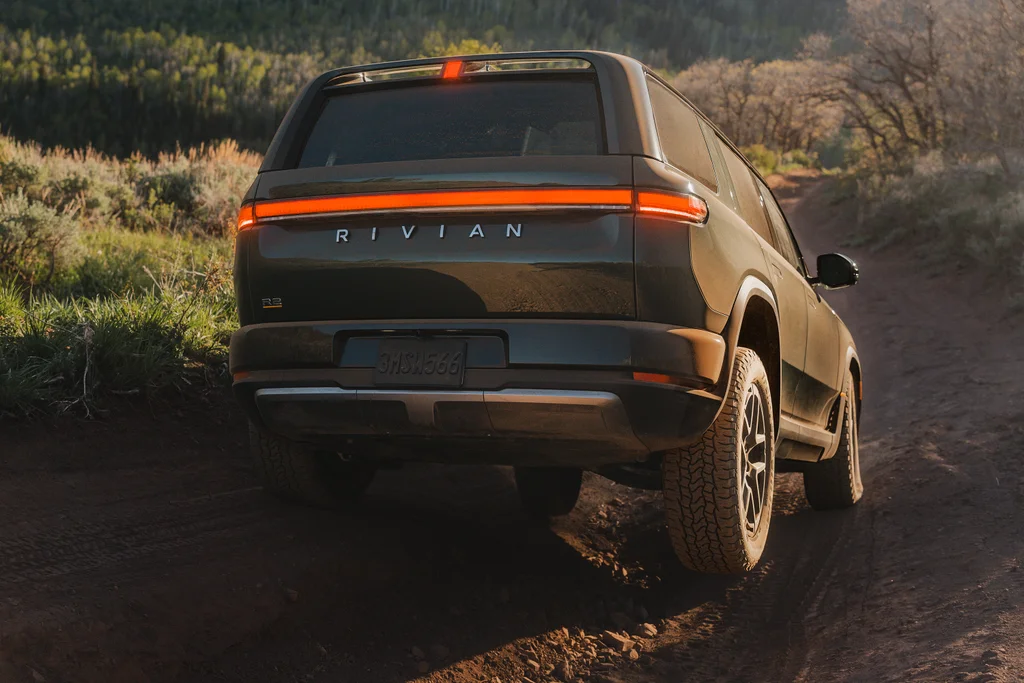
It performs well off-road
One afternoon, a friend and I took the R2 into a nearby forest and turned off onto a steep gravel road. The EV zipped effortlessly up hills. One of the advantages of an electric drivetrain is the instant torque; the SUV’s all-wheel drive also makes it easy to go uphill.
The original R1S is more capable off-road, with air suspension at all four corners and an electronically controlled roll-control system. The R2 Performance can’t raise or lower itself, but its damping system offers three settings that make the ride firmer or softer. With 9.6 inches of ground clearance, it easily handled deep ruts on a gravel road. We didn’t take it truly off-road, but it’s designed to handle much more serious terrain.
The instantaneous torque is especially useful off-road, according to Hammoud. A gas engine takes a moment to rev up after the driver hits the accelerator, a delay that can matter when climbing over rocks or other difficult terrain. “That little delay of the engine going could basically mean you may not make it up the hill,” he says. “So the EV, it’s immediate.”
The R2 drives just as well on the highway, with hands-free driving available on roads with clearly marked lanes. (Rivian’s drive styles let you choose how aggressively the autonomous system drives, from “mild” to “spicy.”) The company’s next milestone is point-to-point driving, which it says will roll out widely next year. You’ll be able to enter an address and then let the EV take you from beginning to end, switching by itself from city streets to highways.
The design stands out from other SUVs
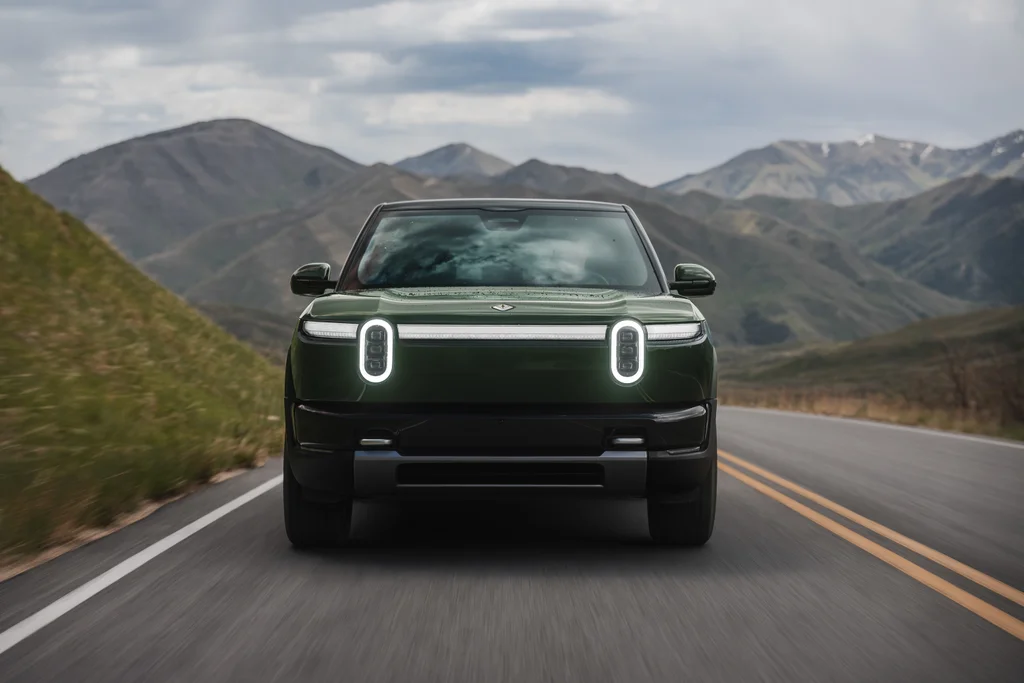
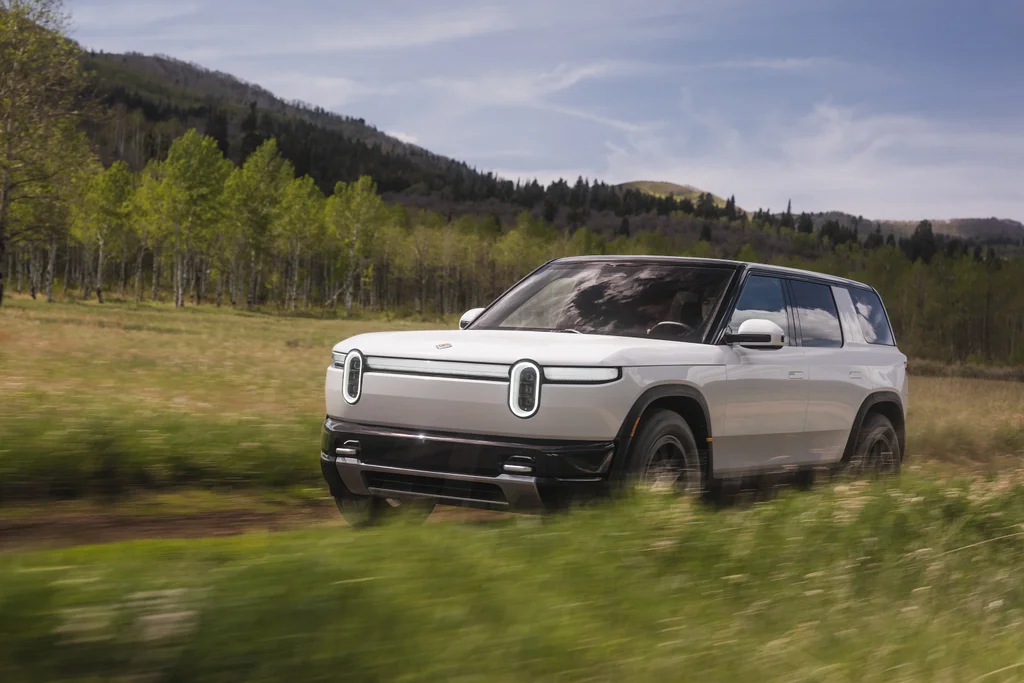
Every time I walked back to the R2 in a parking lot, I noticed how good it looked from the front and the side—and the fact that it stood out in a sea of cars that all looked fairly similar to each other. (It also looked good even when it was covered in mud after the drive through the forest.) The team kept certain design elements so that it immediately feels like a Rivian. The front, unsurprisingly, has the company’s signature rounded lights.
“It was something that was a big challenge we had for R1, especially knowing that traditionally in ICE [internal combustion engine] vehicles, the way they differentiate themselves was with a grille—not needing a grille, how do we get around that?” says Hammoud. The shape is also different from other SUVs. “The silhouette of the car is the first thing that you really notice when something is going down the road. So for us, having that very horizontal hood, the [steep] windshield, the sort of two-box shape really makes it feel like an SUV and differentiates in the sea of sort of jelly bean-shaped SUVs out there.”
Despite the boxy shape, the team worked hard to make it aerodynamic. A pass-through on the front bumper goes back to the rear. “It looks like a race car underneath,” says Hammoud. The roofline also drops sharply toward the rear spoiler, creating another pass-through to let air flow smoothly. “That feature alone is worth 10 miles of range,” he says. Other details also help, like the fact that the windshield wipers are tucked below the hoodline.
It’s roomy inside
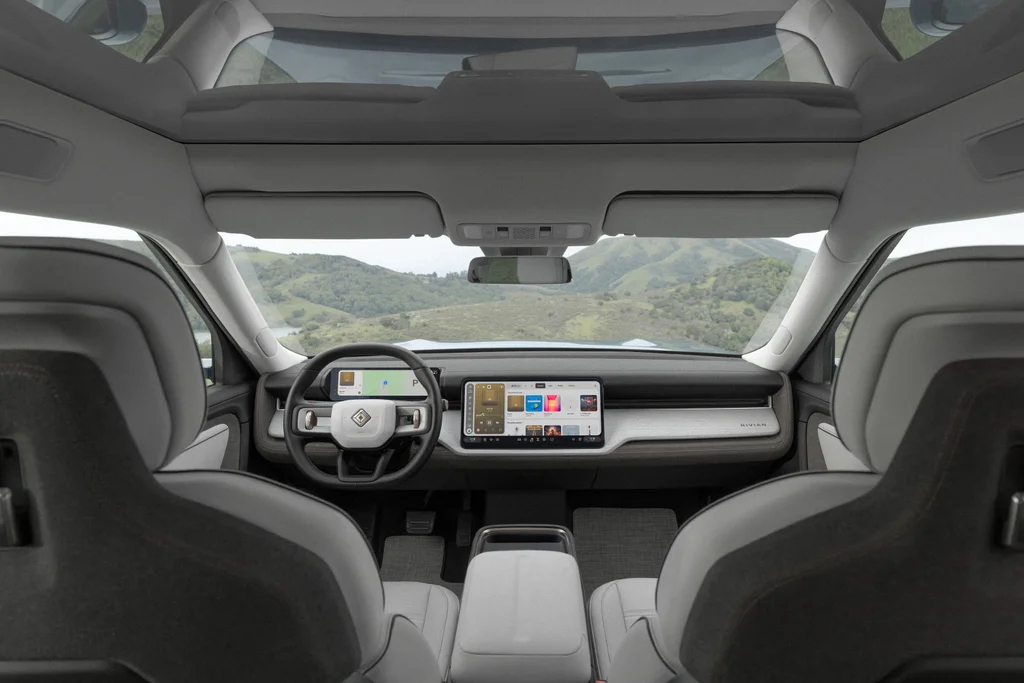
It feels spacious inside compared with some other SUVs. First, the boxy shape helps. The part that car designers call the “tumblehome” of a car, or how the sides of the vehicle angle up toward the roof, is kept wide. “We really box that out as much as possible while maintaining the aerodynamics to make sure when you’re sitting in the vehicle it also feels spacious, and you’re not in this enclosed space,” says Hammoud. “So it was dimensionally really pushing on what we can do.”
The vehicle is about an inch shorter and narrower than a Tesla Model Y, but feels bigger. “We have very short front and rear overhangs,” he says. “That means we can really push all the packaging out to the wheels.”
There’s ample storage space. I picked up three large teak deck chairs from a friend, and easily fit them in the back with the back seat folded down. On the way back, I thought that I wouldn’t have room for groceries, but then remembered the frunk, the storage space in the hood where a gas car would have an engine. (There was space for three bags of groceries.)
On another errand, I picked up 8-foot-long wood trim at the hardware store. With the center of the back seat folded down, I was able to squeeze it inside. Since the back window fully opens, it would also be possible to tie down something longer.
In the front, there are two separate glove boxes. One of these had a flaw: After I opened it, it wouldn’t close. (Rivian told me that its engineering team just discovered a problem with one of the components, and its supplier is rolling out parts for a fix.) The center console has room for a bag. A storage tray on the bottom has space for a full-sized tissue box, something that customers had requested. And in addition to cup holders in the center, the doors also have space for extra-large bottles like Stanley mugs.
There are still challenges
Like any EV, there’s a learning curve. I hadn’t driven a one-pedal car for a while, and it took a little while to get used to it again. For the uninitiated, the design means that if you lift your foot off the accelerator, you can brake without using the actual brake; the car automatically regenerates the battery when you slow down. The first time I drove the R2, I accidentally drove through a nearby college campus as students were moving in, and got stuck in a line of stop-and-go traffic. I kept stopping erratically because I’d lift up my foot expecting to coast. (I assume that people thought I was yet another terrible freshman driver.) But after practice, one-pedal driving is more convenient.
I didn’t have an EV charger at home, so I also got to experience the hassle of relying on public chargers in a small town in upstate New York. At one point, an app directed me to a charger at a local bakery, but I couldn’t find it in the parking lot, and the teenager working the counter said they didn’t have one. Only after I’d left did I learn that the chargers were in a second lot around the corner. I headed to the next spot on the map, but couldn’t get the charging network’s app to download.
Finally, at a third location, I plugged into a painfully slow older charger. I gave up after adding only a handful of miles and tried again the next morning, when I finally found a fast charger. Even then, the process was stressful, involving another clunky app and several failed attempts before charging actually began. Larger cities may be different, but in this small town, at least, owning an EV without access to home charging would be a challenge.
Luckily, of course, around 258 million Americans live in homes that could easily add EV chargers (and apartment buildings are slowly catching up with chargers in parking garages). And with the car’s range of 330 miles, I didn’t actually need to charge the R2 during my week with it. I just wanted to see what the public-charging experience was like.
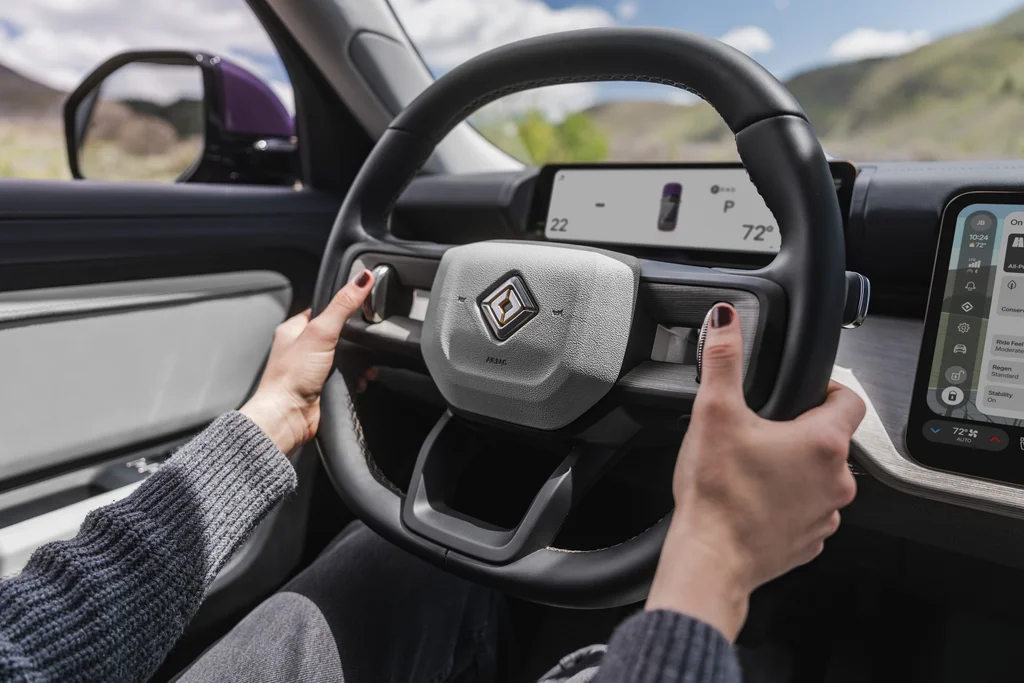
Some of Rivian’s unique features also have a learning curve, including the innovative Halo controls. The two dials, on each side of the steering wheel, have multiple functions, from changing the volume and flipping through songs to checking your tire pressure, adjusting the temperature and fan speed, and switching to different driving modes. To do all of this with two dials, rather than a row of controls, means that you also have to get used to scrolling and clicking in complicated ways. It takes practice, and some drivers might not have the patience. But ultimately, I found it useful; you don’t have to take your hands off the wheel to quickly make changes.
There are still some bugs. At one point, the small display over the steering wheel listed a different amount of range left than the larger touchscreen in the middle of the dash (195 miles versus 185 miles). I couldn’t get my phone to charge wirelessly on the center console, even after removing the case and repeatedly repositioning it.
Other things just weren’t obvious. Once, while working in the R2, I wanted to charge my laptop in the outlet in the back of the vehicle. When I plugged it in, nothing happened; it wasn’t clear that I had to use the touchscreen in the front to turn on the outlet. While I was sitting at an EV charger and staring at bird poop on the windshield, I started thinking about the fact that charging stations don’t have the squeegees that are ubiquitous at gas stations. I tried to spray the R2’s own washer fluid, but it didn’t work, and I later realized that it seemed to function only when the car was driving, not parked.
Still, despite some quirks, it’s an incredible car to drive—and one that I liked better than any gas vehicle I’ve been in. There are even more features that I didn’t get to test, including the fact that the car has capability for bidirectional charging to send power to your home or to the grid. And at a time when gas prices are high, I calculated that charging the R2 at home would have cost me about half as much as buying gas for a similar gas SUV.
The R2’s biggest accomplishment may be making an affordable EV feel not like a compromise, but like the better car.