
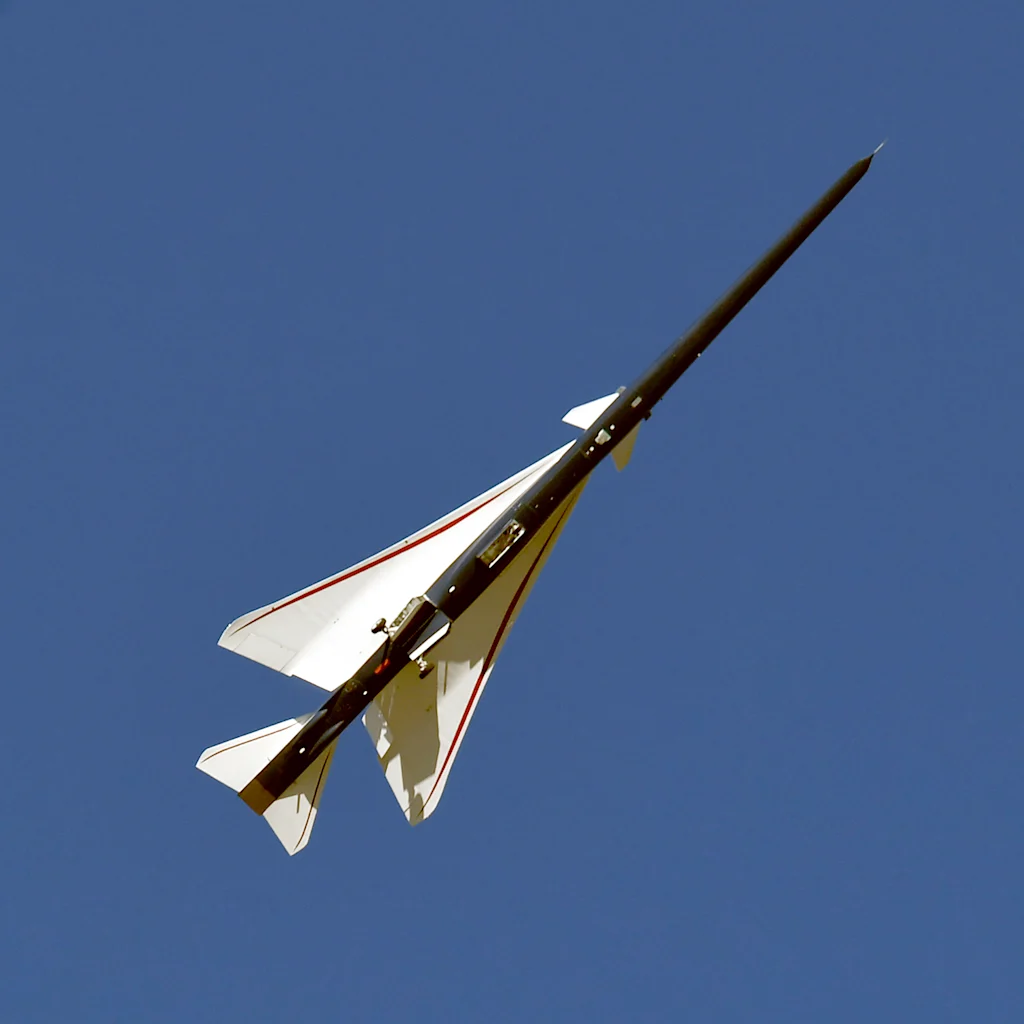
At last, the X-59 is airborne. NASA’s quiet supersonic airplane took to the skies in Palmdale, California, successfully landing back a few minutes later. While this initial sortie on October 28 was a subsonic check of basic systems and airworthiness, the flight represents the penultimate step toward reviving supersonic passenger travel over land.
It also marks the beginning of a race to see which of three supersonic airplane ideas wins to become the dominant design of the 21st century. There’s Lockheed Martin’s X-59 dart-like shape developed to avoid the sonic boom. Then we have Boom Supersonic’s XB-1, which doesn’t look to avoid the sonic boom but to stop it from reaching the ground thanks to computer calculations and clever use of atmospherics physics altogether. And finally, let’s not forget that China is also in this race with a design that seems to mix ideas from the X-59 and the XB-1.
The importance of the X-59 is rooted in the spectacular failure of the Concorde. While a technological marvel, its eardrum-shattering sonic booms led to a public outcry that resulted in a 1971 ban on supersonic flight over populated areas, a move that crippled its commercial case and was followed by regulators worldwide. Now, although the Trump administration has lifted that ban over the United States, the rest of the world still doesn’t allow these flights.
The X-59’s design
The X-59 was conceived to make all the bans obsolete, worldwide. It aims to prove that a supersonic jet can fly without causing a disruptive boom, generating instead a quiet “thump” no louder than a car door slamming. “The real breakthrough for supersonic flight would be to be able to fly over land again so that you have those long routes where that supersonic flight is more advantageous,” Dave Richardson, the X-59 program director at Lockheed Martin, told me last year, when the physical prototype was unveiled.
Made with recycled parts fitted in a radical arrow-tip-shaped fuselage, the X-59 looks more like a weapon than a research vehicle, an impossibly long and sharp needle of a plane. Its design is the magic trick. According to Richardson, the secret to its quiet flight isn’t some exotic new material or engine. “There is no radical technology in the airplane itself,” he explains. “It really is just the shape of the aircraft.”
That shape—with a nose that makes up a third of its length, a cockpit with no forward-facing window, and an engine perched on its back—was born from immense computing power. Advanced modeling allowed engineers to simulate how shockwaves would behave, a process that would have previously required “hundreds or thousands of times at a huge expense” in a wind tunnel.
Lockheed Martin’s design works by fundamentally reshaping the physics of a sonic boom. Instead of allowing the shockwaves generated by the plane’s movement through the air to coalesce into one massive, explosive boom, the X-59’s slender form is engineered to keep them separate. “You want to be able to stretch out and manage the different shocks across the length of the airplane,” Richardson said.
Every element is meticulously placed to support this goal. The engine’s air intake is on top of the fuselage so its shockwave travels up, away from the ground. The pilot navigates using a high-definition “external vision system” instead of a window, eliminating the canopy bulge that would otherwise create a powerful shockwave.
The ultimate goal is not to build a new airliner, but to collect data. The target for NASA’s Quesst mission is to turn the Concorde’s 105-decibel boom—as loud as a chainsaw—into a 75-decibel thump. This is the critical data point. The X-59 is an experimental tool designed to fly over communities and ask a simple question: is this quiet thump acceptable? The subjective feedback from people on the ground will be compiled into a database for U.S. and international regulators, providing the evidence they need to rewrite the rules on supersonic flight.
Test piloting a new kind of airplane
This inaugural flight, piloted by Nils Larson, was just the beginning of a rigorous testing process. Over the coming months, the X-59 will fly progressively faster and higher, eventually pushing past Mach 1.4 at an altitude of 55,000 feet. Once its performance is validated, the plane will begin its community overflights across several U.S. cities. If the public response is positive and the data supports a rule change, the path would be cleared.
For commercial manufacturers, Richardson says they could “start right away” on a new generation of quiet supersonic jets as soon as the laws are repealed. That future of dramatically shorter travel times now rests on the performance of this one magnificently weird airplane.
Meanwhile, after successfully testing the XB-1, Boom Supersonic is charging ahead with Overture, its first commercial airplane. If they continue developing it at the current pace, they might actually become the winners of this silent supersonic race.
Brian Scholl—the company’s CEO—told me a few months ago that Overture is designed to fit within existing airport infrastructure. The airplane will be able to operate from existing gates and runways, making it practical for commercial use. He claims that it will be impossible for something like the X-59 to scale to airliner size because it will be absurdly long and impossible to fit in current airports without redesigning or building new gates.
Still, it is too soon to tell what’s going to happen, since X-59 still needs to start and successfully complete its testing campaign—and Overture needs to actually materialize. Same with the Chinese design. For now, it’s just fun to see all these cool machines taking off and making history, wherever we are going next.