

Serhii Kupriienko sits in an unadorned room in an unadorned house on a quiet residential street in Kyiv, sketching out for me what the future of war looks like.
“I’m not very good at drawing,” he says, dragging a blue marker across the lid of his laptop (he assures me it washes off), creating a series of rough formations meant to represent groups of drones. The point of the art is to show how his company is making it so the machines might better coordinate with one another in order to eliminate Russian forces.
Before Russia’s full-scale invasion of Ukraine in February 2022, Kupriienko, who sports a black T-shirt and thick glasses, led artificial intelligence teams for Amazon’s Ring division in Ukraine. At the time we meet, he is the CEO and cofounder of Swarmer, a Ukrainian defense tech company that builds AI software to help groups of drones and other unmanned systems coordinate with less human direction. (He would step down as CEO later that month, remaining on the company’s board.)
The idea for Swarmer came to Kupriienko in early 2023. Ukraine’s drone warfare program was still taking shape. Small first-person view (FPV) drones had begun spreading across the front but had not yet become the ubiquitous specter they would soon be. Drones caused less than 10% of battlefield casualties in 2022; by 2025, that figure had risen to as much as 80%.
Kupriienko saw both a scarcity and an opportunity: Ukraine was using more drones but still relied heavily on humans to fly and coordinate them. What if, he wondered, you could take people out of the loop? The question was personal, too. Kupriienko has three children living in Kyiv and wanted to build a system he could trust to protect them—an “ethical Skynet,” as he once put it.
He called Alex Fink, an American businessman he’d known for over a decade, initially looking for advice on how to turn the idea into a company. After Fink sent him a five-page plan, Kupriienko called him back and suggested they build it together.
His marker zigzagging rapidly across the computer, Kupriienko shows me how Swarmer’s software can be integrated with different unmanned systems, allowing them to share battlefield information and divide up duties with less direction from human operators. While people still set the mission and its constraints, its AI helps with jobs including coordinating actions, choosing routes, and deciding which drone should take on which task. In practice, it also has to evolve with conditions at the front.
Swarmer’s creation and integration into the Ukrainian military tracks the progression of the conflict. When war broke out in 2022, Russian armored columns pushed toward Kyiv, and much of the world expected Ukraine to surrender quickly. Instead, Ukrainian forces repelled the assault on the capital, then retook large stretches of territory in the Kharkiv region and, later that year, the southern city of Kherson.
But despite those against-the-odds Ukrainian victories, the fighting soon developed into a grinding contest that favored Russia’s deeper reserves of troops and ammunition. By early 2024, Russian forces were at times firing as many as 10 artillery shells for every Ukrainian one, while a delay in U.S. aid helped produce what Ukrainian soldiers called “shell hunger.”
Drones helped Ukraine compensate, thanks in large part to cheap FPVs that acted as both scouts and armaments. What started with imported drones from China, Turkey, and the U.S. quickly grew into a thriving domestic industry. By late 2024, Ukraine could manufacture roughly 1.5 million unmanned aerial vehicles (UAVs) a year. Russia, in turn, adapted by blanketing parts of the front with electronic warfare that could jam GPS and sever the radio links connecting drones to their pilots. That accelerated the Ukrainian military’s push toward AI, as developers began using machine vision and other autonomous systems to help the airborne robots recognize and track targets and steer without GPS or communications.
The country’s experiments in autonomy are also feeding a much larger race to develop autonomous weapons. U.S. investors, including Eric Schmidt (former Google CEO) and Alex Karp (Palantir CEO), are pouring money into Ukrainian defense tech. The Pentagon—which saw conventional U.S. troops beaten handily by Ukrainian drones in a recent war game—has requested more than $54 billion for its Defense Autonomous Warfare Group, charged with rapidly testing and integrating autonomous systems. Russia, meanwhile, has likely already fielded a fully autonomous strike drone, while China is testing AI-enabled drones, swarms, and “loyal wingmen” that still generally require substantial human input. Against that backdrop, Ukraine’s AI strategy has become increasingly relevant far beyond its borders, drawing foreign investors and arms makers not only to support the war effort, but to study a defense industry being remade under the strain of combat.
Ukraine and Russia are often cast as David and Goliath. But another analogy may be more apt: that of the scrappy startup competing against a corporate behemoth, trying to make up for what it lacks in scale through speed and iteration—even as the technology raises thorny moral questions.
Inventing a new kind of war in real time
I meet Kupriienko on a balmy afternoon in early July, in the middle of a brutal stretch for Kyiv. Just hours earlier, Russian ballistic missiles had struck the capital overnight; drones would continue attacking throughout the day. By evening, the bombardment would kill three people and wound 13, marking Russia’s third blitz on the city in less than a week. Until shortly before my appointment, I don’t know exactly where I’m going. At his instruction, an Uber drops me at a street corner, where I wait until a man appears and leads me on foot through a series of streets and alleys before we stop at the house. Its location is not for publication.
Such secrecy becomes the norm during my brief stay in Kyiv, where I shuttle between discreet meeting points, usually ending up in offices as nondescript as Swarmer’s—all the more anonymous in a city of chestnut-lined streets, ornate facades, and gilded churches—to speak with people across Ukraine’s military, government, and private sector who are building and deploying AI for the battlefield.
Their work has become big business. Ukraine’s defense tech market reached roughly $6.8 billion last year, with drones accounting for most of it. Brave1, the country’s government-sanctioned defense tech platform that both helps fund new tools and get them to units in the field, now counts more than 500 UAV manufacturers and 200 AI product-makers. Those categories increasingly overlap, as AI is being added to drones to help them recognize targets and navigate when signals are jammed.
The technology has already figured into some of Ukraine’s most audacious operations. During its “Spider’s Web” attack on Russian air bases in June 2025, FPV drones were concealed in trucks positioned nearby; Ukrainian officials later said AI could help the drones identify aircraft and continue their missions if contact with their human operators was lost. “AI has become sort of commonplace,” says Jovana Davidovic, a philosophy professor at the University of Iowa, and it’s mostly being used “at the edge”—in other words, on the battlefield.
Its importance is not limited to weapons. A Ukrainian soldier who goes by the call sign Morgan tells me that AI is now used for everything from tracking ammunition and drone inventories to maintaining personnel records and preparing operational documents. “In many ways, AI has effectively become another member of every unit,” he says, “a ‘virtual soldier’ that performs unique and highly valuable functions.”
Ukraine’s importance to the future of military AI lies not simply in the amount of technology it is building, but in the swiftness of its problem-solving system. And the obstacles are immense: Ukraine’s drone makers can’t hire engineers fast enough, Russian jamming can sever aircraft from GPS and their pilots, procurement cycles can lag behind new products, and commanders face more data than they can absorb. Software that performs admirably on a test range can still fail when confronted with the chaos of electronic warfare, enemy fire, or even just bad weather.
Ukraine has moved to limit these issues with a tight feedback loop between soldiers, engineers, startups, investors, and government officials, allowing problems encountered at the front to reach developers for a fix unusually quickly. Kupriienko recalls once changing code while a drone was still hovering over a target after its payload failed to release.
“You can’t develop something that works sitting in the garage in California,” Kupriienko says. “You have to be present here to work daily with the front lines.”
Betting on a new defense industry
By this point in the war, the battlefield itself has undergone a vertiginous transformation, bearing little resemblance to what most people imagine when they think of modern warfare. In parts of eastern Ukraine, the front can look eerily empty, as drones constantly scan the terrain for targets and deliver their readings to operators and command posts farther rearward. Tanks, ambulances, and even individual soldiers risk being spotted and attacked within minutes; infantry move in small groups, often under cover of darkness and on motorcycles or quadrunners, then disappear into dugouts and tree lines. That evolution makes Swarmer’s once-novel premise suddenly very practical.
Just three years after Kupriienko and Fink started the company, Swarmer went public in March 2026. Its shares spiked nearly 1,000% over their first three trading sessions, a striking indication of how dramatically the appetite for Ukrainian defense technology had changed. “It was a big sign for the emerging Ukrainian defense market,” Kupriienko says. “It helped a lot of startups to work better with VCs and to attract more money.”
But before Swarmer could ever reach the public markets, it needed investors willing to bet on a weapons startup in the middle of a war. One of its earliest backers was D3, a Kyiv-based venture fund that invested in Kupriienko’s company at the preseed stage in late 2023 and later participated in its $15 million Series A in September 2025.
D3 is itself still a young enterprise. Launched in July 2023 with about $19 million, the fund counted Eric Schmidt as its most prominent early backer. The former Google CEO reportedly contributed $10 million after a trip to Ukraine convinced him the war was previewing a technological shift that would eventually spread around the world. “Ukraine has continually out-innovated the enemy,” he wrote at the time, predicting that “the future of war will be dictated and waged by drones.”
His bet was an unusual one at the time. At the start of the war, conventional venture firms were largely unwilling to touch Ukrainian startups, with some funds operating under agreements that prohibited them from backing weapons like strike drones, and others simply reluctant to deploy capital to a war-torn country, much less travel to one.

That hesitation has largely faded. Ukraine-linked defense and dual-use startups attracted more than $776 million in venture money in 2025, a record, according to PitchBook, bringing total investment since 2022 to roughly $1.8 billion. D3 now backs more than 20 companies, and foreign governments have begun investing alongside private capital. “Every second person I meet is launching a defense tech fund,” says Eveline Buchatskiy, D3 managing partner.
D3’s office is located in a swanky neighborhood in Kyiv but, like Swarmer, remains unremarkable from the outside. Ukrainian defense companies have good reason to keep a low profile. Buchatskiy tells me they sometimes have trouble finding landlords willing to house them. “It can become an immediate target [for Russian missiles],” she says with a sigh.
Buchatskiy had spent years in technology and venture capital before the invasion. After the war began, Schmidt’s representatives approached her and several colleagues about ways to strengthen Ukraine’s tech sector. Those conversations eventually produced D3. “It was obvious that no investor in Silicon Valley was going to touch ground here,” she says, but Ukrainian innovators would be “the secret sauce” in competing against Russia’s military leviathan.
For all the danger implicit in that work, Kyiv can at moments seem remarkably ordinary. Cafés and bars are often crowded, and pedestrians stream steadily along the sidewalks. One afternoon, the day before my meeting with Buchatskiy, I caught sight of newlyweds posing for photographs near St. Michael’s Golden-Domed Monastery.
By evening, however, that precarious normalcy was gone, as Russia pounded Kyiv with hundreds of drones and dozens of missiles in an attack that would leave 26 people dead across the capital and surrounding region. Strikes hit residential buildings in several parts of the city, including near where I am staying. I spent much of that night, as I would many others, sleeping on the bomb shelter’s cement floor.
Buchatskiy did not go underground. After years of war, she’s grown accustomed to the piercing sirens and sudden flashes across the night sky, and has mostly ridden out air raids at home. “I can kind of calculate in my head the risk,” she explains.
But even that calculus has its limits. Buchatskiy lives not far from my hotel—which means not far from the area hit last night—and she concedes it may be time to buy a camping mattress and start sleeping in the metro station near her apartment. “It is getting very, very close,” she admits.
“They literally have the best tactical drones in the world”
The influx of money has put more technology into development, but it doesn’t guarantee that any of it would actually survive the rigors of real warfare.
Foreign defense companies began arriving in Ukraine almost immediately after Russian forces moved in, often discovering that systems that performed well elsewhere were poorly suited to conditions at the front.
The experience could be humbling. In 2023, a company called Shield AI deployed its V-BAT reconnaissance drone, which initially arrived without its AI-pilot software and remained dependent on GPS and communications links that Russian electronic warfare could disrupt—which is exactly what happened.
“Anything reliant on GPS failed in that environment,” Brandon Tseng, the Shield cofounder and president, tells me. Shield later returned with autonomous navigation software designed to let the aircraft continue operating without those connections.
Tseng says the problem extended well beyond his company. Western manufacturers had spent decades designing weapons around assumptions that the war was now exposing, particularly the availability of reliable satellite navigation and communications. The failures also made Ukrainian troops skeptical of foreign vendors’ promises. Ukraine’s approach, Tseng says, “has had to be bottoms-up,” with technology increasingly expected to prove itself alongside the people who would actually use it.
The battlefield remains an unforgiving judge. A 2025 assessment by the Royal United Services Institute found that, depending on the section of the front and the skill of the operators, 60% to 80% of Ukrainian FPV drones failed to reach their targets, with electronic warfare and weather frequently sinking operations. Yet tactical UAVs accounted for an estimated 60% to 70% of damaged or destroyed Russian military systems. Drones had become indispensable even as keeping them useful remained extraordinarily difficult.
That pressure has played to a particular Ukrainian strength. The country cannot easily reproduce the huge aircraft and missile systems built by the United States and its allies. But it has become exceptionally good at producing smaller systems that can be produced quite cheaply, thanks to a strong civilian tech sector and a robust private defense industry—both of which ramped up after Russia’s 2014 occupation of Crimea. “The tactics and the capabilities of tactical warfare can evolve very, very quickly,” Tseng says. Ukraine, he argues, now leads in precisely that category: “They literally have the best tactical drones in the world.”

One of the companies building them is Frontline Robotics. Founded in 2023 by four Ukrainian engineers, including two who had already spent years working on unmanned systems, Frontline set out to create a Ukrainian alternative to the commercial, Chinese-made DJI Mavic drones that had become fixtures of the battlefield.
Their bet was that the future belonged to small, cost-effective robots that could take on more of the work otherwise done by soldiers, like carrying supplies to exposed sites or laying mines. And it appears to have been a smart one. Frontline says its systems are now used by more than 60 Ukrainian military units, and last year the company sold a 10% stake to the German drone maker Quantum Systems. “Our main limitation is how many we can do,” Frontline’s business development officer, Mykyta Rozhkov, tells me over pizza one evening in Podil, a fashionable, low-slung Kyiv neighborhood along the Dnipro River.
Rozhkov, whose shoulder-length red hair pokes out from under his baseball cap, speaks at a madcap tempo as he recounts how he wound up in defense tech. Before the invasion, he had been preparing to launch a Ukrainian buy-now-pay-later startup. Its first product was supposed to debut in March 2022. “The priorities have changed,” he says mordantly. He joined Frontline in 2024, about six months after its founding.
By then, Frontline was developing its drone, the Linza, the latest iteration of which can carry up to 4 kilograms (almost 9 pounds) roughly 15 kilometers (9 miles) and stay aloft for as long as an hour. It can be used for strike missions, reconnaissance, logistics, mining, and recovering other drones, and includes an AI-powered visual-inertial guidance system meant to help it map its route, hold position, and land when conventional navigation is unreliable. “We understood that we needed something the end users could just get and use out of the box,” Rozhkov says.
But perfection comes at a cost on a battlefield where technology changes constantly. Rozhkov pushed Frontline’s engineers to start putting drones onto test ranges and in front of military units before the team considered them finished. His message was essentially borrowed from startup culture: If you aren’t at least a little uneasy about how ready a product is when you put it in users’ hands, you waited too long.
An Army of Drones
The wartime innovation system Rozhkov describes did not exist in anything like its current form when Russia launched its invasion. Ukraine’s early defense tech response was largely grassroots and improvised, with civilian drone enthusiasts helping track Russian troops advancing on Kyiv and volunteers jury-rigging off-the-shelf drones into small arms.
By the summer of 2022, Ukraine was badly outgunned in artillery, while relatively cheap drones—often operated on an ad hoc basis—were proving their value for reconnaissance and targeting. Officials increasingly saw them as a way to offset Russia’s advantages in weapons and manpower while exposing fewer Ukrainian soldiers to danger.
That July, Mykhailo Fedorov, then the minister of digital transformation before he was appointed defense chief, launched the Army of Drones initiative to systematically procure UAVs and train their operators. (Russia was bolstering its own drone capacity during that time, too. After initially relying on Iranian-made Shaheds, the Kremlin has since established a vast domestic industry; by 2026, Russian factories were producing more than 6,000 long-range one-way attack drones a month.)
Ukraine’s drone push was followed by broader efforts to streamline procurement. In April 2023, the government launched its Brave1 platform, which offers grant funding, connects developers with military experts and testing resources, shares technology priorities shaped by battlefield needs, and guides companies through the process of bringing new systems into military use.
Three years later, I see that machinery up close. There are no gleaming product displays or startup contrivances inside Brave1’s Kyiv office. The senior official meeting me has agreed to speak only on the condition that I not identify him. “Militaries of the world are, in general, some of the most old-fashioned and rigid organizations that humanity has devised,” the official tells me. Brave1 offers a workaround to that rigidity. Startups can apply for grants tied to technology priorities drawn from what the military says it needs, while companies that do not require funding can still seek technical assessments from military experts. “We serve the warfighter,” he says.
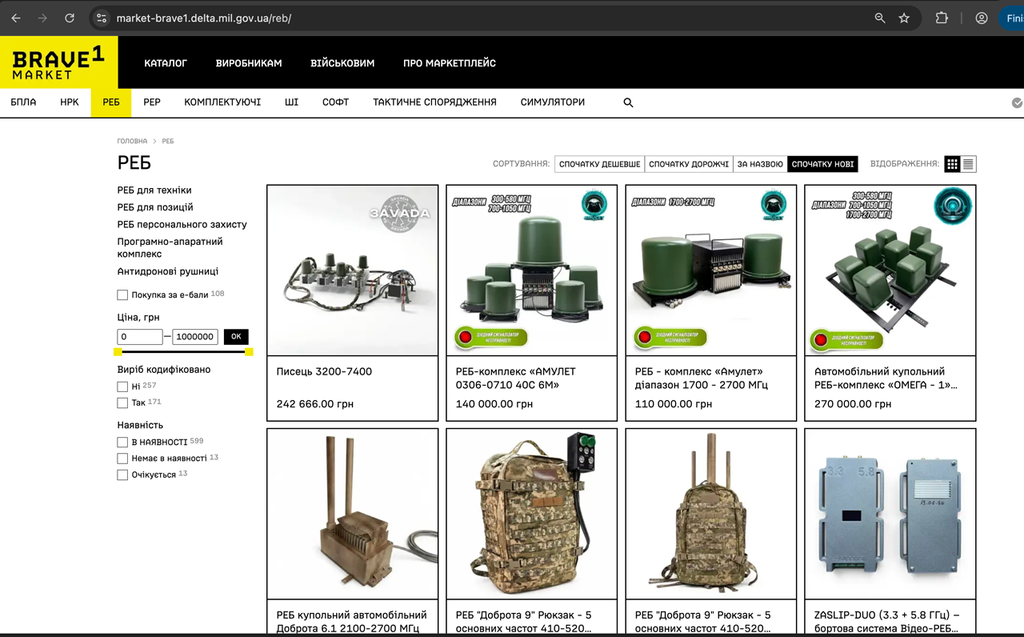
Perhaps the clearest expression of the group’s approach is Brave1 Market, the online military marketplace it operates. The website looks strikingly like a bare-bones e-commerce store, a menagerie of drones, electronic-warfare equipment, AI modules, software, tactical gear, and other hardware arranged in rows of product photos and prices. Soldiers can browse everything from tiny camera and drone components to jammers and complete aircraft. Think of it as Amazon for war.
Rather than having the Defense Ministry pick every system centrally, military units can select among competing products themselves. Manufacturers are forced to compete on price, reliability, ease of use, and battlefield performance. If soldiers don’t like one product, they can choose another.
By July 2026, Brave Market offered more than 4,000 items, and the Defense Ministry said equipment that was already in stock was reaching frontline units in an average of eight days, down from roughly two weeks. In June alone, units placed about 5 billion hryvnias, or $111 million, in drone orders through the system, according to Business Insider. Manufacturers can track how widely their products are being used, while soldiers can leave ratings and reviews.
Under its Electronic Points program, military units receive credits for verified battlefield results and can redeem them for additional gear on Brave Market. The incentives have since expanded beyond destroying Russian equipment. They can also earn points for using ground robots to carry cargo and evacuate casualties. By early August, Ukrainian troops had ordered more than 3,000 such machines through the marketplace, including more than 640 in July alone. “The supplies flow to those who most effectively use those supplies,” the Brave1 official puts it matter-of-factly.
But the system’s laxity can also create risks. In July, investigators carried out as many as 70 searches connected to Vyriy Industries, one of Ukraine’s largest drone manufacturers, as part of an inquiry into whether it inflated costs on nearly $157 million in government drone contracts and used shell companies to move money. Vyriy’s CEO denied wrongdoing and said the probe was an attempt to disrupt business operations; no charges had been announced at the time.
Still, scandals aside, the system has helped create something more than just a faster procurement process: an enormous, quickly iterating, startup-fueled domestic defense industry. That raises a different question. What happens to it if the fighting stops? The country’s defense industry has expanded feverishly since the war, with its annual production capacity growing from about $1 billion in 2022 to $35 billion by 2025. That leaves Ukraine with an industrial base built for a level of demand that will not necessarily last forever.
Michael Bohnert, an engineer and a defense researcher with the RAND Corporation, a security-focused think tank, worries about what happens to all that capacity afterward. Ukraine and Russia, he notes, have built enormous industries around drones and other relatively cheap, easily exported weapons. When the war ends, companies that have spent years making them may have neither the finances nor the incentive to pivot. “They’re going to have to sell somewhere,” he says. The result, he argues, could be a wave of battlefield technology flowing into smaller conflicts around the globe.
The Brave1 official views such a future through an entirely different lens. Ukraine has already begun cautiously opening its defense industry to foreign customers; in July, the government announced a framework allowing manufacturers to export weapons and parts while directing a share of the proceeds back into the country’s defense. When I ask what happens to Ukraine’s factories and defense-tech companies if a ceasefire is reached, he barely hesitates: “We rearm the world.”
AI enters the battlefield
Even as Ukraine builds a faster system for developing and buying weapons, another bottleneck is emerging: making sense of everything those systems are seeing. Drones, cameras, strike reports, logistics platforms, and battlefield sensors now produce enormous quantities of information. Increasingly, Ukraine is turning to AI not just to operate weapons, but to help humans decide what to do with all that data.
In March, the Defense Ministry created A1, a new center charged with putting artificial intelligence into practical use across the military. At the time of my visit to its Kyiv office, it is still staffing up even as it races to get new technology into the field. Our meeting takes place in a spare gray room whose drabness belies A1’s futuristic mandate.
A1’s director, Danylo Tsvok, cuts a contrasting figure: Clean-cut and dressed in a black polo and jeans, he has the practiced informality of a tech executive. When a photographer begins shooting, he notices the logo on his coffee cup and quickly rotates it out of view. Better to leave as little identifying information in the frame as possible.
Tsvok is not a career soldier. Before A1, he led an AI center inside Ukraine’s Ministry of Digital Transformation; when Mykhailo Fedorov moved from there to become defense minister, Tsvok and much of his team followed. He describes A1’s mission in four pillars: helping commanders interpret battlefield data, shortening the time between identifying a target and acting on it, making AI tools more widely usable across the military, and using AI to continuously improve various weapons.

A few months in, A1 is still more R&D shop than product catalog. But one of the center’s most ambitious projects, an AI platform for military decision-making called SPECTR, is beta testing across several military units. Designed to turn combat data into faster, more precise operational planning, the system allows commanders to ask about available resources, identify which equipment is most likely to work against a specific target, and receive a recommended course of action.
Eventually, A1 wants SPECTR to move beyond assessing the battlefield as it stands and begin rapidly predicting what the enemy is likely to do next. That ambition is part of a much larger one: Reuters reported in June that A1 ultimately aims to create a single operating system capable of recommending decisions from frontline units up through strategic command.
Moving AI from individual weapons into decision-support tools for commanders introduces a different set of concerns. Peter Asaro, a professor at the New School and cofounder of the International Committee for Robot Arms Control, distinguishes between AI-assisted decision-making and weaponry that chooses whom to attack. “An autonomous weapon is a system that automatically selects and engages targets without human supervision or meaningful control,” he tells me. But even when a human formally remains in charge, Asaro worries about how much real oversight is possible when ever more complex AI systems are generating targets or recommendations for commanders.
Not even a week after I meet Tsvok, however, the political foundation beneath the young center shifts. On July 15, Ukrainian President Volodymyr Zelenskyy dismisses Fedorov after just six months as defense minister, part of a broader government reshuffle. The firing brings into the open a bitter struggle over the direction of Ukraine’s military. Fedorov, who had pushed a data-driven overhaul of procurement and sought to shift more resources toward drones and other emerging technologies, publicly accuses Oleksandr Syrskyi, the commander in chief, of blocking reforms. The move prompts rare wartime protests in Kyiv and other cities, where demonstrators demand Fedorov’s return and Syrskyi’s removal.
Then, six days later, Zelenskyy fires Syrskyi, too, replacing him with Mykhailo Drapatyi, a younger battlefield commander associated with a more adaptive approach to the war. The upheaval doesn’t bring Fedorov back—he rejects an offer to take another government post—and the protests carry on for weeks. But neither does it amount to a rejection of the technological modernization Fedorov had championed. Drapatyi’s new command has continued to emphasize drones, robotics and other emerging technologies, while Yevhenii Khmara, a former special forces commander, takes over the Defense Ministry.
For A1, the shake-up is especially consequential. Fedorov had, after all, created the center and brought Tsvok and much of his team into the Defense Ministry. In a follow-up statement, Tsvok insists A1 will continue its work, but acknowledges the importance of having what he calls a “technology partner in the government” capable of steering the effort. “The war is not over,” he says.
“We’re fighting a war in a physical world”
For all Ukraine’s efforts to formalize this system, much of its advantage still comes down to something more basic: putting engineers close enough to the battlefield to see what breaks, talk to the people using their systems, and fix issues quickly. Few foreign founders have embraced that idea more literally than Brian Streem, founder of Vermeer, a company that builds vision-based navigation systems for drones.
Streem came to Ukraine because the challenge his company had spent years trying to solve had become critical to the war’s outcome. He has spent significant stretches of the past two years here, alongside a handful of the company’s 50-plus employees.
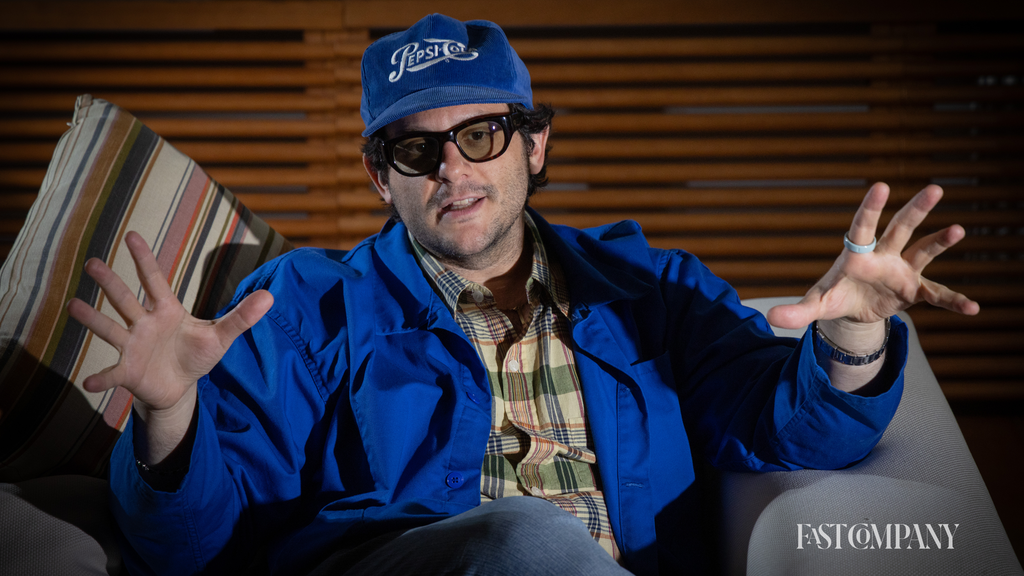
I meet Streem, who speaks with the unmistakable cadence of a native New Yorker (Queens, specifically), at a snug café in downtown Kyiv. Wearing a bright blue jacket and vintage Pepsi cap, Streem tells me that he recently tried moving back to the U.S. for several months, but he didn’t take to the respite. “I thought I needed a vacation,” he says. “But ultimately I was just bored to tears living in Manhattan.” Kyiv, he says, is simply more interesting.
Streem’s path into defense was circuitous. He produced independent films and commercials, then built a drone-cinematography company whose crews shot aerial footage for Hollywood productions. He began developing software to make those flights more precise. In 2019, a U.S. Air Force technology accelerator spotted one of his prototypes and suggested the military might have a use for it. Vermeer eventually received more than $7 million in Air Force funding.
Sitting in the courtyard, Streem recalls once thinking that producing movies was an unusually exciting career. He’s since revised that assessment. “Building guidance systems for missiles might give film producing a run for its money,” he says.
Vermeer’s main product is a visual navigation system designed to keep drones, missiles, and other unmanned systems moving when GPS is jammed or spoofed. (Morgan, the Ukrainian soldier, calls that kind of terrain-based navigation “a genuine game changer” and says his unit uses Vermeer on a range of missions.) Streem had been building versions of the technology for years when Russia invaded Ukraine. “The first thing to disappear was GPS,” he says, “the very thing I was solving.”
He had no real network in Ukraine, and his entry into the market was characteristically unsophisticated. “I just showed up in the war,” he says, and started cold-messaging people on LinkedIn who were talking about Ukrainian drones. One of the first strangers he contacted ultimately connected him to a customer that gave Vermeer a multimillion-dollar contract.
Streem describes his approach as partly a product of ignorance. More experienced defense executives, he says, knew how to hire lobbyists and work Washington. He did not. “I’m just naïve,” he quips. That naivete has since become a competitive advantage. American companies can test a drone on a range and say it works. Streem can point to systems that have been integrated with demanding operating conditions. “I have the goods,” he says. “I have the proof.”
That battlefield record has paid off commercially, too. Vermeer later raised $12 million, and The New York Times reported in 2025 that the Pentagon had proposed putting its navigation technology on new American deep-strike drones.
Streem is skeptical of some of the grander claims surrounding military AI. Companies are raising enormous sums to build what he calls an “orchestration layer,” in which large numbers of autonomous drones might sense what is happening around them, communicate among themselves and coordinate their actions. Streem thinks much of that remains further away than its boosters suggest. When I describe military AI as something of a Wild West, he proposes another term: “Fantasyland.”
The hard part, he says, is not nearly as glamorous. The neural network may be only a small piece of what it takes to make a system work in combat. You’ve also got to deal with vibrating cameras, for example, or overheated computers, or worse yet, airfields getting bombed.
“We’re fighting a war in a physical world,” Streem says. “This stuff is flying in physical reality.” He rejects the facile assumption that sufficiently sophisticated software can make those constraints disappear. “It’s not magic,” he says. “It’s complicated.”
“In a couple months, it might not even be usable anymore”
The next morning, a Vermeer employee I’ll call Clayton picks me up at an undisclosed location in Kyiv, wearing a faded gray T-shirt and dark sunglasses, and we head to a field test site. Clayton handles testing and integrations, which often means attaching the company’s AI systems to manufacturers’ aircraft and, at times, supporting Ukrainian operations in demanding field environments. His role, he says, is essentially “in-person tech support.”
Some of that work takes place in high-risk situations. On one trip, Clayton recalls, a Ukrainian commander offered a grim bit of gallows humor about the risks of working in a war zone: If a Russian attack drone found them, the officer told him, at least “you won’t feel anything.”
Today is much less dramatic. The test site is an unassuming patch of rough grass, with little to distinguish it as a place where military technology is being developed. Nearby drones produce a dissonant mechanical hum that seems to hang over the field. Underfoot, I can discern gossamer strands of fiber-optic cable threaded through the grass, remnants of earlier tests.
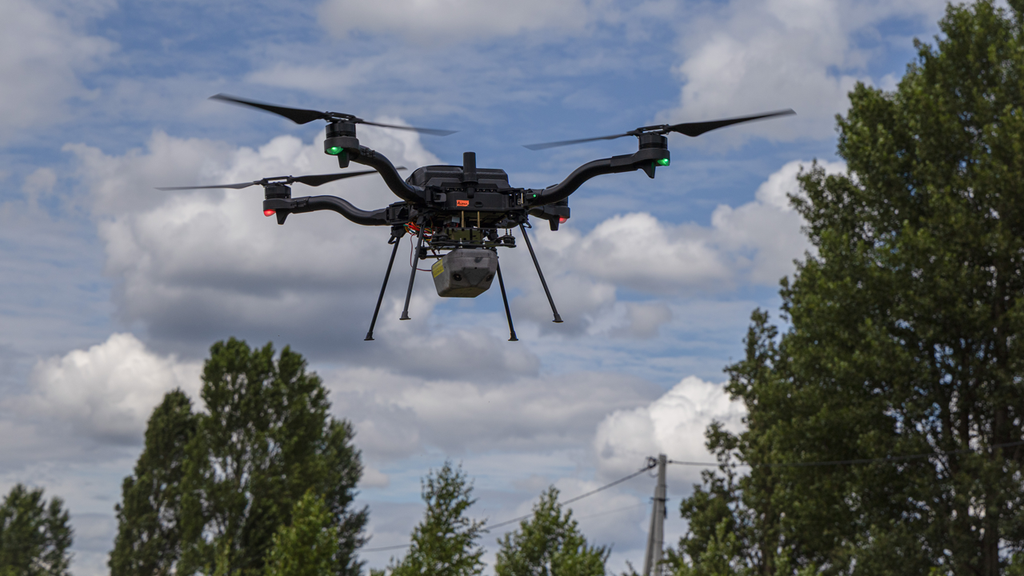
The Vermeer team unloads a squat black quadcopter, its wiring and electronics plainly visible, with the company’s boxy camera-and-sensor unit hanging beneath it. The farmland, creeks, and two-lane roads around us resemble the terrain Ukrainian aircraft often fly over. A few minutes later, the drone is buzzing overhead, whooshing through the sky like an insect built in a machine shop. It’s unsettling only because I’m keenly aware of how much violence has come to arrive with that sound.
The flight is deliberately mundane, a way to collect data before the software moves onto larger aircraft and more demanding tests. Sometimes, Clayton tells me, the threshold for a successful test can be considerably lower. Some experimental drones are flown with the expectation that they will crash, and engineers simply try to retrieve the readings before the hardware is destroyed. And sometimes the relevant question is just, “Did it fly?”
That tolerance for failure is the key to understanding a war as rapidly changing as this one. New drones and countermeasures can alter battlefield conditions within weeks, a pace Western militaries are trying to learn from even as their own development and procurement systems remain far slower.
Indeed, a company might spend weeks in the testing field identifying a problem and developing a fix, only to find that by the time it is ready, the circumstances it was designed for have already morphed. “In a couple months, it might not even be usable anymore,” Clayton says, “because the war has changed again.”
This reporting was supported by a grant from the Tarbell Center for AI Journalism.