
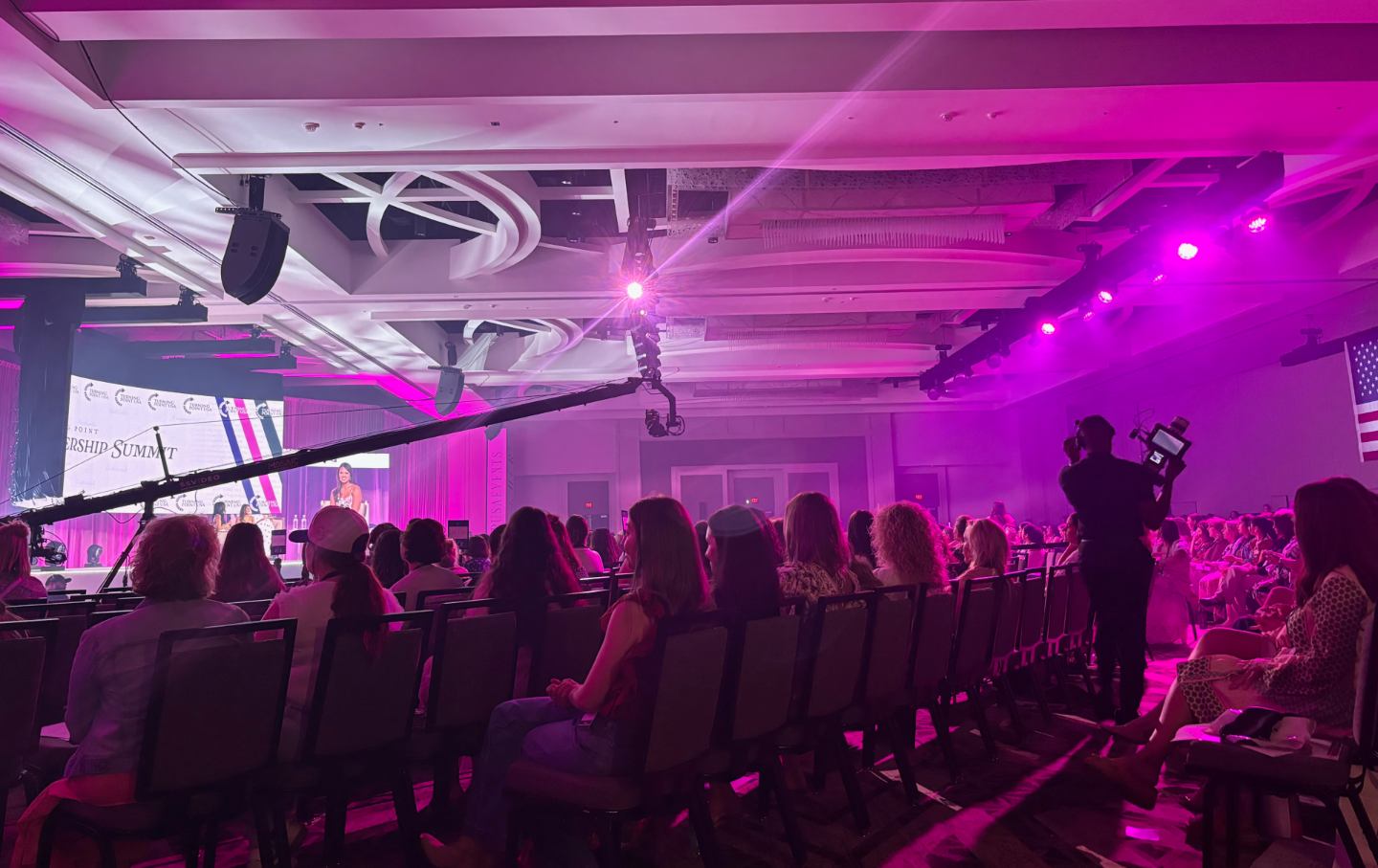
The mainstreaming of brazen sexism in the conservative movement left the attendees at Turning Point’s women’s summit looking for a soft place to land.
Turning Point USA’s 2026 Women’s Leadership Conference in San Antonio, Texas.
(Amy Littlefield)
Two jets of pink smoke erupted on either side of the stage in a San Antonio hotel ballroom as the Christian wellness influencer Alex Clark strode to the podium in a filmy white dress. Behind her a screen displayed the words “faith over feminism” in cursive. The conservative organizing network Turning Point USA had kicked off its first annual women’s leadership summit since the group’s cofounder Charlie Kirk was fatally shot last year, and Clark was about to give some of Kirk’s offensive words about women a makeover.
Clark queued up video of a viral moment from last year’s conference. Sitting on stage with his wife, Erika, Charlie Kirk had lectured the 3,000 young women present to focus on finding a husband. “If you’re not married by the age of 30, you only have a 50 percent chance of getting married, and if you don’t have kids by the age of 30, you have a 50 percent chance of not having kids,” Charlie pronounced, and Erika interjected, sweetly, “To add on to that, to the women who are getting married after 30, that’s OK…. God is good.” This year, about 2,000 people, most of whom didn’t raise their hands when asked if they had attended last year, sat watching this video. The word “young” had been dropped from the conference’s title and many of the attendees were well over 30. Some of them laughed appreciatively at Erika and Charlie’s rapport, as if they were watching their mom gently chide their dad.
Then Clark got serious. She said Kirk’s words last year had hurt because she herself is in her early 30s and still unmarried. “I’ll be honest, I was sitting in the audience, and it stung a little bit,” she said, and the titters of laughter ceased. “But I also knew Charlie.” Because even though Kirk could be a little direct, he wasn’t wrong about the statistics on marriage, Clark went on to say. “They’re actually worse,” Clark breathed.
Clark went on to advise her fellow single ladies on how to have a “God-honoring single season,” a time when young women were free to have a career and buy as many throw pillows as they wanted while waiting for a husband.
For at least some of the women present, there was an edge of hurt to reliving this moment. Ann Dailey Moreno was in the audience last year, unmarried, and 28. She’d been so upset by Charlie’s words that she started to cry right there in her seat. “I was like, ‘Oh, I’m not welcome,’” Dailey Moreno told me, choking up again at the recollection. “That was disgusting. I’m sorry. I love Charlie Kirk but that was not the right thing to say.”
She wasn’t alone in feeling offended. “Literally not every woman has kids,” Roselle, 26, and president of the Turning Point chapter at her California state university, agreed. “Like, they either can’t have kids, or they might love kids, but their job takes them elsewhere.”
“I agreed with all the women that kind of criticized him,” she added.
There are moments when the misogyny that animates the conservative movement becomes so visible that even the women who help power that movement can’t stomach it. We are in such a moment now. The mainstreaming of brazenly sexist influencers like Nick Fuentes; the young men chanting, “Your body my choice,” the naked pro-natalism of the Trump administration’s Moms.gov website; and yes, attempts to revive a 1980s-style marriage panic have driven young conservative women to the left. The number of women ages 18–29 identifying as liberal has surged in recent years, creating a widely noted gender gap between these women and their male peers. Even Charlie Kirk, all but sanctified by his martyrdom, was being gently rebuked for sexism at his own organization’s summit. “Charlie and Erika were the perfect combination, because Charlie could come off a little blunt,” Clark said from the stage to a round of appreciative laughs, “and Erika was always this sweet, soft-spoken one, who could tie up everything in a really nice bow.”
Current Issue
The solution? Those sweet, soft-spoken women were going to have to deliver the word. In Kirk’s absence, women at the conference were rebranding the same message—feminism is evil, marriage and God are good—in more relatable form, with sizable doses of MAHA, and just a hint of spice flaring between the Trump administration and the MAHA moms. Erika Kirk was the poised figurehead, the Christian mom under siege by the violent left as she defended the right of women to be feminine.
“At its core, feminism is a worldview that treats many of the things that make women uniquely women as obstacles to overcome rather than divine gifts to embrace,” Kirk declared, as she kicked off the conference. But while Kirk now leads Turning Point, she was scarcely present at the summit beyond her opening speech. Instead, the face was Clark, who joined Turning Point in 2019 as host of a pop-culture podcast and now hosts the conservative wellness show Culture Apothecary. She’s built an audience of “crunchy” conservatives by blending warnings about microplastics and mouth-breathing with bizarre claims about how hormonal birth control can make you “falsely” bisexual.
Thanks largely to Clark’s curation, this was Gen Z conservatism dipped in a buttery vat of MAHA. In the exhibit hall, mixed in the Christian right’s typical fare—booths set up by policy shops like the Heritage Foundation, anti-abortion groups like 40 Days for Life, and Christian education institutions like Hillsdale College—were displays advertising prenatal vitamins, toxin-free toothpaste, organic makeup, wheat mills, blue-light-blocking glasses, and seasoning made from cow brains. Women in floor-length skirts stood shaking violently side-to-side on vibration boards intended to burn calories and reduce joint pain. The Let Freedom Bling Boutique sold sequin tank tops; the Stacked with Purpose booth peddled bracelets that would unlock your “prophetic identity”; the XX-XY athleticwear company was raising money to help athletes who defend women’s sports—by keeping trans women out.
I was offered a sample of guava-grapefruit-flavored electrolytes. It was delicious. I bought a box of PFAS-free dental floss, just to see if it would stick in my teeth. It didn’t. I was encouraged to host a discussion on taxes or education with my friends, “like a book club, but for policy.” I grabbed a sticker depicting Rosie the Riveter flexing alongside the words “Voting is My Superpower,” a brochure on biblical femininity from the conservative alternative to Girl Scouts, a postcard from Students for Life that read “Will You Go Green?” and, on the back, warned of the dangers of contraception. A purveyor of bread mills told me that their products could cure my Celiac disease. The man hawking the tins of cow organ dust told me it would be a good way to reintroduce meat into my vegetarian diet. Later, I turned down the opportunity to do group Pilates because I was in a dress; I’d followed the official conference “look book,” which was heavy on florals and cream.
Without feminism to turn to in the face of misogyny, the women present were finding sisterhood through grievance with the woke left (especially the trans women they saw as threatening to womanhood), personal health optimization (for longevity and fertility), and a softer version of the same message about marrying young and having babies.
The mainstage speakers showed the range of femininity that the modern conservative movement would endorse: There were political figures like Arkansas Governor Sarah Huckabee Sanders and marriage influencers like Savanna Stone, who believes women shouldn’t have the right to vote. The speaker’s messages about women’s roles ranged from the biblically literal to the feminist-adjacent. Millicent Sedra, a Christian influencer from Australia who casually denied evolution from the stage, told women to stop complaining about being “servants” to their husbands and to “start serving with gratitude.” On the other end of the spectrum, Students for Life president Kristan Hawkins talked about the challenges of working 15 hours a day and how she found the linen-wearing, sourdough-baking “trad wife” influencer image unattainable. What unified these speakers was their urgent warning to steer clear of feminism, an ideology that not all of them seemed well versed in.
“Allow me to share with you some quotes from our feminist icons,” Savanna Stone said dramatically, before reading off a quote about abolishing the nuclear family from a feminist icon she called “Shula Smith Firestone.”
There were pyrotechnics and stickers cut to fit the sides of the escalator and the hotel’s columns and windows that spelled out the title of the conference: “Curated for H.E.R.,” which stood for Holistic, Empowered, Redeemed. There were illustrations showing Clark and former competitive swimmer Riley Gaines—who has built an influencer career on outrage at having to compete against a trans woman—as paper dolls, complete with accessories, a dumbbell for Gaines, heels for Clark.
There was drama: Conservative radio host Dana Loesch’s rapid-fire reading of Bible verses about the need to defend widows was a subtextual rebuke of podcaster Candace Owens, who has been telling her millions of followers that Erika Kirk killed her husband.
Erika met Charlie in 2018 when she interviewed for a job at Turning Point, during which he looked at her and declared, “I’m not going to hire you; I’m going to date you.” Now, she stood on stage alone as the heir to her husband’s career. Her shining moment came when a protester interrupted her to shout, “Erika Kirk protects pedophiles!” before spraying a container of urine on a security guard. As if she were expecting it, Erika calmly responded, “It’s important to remember that happiness comes and goes, and I pray that you find it.”
While the reference to “pedophiles” seemed to come from the swirl of conspiracy theories promoted by Owens, the interruption only heightened the sense among attendees that they were under siege by a violent left that wanted them infertile and in cubicles. Their left-leaning coworkers and friends were “canceling” them. And outside the hotel, more than 100 activists rallied to protest the gathering, wielding signs that read “Pro-life is a lie if you don’t care when people die” and “San Antonio will not stand with Turning Point USA and their racist, hateful, transphobic rhetoric.” Some of the protesters clashed with police and engaged with right-wing content creators, helping to gin up a sense of camaraderie inside.
“These women have really inspired and empowered me,” Caitlin Watters, an attorney from Tucson whose husband paid for the conference as a Mother’s Day gift, told me, as she sat drinking a glass of white wine with new friends. “Seeing the protests outside inspires me more.”
The protests were a reminder that this was in fact a political conference, although explicit mentions of politics were few and far between. There were stickers that read “No Voter ID, No Vote” over a picture of a pink envelope sealed with a lipstick kiss. There was a touchscreen with a map of the United States that scored states on a “tyranny” scale—although the young woman leading the demonstration, who described herself as one of four staffers who run the scorecard, couldn’t find my home state on the map.
“Where is that?” she asked as I pointed to Massachusetts.
But Alex Clark understood the political power of what she was doing. Her Saturday afternoon panel with Riley Gaines, called “How to Be Brave,” drew a capacity crowd; outside, an attendee who couldn’t get in wept openly. Gaines and Clark each offered a glimpse into tensions between the Trump administration and two key factions of his base—Christians and MAHA. Clark had drawn the ire of the Trump administration for rallying her base of “crunchy” moms against policies that shield pesticide companies from lawsuits.
“I was getting uninvited by the White House,” Clark said. “Erika [Kirk] was getting lots of phone calls, like ‘How are you going to shut up Alex Clark?’” But the MAHA moms claimed a win when a pesticide liability shield was stripped out of the federal farm bill, and Clark has continued to slam federal agencies for their lax regulation of pesticides.
“The president has some people around him that I believe are giving him bad information, and so when I come out with these criticisms, it’s not because I’m attacking the admin; it’s because I want us to freaking win,” Clark proclaimed. “I want us to crush in midterms; I want us to crush in 2028, and I believe that MAHA is the way that we can get there.” She went on, “My job, first and foremost, is to keep the MAHA moms happy and enthused, and that they feel like they can trust us as a party, because MAHA moms are not beholden to the Republican Party.” Indeed, Clark’s followers, who want a life free from pesticides and vaccines, voted for Trump hoping he would help detoxify their food, only to watch him sign an executive order protecting the pesticide glyphosate as crucial for national defense.
Gaines offered her own heavily moderated critique of the Trump administration, saying that while she agreed with “99.5 probably percent of things” the administration was doing, she had publicly objected when Trump’s social-media account shared an AI-generated image that seemed to show him as Jesus. Trump shot back that he was “not a fan” of Gaines.
“What’s not to love?” Gaines said during the panel, laughing it off.
The young women I spoke with seemed grateful to see speakers like Gaines and Clark offering them a way to remain conservative without completely forgoing their ambitions.
“I think a lot of, like, the Christian evangelical movement really focuses on a woman’s value being determined by their marriage and being determined by how many kids they have, and sometimes that movement is also very anti-career, so that’s just not something relatable for a lot of people,” Zuriel Balares, a junior at UC Riverside, told me.
Clark had offered “evidence that, like, oh yeah, you can, you can have both.”
“Am I contributing to feminism by going to work?” another attendee, UCLA student Ireland Daniel, had been wondering, before this weekend. “Am I doing the wrong thing by going into politics as a woman?” She felt reassured by the conference that it was OK at least for now to pursue her next career step— as a field organizer for Turning Point.
On the second evening of the conference, Alex Clark stood in front of a ring light posing for photos with her fans. The line to meet her snaked around the foyer and down a hallway. A camera crew revved people up to cheer.
One of the women standing in line was Nikki, a 25-year-old nurse from Illinois. “I really like Alex’s podcast, and I feel like she’s changing a lot of lives,” Nikki told me. “I’ve been eating healthier and making healthier food choices, buying organic foods, and decreasing toxic beauty products, so I don’t have fragrances in my products anymore, because of the show.”
MAHA followers as young as 19 had packed into a session at eight o’clock that morning called “Built to Thrive: Optimizing Your Hormones, Fertility, and Metabolism at Every Life Stage.” It was presented by Geviti, a blood-testing company that sells supplements and AI analysis of your biomarkers; an annual membership costs $1,529.
Most of the women I met were raised in conservative Christian homes, but a few described coming to the conservative movement later in life after getting disillusioned with “wokeness.” Ann Dailey Moreno—the woman who cried in response to Charlie Kirk’s words on marriage last year—had been living in New York City studying theater in 2020 during the Black Lives Matter protests and Covid lockdowns. She had voted for Hillary Clinton in 2016 but was dabbling in conservative content and felt judged by her liberal friends. “If you’re gonna call me white supremacist just for, like, listening to Candace Owens’s podcast about Black Lives Matter, or whatever, first of all, she’s Black, that doesn’t make any sense,” Dailey Moreno told me. “I wasn’t even sold on voting for Trump in 2020. I was questioning it, and just for questioning it, and starting to ask people…the response I got, is… well, if you’re considering it, if you’re questioning this, you’re a white supremacist.”
Popular
“swipe left below to view more authors”Swipe →
Dailey Moreno still hadn’t swallowed the whole conference package. She wasn’t sold on the MAHA messaging and still took ADHD medication, even if Alex Clark opposed it.
The night before, Dailey Moreno had watched as Clark told women like her how to spend their single season while waiting for a husband. Clark had been spending her waiting season listening to podcasts about baby formula, parenting philosophies, sleep training… and then came the final reveal. The lights went dark. Music rolled. A photo appeared on a screen of Clark embracing her surprise fiancé, a fellow butter enthusiast named Vance Voetberg whom she had managed to keep off her social media until now. She extended a hand with a ring and there was the sparkling message: Ladies, you can have it all.
Dailey Moreno felt happy for Clark, even if the kicker had kind of undermined the message.
“The whole speech was about it’s okay to be over 30 and not married, and then she ended it with, like, ‘I’m getting married,’” Dailey Moreno said. “It’s like… great.”
Dailey Moreno, still unmarried at 29, felt caught between a left that she felt expected her to have a glamorous career by now and a conservative movement that wanted her married by 30.
“This is, like, the Women’s Leadership Summit,” she said, “and I still don’t feel like I can have it all.”
With the midterm elections now firmly upon us, the question is whether Democratic candidates will do more than merely occupy ballot lines as mild alternatives to the red-hot crisis that is Donald Trump.
As Trump spends over $1 billion a day on a globally destabilizing war on Iran and admits that he doesn’t “think about Americans’ financial situation,” millions across the country are struggling with the surging costs of essentials. Democrats must seize this moment and advance bold, small-“d” populist ideas—not settle for cynical caution that once again snatches defeat from the jaws of victory.
The Nation elevates progressive ideas, movements, and elected officials achieving real change across the country into the national conversation. At the same time, our journalists are exposing how crypto and AI-funded super PACs are spending hundreds of millions of dollars to knock out candidates they oppose, reporting on the devastating impact of the Supreme Court’s evisceration of the Voting Rights Act, and sounding the alarm on attempts by red states to quickly redraw electoral maps, disenfranchising Southern Black voters.
We can play this critical role because of support from readers like you. This June, we’re raising $20,000 to power The Nation’s independent journalism in the run-up to November’s immensely consequential elections.
It’s in our power to build a more just society, and your support at this critical moment brings us closer to that bold vision. I hope you’ll donate today.
Onward,
Katrina vanden Huevel
Editor and Publisher, The Nation
More from The Nation

Todd Blanche might be the most craven attorney general yet. Thankfully, he’s also incompetent.
Don’t let Trump’s blowup on NBC’s Meet the Press distract from what he actually said.