

Despite what Timothée Chalamet may think, the Metropolitan Opera’s production of Richard Wagner’s epic Tristan und Isolde is generating a lot of buzz this season.
That’s thanks in no small part to director Yuval Sharon’s bold choices, which include cutting-edge video projections and an immersive set design by Es Devlin.
Sharon believes it is necessary to be forward-thinking, especially since the arts are facing a hard economic reality. He also believes it’s what helped drive the production’s impressive ticket sales.
“People all saw that there is something new is being attempted here that you’ve just got to see,” he tells Fast Company. “I think that is its own reward.”
In an era where New York’s storied Met Opera has faced layoffs, pay cuts, postponed productions, and a controversial financial agreement with Saudi Arabia, Chalamet’s comments, while dismissive and disrespectful, may have a kernel of hard truth in them.
According to reporting by the New York Times, declining ticket sales are part of the problem, down $20 million in 10 years. And live performances are not the only ticket revenue dwindling—live broadcasts of opera in movie theaters are down as well.
Because of high production costs, opera cannot survive on ticket revenue alone. Companies such as the Met also rely on investment endowments. Unfortunately, the Met has also depleted its endowment by one third, dropping from $340 million in 2022 to $212 million today, the Times reports.
Sharon is aware of this budget crisis but also views it as an opportunity.
“The business of opera is ludicrous, and we’ll never make money . . . That’s kind of part of the deal,” he says. “But part of that also means it’s about the experimentation. And for me, that is so liberating.”
“The storytelling needs to demand it”
It seems only natural to push the boundaries of technology to further innovate opera. To its diehard fans, the over-400-year-old art form is not dying but progressing forward, no matter what outsider Hollywood movie stars say.
Because of opera’s long history, integrating elements such as prerecorded and live video into the mix opens up a larger discussion about the role of technology in live performance.
Both Sharon and Devlin believe if Wagner were alive today, he would have approved, and perhaps would have even worked in VR or cinema himself.
“I think he would absolutely have wanted us to work with the most advanced means of creating magic, of transporting an audience to another time and place,” Devlin says.
Sharon considers opera a “constantly evolving language, not something that is stuck in the past” but “something that’s always ever present.” He views his job as the director to help articulate its universal message to a modern audience.
“I’m not changing a word, but something new has emerged from it based on who we are as 21st-century artists making it,” he says. “I just love that. It’s part of what makes me believe in the art form so much.”
His interpretation of Tristan und Isolde utilizes a split-world concept. Actors dressed in contemporary clothing at a table act as a bridge or tunnel into the mythical world of the story.
“The mythic still is always churning in our everyday contemporary lives in ways that maybe we are not always conscious of,” Sharon says. “Sometimes in everyday rituals of sitting at a table, we are unconsciously enacting memories from the mythic past . . . they’re with us in these ways that we don’t necessarily anticipate.”
He views the opera as a kind of solemn rite, with technology being just another tool on this larger mission.
“I don’t come into a project saying, ‘Well, of course I’m going to use video because I like using video.’ The storytelling needs to demand it,” he says.
In the story, the overwhelming and sudden love between Tristan and Isolde causes the characters to question their reality, making video the perfect medium.
Devlin’s set, designed as an end-to-end immersive system, gives Sharon’s vision an ideal playground.
Not only does it act as a platform for projections, but this is the first time that a set will fill the full square of the proscenium on the Met’s main stage at Lincoln Center for the entire production.
“Often when you work at the Met Opera, you will work in the bottom two-thirds of the picture in a rectangular orientation,” Devlin says. “But we are working with the full square throughout—right up to the edge of the proscenium.”
Utilizing the whole space was a goal of hers since working on Verdi’s Otello in the same space in 2015.
The existing architecture of the building acted as one of her inspirations.
“The Met is this extraordinary selection of shapes . . . the stage sculpture feels very continuous with the sculptural architecture of the design of the interior of the building, which is incredibly beautiful,” she explains.
Beyond its expansive size, the set supports the cast, who are singing a beautiful but notoriously difficult score.
“We’ve designed the set in such a way that it’s a musical instrument,” Devlin says. “We’ve designed literally a series of megaphones around them.”
Striking the right balance for humans
Both Sharon and Devlin believe technology is a tool that needs a human element, while Devlin says she hopes the innovative use of video projections draws in fresh spectators.
“If including some contemporary means of storytelling brings a new audience to the work, then that’s fantastic,” she says.
However, Sharon wasn’t afraid to cut technological elements when they overwhelmed the human performers.
“Before the singers come in, it’s like an art installation,” he says. “And then the singers come in and then you realize that, well, actually we need to tone it down to such a degree that the singers are still at the center.”
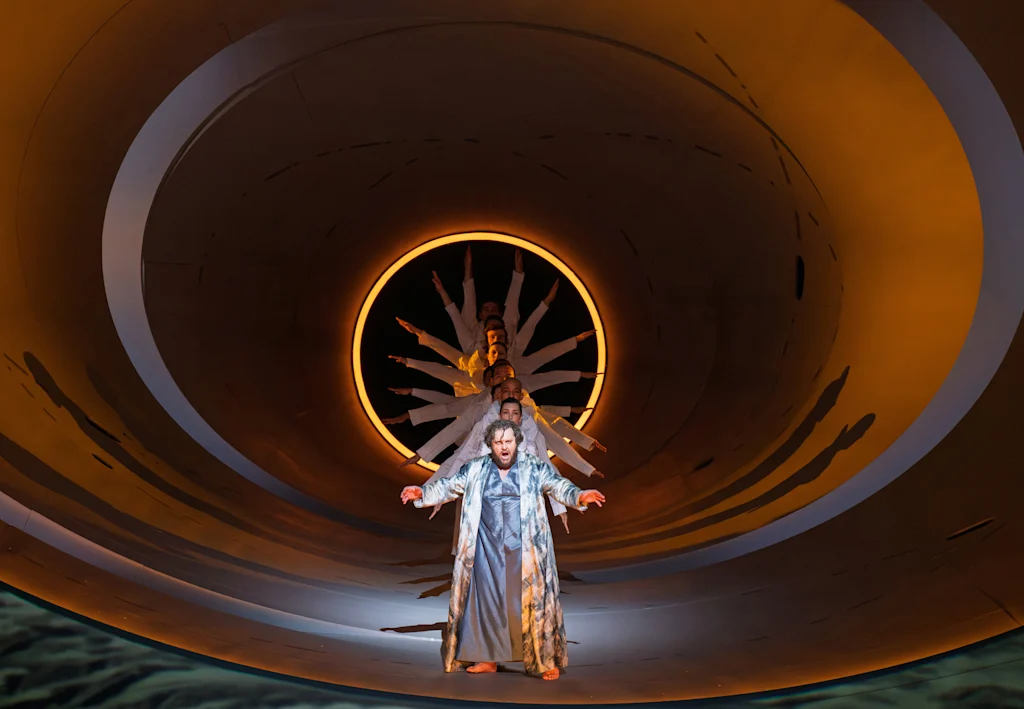
While the opera is larger-than-life, Sharon wants to showcase intimate human moments.
He couldn’t say enough good things about the cast, featuring Michael Spyres and Lise Davidsen in the title roles, which he called “the greatest cast I think that’s ever been assembled for this opera.”
“A big part of my job is also supporting and being there to make sure that singers can give the very best performance they can,” he adds. “And if there’s a stumbling block in their way, I have to remove it.”
In the end, Sharon firmly believes that opera is still for everyone. In fact, he literally wrote a book on it.
Audiences outside of New York City can catch a filmed live performance of Tristan und Isolde on March 21 through the Met’s “Live in HD” program. After the experience, you can decide for yourself if opera is alive and well in 2026.