
Marks & Spencer is one of the latest U.K. high-street brands to launch a skiwear collection. Even supermarket Lidl is in on the action, with items in its ski range priced at less than 5 pounds (roughly $6.75). This follows earlier moves by fast-fashion retailers such as Topshop, which launched SNO in the mid 2010’s, and Zara’s imaginatively titled Zara Ski collection, which launched in 2023.
Fast-fashion brand PrettyLittleThing’s Apres Ski edit (a collection of clothes chosen for a specific theme) tells potential shoppers that going skiing is “not necessarily essential,” which is good, because many of the products in the collection are listed as athleisure, not sportswear.
It’s not just the high street. Kim Kardashian’s shapewear brand Skims has recently collaborated with the North Face and has dressed Team USA for the 2026 Winter Olympics—though these are strictly designed to serve the athletes during downtime, not for the piste.
Alongside dedicated skiwear lines, the apres-ski aesthetic has become a recurring seasonal trend over recent years, expanding well beyond the slopes. You may have noticed the slew of ski-themed sweatshirts across the market. One of these, an Abercrombie & Fitch sweatshirt, went viral in January after a buyer noticed that the depicted resort was actually Val Thorens, France—not Aspen, Colorado, as the text printed on the garment claimed.
It is not only the quality of ski-themed fashion products that is a cause for concern, but also those designed for the slope. Many of these high-street collections have received criticism from consumers, with some claiming that the garments are “not fit for purpose.” Meanwhile, many influencers have taken to social media to warn their followers to avoid skiing in garments from fast-fashion brands. Such were the complaints that Zara Ski reportedly renamed its products “water resistant” instead of “waterproof.”
These collections respond, in part, to a genuine need for women’s sportswear that is practical, fashionable, and, most critically, affordable. Ski and performance wear in general is costly, and such collections being both fashionable and relatively low-cost make for an attractive prospect. And yet, if these garments are so poorly suited to skiing, then what are they for?
The visual allure of skiing
Despite sports playing a key role in challenging gender ideology and perceptions of female physicality, the perceived importance of femininity and how women look while doing sports has lingered. Images of sportswomen frequently fixate on gender difference and femininity is foregrounded over athleticism. Here, the glamorous image of skiing has much to account for.
Glamour relies on distance and difference to conjure a feeling of longing. For many, the novelty of eating fondue at 3,000 feet is out of reach, as is the ever-increasing price of a lift pass.
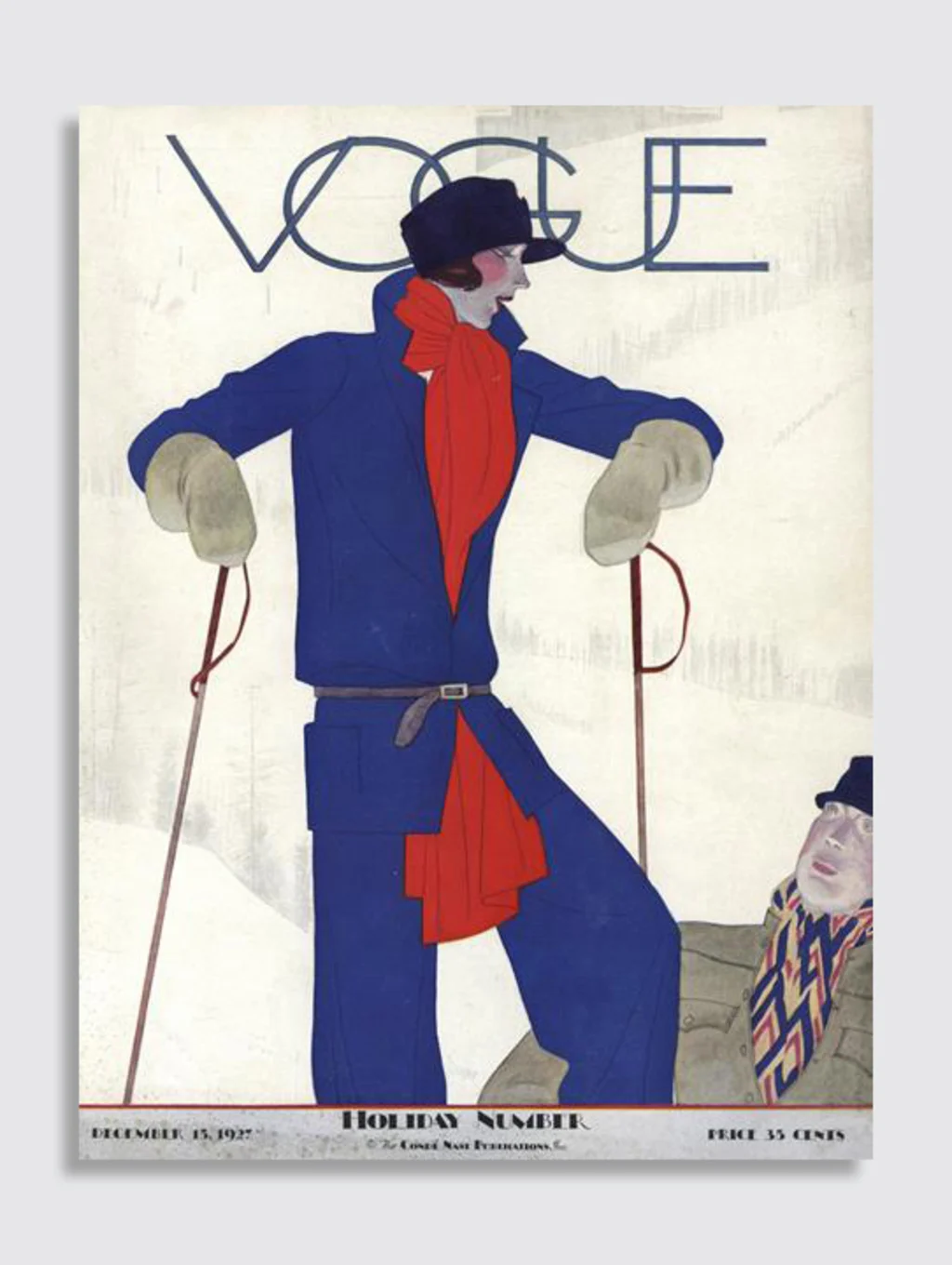
Throughout the 20th century, the glamour of skiing has been defined by women’s fashion. In the 1920s, Vogue magazine featured illustrations of elongated skiing women on their covers. Designer Pucci’s aerodynamic one-piece ski suit premiered in Harper’s Bazaar magazine in 1947, while Moncler’s ski anoraks—photographed on Jackie Kennedy in 1966—gave birth to a vision of American ski “cool.” Changing ski fashions were recorded in photographer Slim Aarons’s resort photography, capturing the leisure class on and off piste between the 1950s and 1980s.
Women’s fashionable skiwear has taken many forms since the activity first became popular in the 1920s. It was during this decade that skiing became a marker of affluence. Leather, gaberdine, fur, and wool were popular materials in early women’s skiwear and were selected for their natural properties; water-repellence, insulation, breathability.
By the mid-century, women’s skiwear became more focused on silhouette and excess fabric was considered unfeminine. Equally, skiwear gradually became more colourful, and in the fashion press women were even encouraged to match their lipstick to their ski ensemble. By the 1980s, skiwear aligned with the fashionable “wedge” silhouette; causing the shoulders of ski jackets to widen and salopettes (ski trousers with shoulder braces) to draw even tighter.
These historic developments parallel today’s aesthetic ski trend where fashion and image arguably comes before function. For example, PrettyLittleThing’s models are photographed on fake slopes, holding vintage skis. The glamorous image of the skiing woman lies not only in the clothing but in her stasis. The suggestion is that ski culture does not necessarily require skiing at all: It may simply involve occupying the most visible terrace, Aperol in hand.
No wonder then, that so many fast-fashion ski lines for women are deeply impractical—they appear designed less for physical exertion than for visual consumption. They sell women on the alluring glamour of skiing, while leaving them out in the cold.
There is an additional irony here: Climate change means that skiing is becoming increasingly exclusive. Lower-level resorts are closing as the snow line moves up, meaning fewer options and increased demand. In this sense, the image of skiing looks to become even more glamorous via increasing inaccessibility and therefore distance. Fast-fashion has a negative impact on the environment, and the ski aesthetic risks damaging the very thing it claims to celebrate.
This article features references to books that have been included for editorial reasons, and may contain links to bookshop.org. If you click on one of the links and go on to buy something from bookshop.org, The Conversation UK may earn a commission.
Tamsin Johnson is a PhD candidate in visual cultures at Nottingham Trent University.
This article is republished from The Conversation under a Creative Commons license. Read the original article.