

“Houston, we have a problem.”
The misquoted phrase is so ingrained in popular culture that it has become the standard comeback to any unexpected mishap. It’s also the last phrase NASA’s Artemis II mission control wants to hear in the coming days because, unlike those of us on Earthly terrain, an astronaut midway to the moon won’t be muttering it after they accidentally burn their toast.
A four-person crew took off from Kennedy Space Center in Florida on April 1 for NASA’s first lunar flyby since Apollo 17 in 1972. The organization has done everything it can to ensure the safety of the astronauts, knowing that any harm to the courageous humans could set its lunar program back many years, or cancel it altogether.
One part of its insurance policy is a new space suit that’s designed to sustain the Artemis II crew for six days—enough time to go to the moon and back—in case there’s a catastrophic event in their Orion spacecraft.
A lifeboat in a space suit
When Jack Swigert, command module pilot of Apollo 13, radioed “Houston, we’ve had a problem here” on April 13, 1970, an oxygen tank explosion had just severely damaged the spacecraft just 56 hours into its journey to the moon. The astronauts on board couldn’t simply pull a U-turn 200,000 miles away from Earth.
And since they didn’t have enough oxygen, Swigert, along with commander Jim Lovell and lunar module pilot Fred Haise, abandoned their crippled spaceship and hunkered down inside the lunar lander, using it as a makeshift lifeboat for the harrowing trip home.
But the Artemis II mission—a roughly 10-day loop around the moon—flies without a lunar lander. If the Orion capsule’s hull breaches for any reason and vents its breathable air into the void, the crew has nowhere else to go. NASA’s answer was to build a lifeboat of sorts directly into their suits.
For this return to the moon, the space agency assumed such a leak could happen and they needed a last line of defense to keep the crew alive in a vacuum for a week. The suit gives astronauts a 144-hour survival window, the exact time required to abort a translunar flight, whip around the dark side, and coast back home.
How it’s made
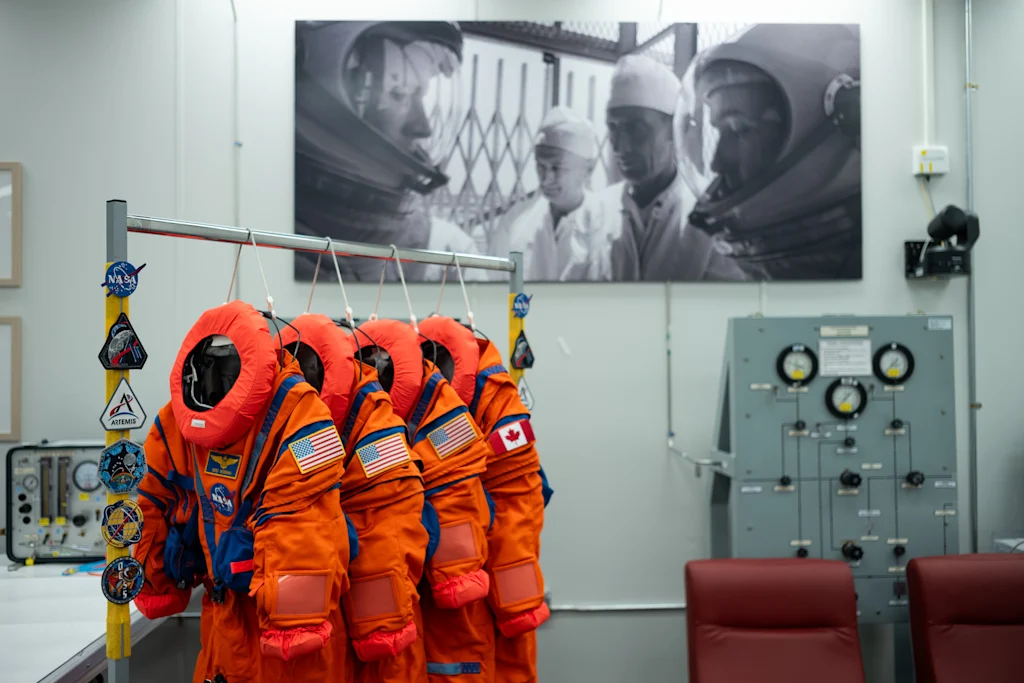
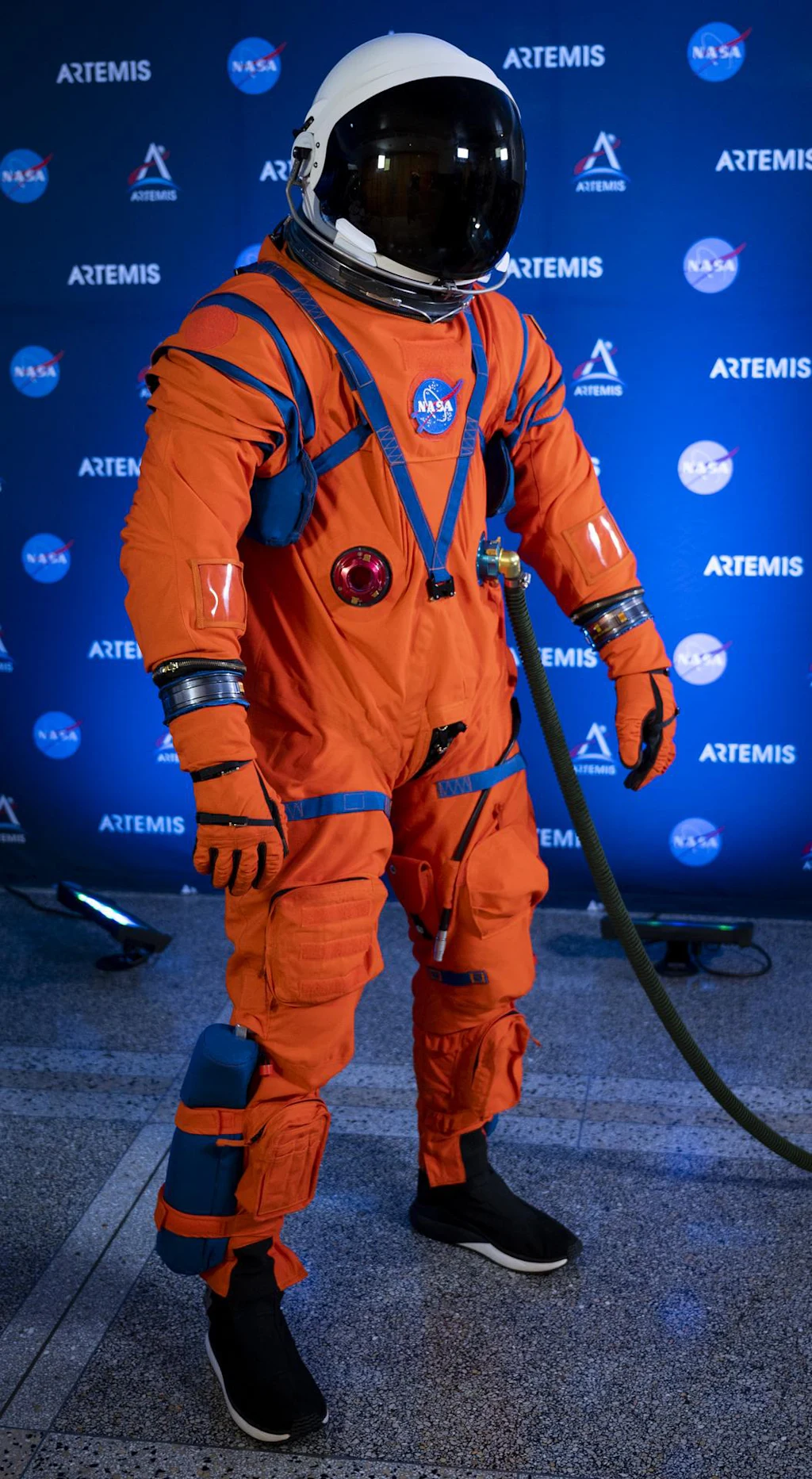
The aptly named Orion Crew Survival System (OCSS) serves as this wearable sanctuary. According to the agency’s Crew Systems branch, “the suits can keep astronauts alive for up to six days if Orion were to lose cabin pressure during its journey, with interfaces that supply air and remove carbon dioxide.”
Dustin Gohmert, a mechanical engineer who worked on Space Shuttle garments before taking over the OCSS program at the Johnson Space Center, notes that the gear operates as an independent vehicle. “They become your own personal-sized spacecraft that can last up to six days,” he told CBS News.
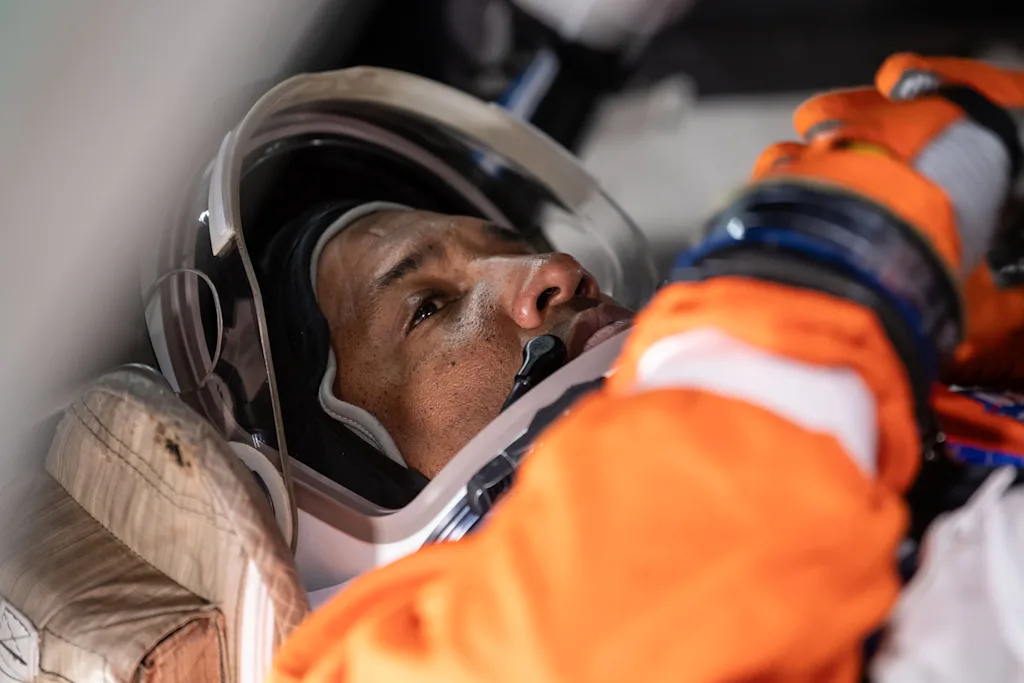
A NASA lab tour details the concept: “In effect, the space suit is a body-shaped balloon that holds your personal atmosphere,” strictly for use inside the ship. The suit plugs directly into the Orion capsule’s Environmental Control and Life Support System (ECLSS) via a thick umbilical cord. This artificial artery keeps the astronaut from overheating by pumping chilled water through an undergarment. Simultaneously, the capsule acts as a mechanical lung that regulates humidity, scrubs out deadly carbon dioxide, and forces a breathable nitrogen and oxygen mix into the helmet.
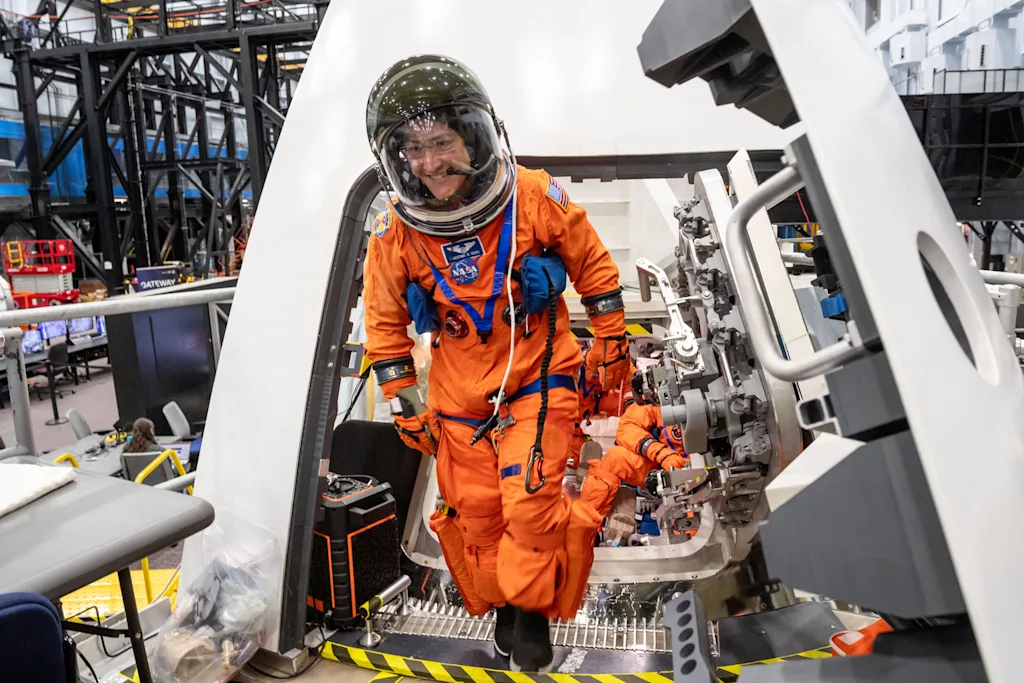
Astronauts eat and take medicine inside the sealed balloon using a pass-through port built into their rigid helmet dome. They snap pouches of liquid food and water right into this valve. If someone falls ill during the six-day ordeal, the ship’s medical kit includes a specific tool that shoves pills through the same helmet port without venting the suit’s precious pressure.
Each suit is meticulously tailored to the individual wearer and paired with custom-molded, shock-absorbing seats for launch and reentry. The suit also features a pleated fabric design hidden in the shoulders that unfolds when pressurized, giving the arms enough clearance to move. The gloves are spun from rugged materials that interact flawlessly with Orion’s digital touchscreens, while internal microphones and speakers are embedded directly into the helmet so the crew can communicate. To prevent snagging in the tight cabin, the communication wires run down a protected channel on the right leg.
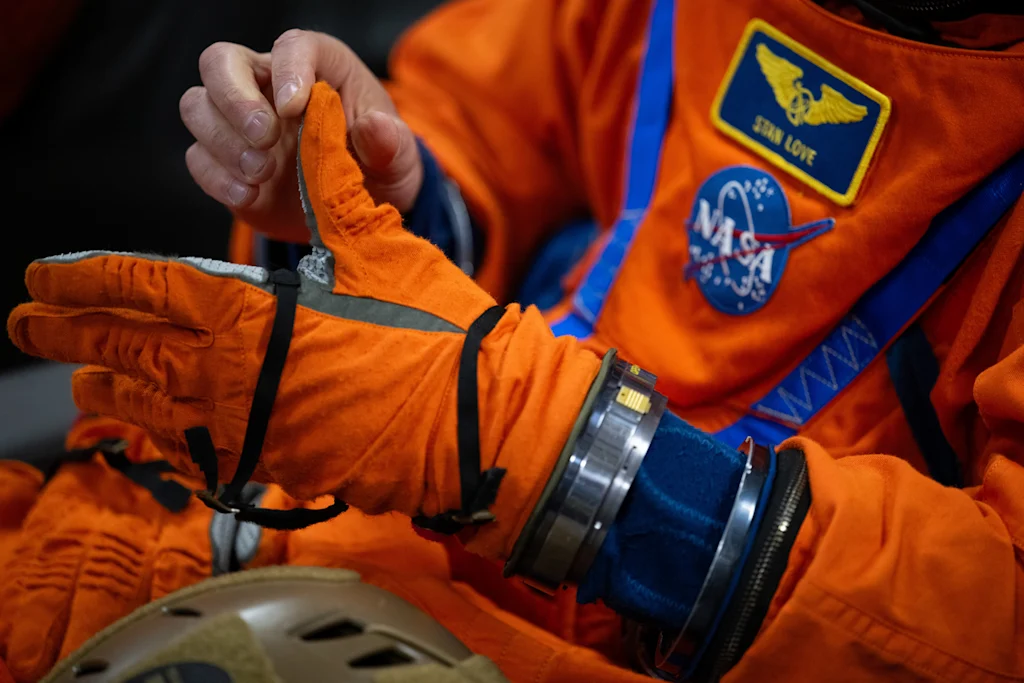
Floating in zero gravity inside a cramped cockpit means a loose cord can easily snag a critical flight switch and trigger a disaster. To prevent this, designers built an asymmetrical storage system directly into the fabric instead of using cargo pockets. The right thigh features a custom compartment that swallows the temperature-control dial and the thick tubes pumping ice water to the undergarment, locking them flush against the astronaut’s leg. Meanwhile, hidden channels route the electronic brain that controls the suit and the plumbing for human waste safely out of the way.
What if the ship dies?
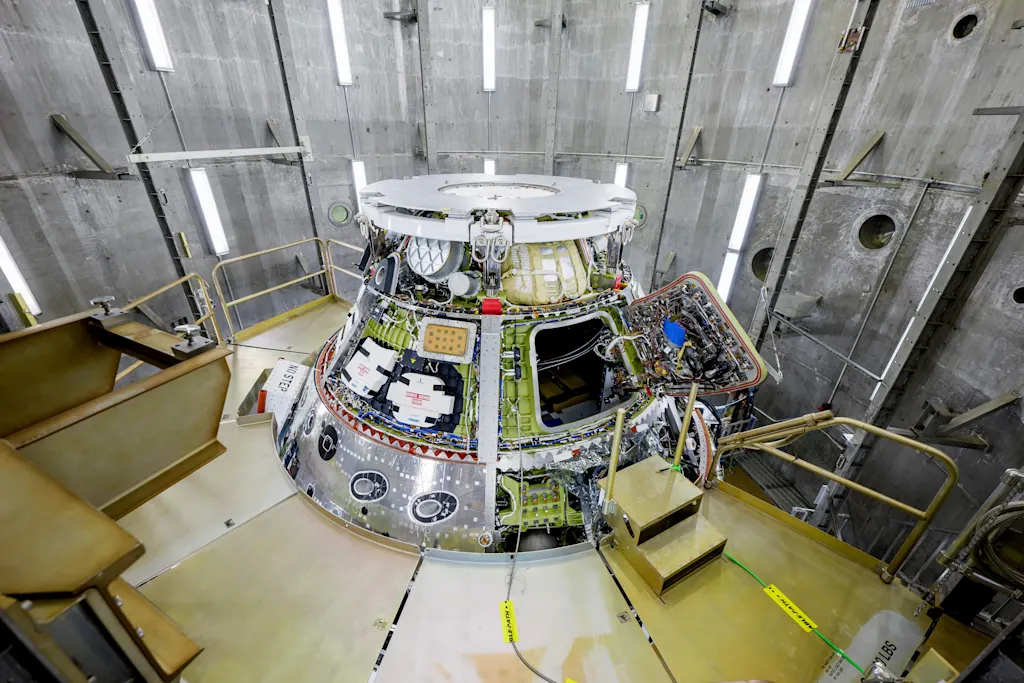
There is only one problem with the suits, and there’s no way around fixing this one: They depend on the spaceship’s ECLSS. If the life support system fails, the astronauts will not survive no matter how well-designed their space suits are.
To avoid that extreme scenario, the Orion capsule prevents a catastrophic ECLSS failure by implementing overlapping safety nets. Lockheed Martin—the designers and manufacturers of the ship—created a life support architecture with duplicate secondary pumps and backup valves that automatically kick in if the primary hardware chokes. The ship’s digital brains also have redundancies: Four identical flight computers run the show simultaneously. If a software glitch wipes out all four, a completely isolated fifth computer (running entirely different code) takes the wheel.
If every single spacecraft system fails and the umbilical stops flowing, the astronaut relies on something called the bailout bottle. This suit-integrated emergency oxygen tank holds a tiny amount of breathable air—just enough to do one last Hail Mary operation, like switching to a different ECLSS oxygen line or getting out of the capsule after crashing into the ocean.
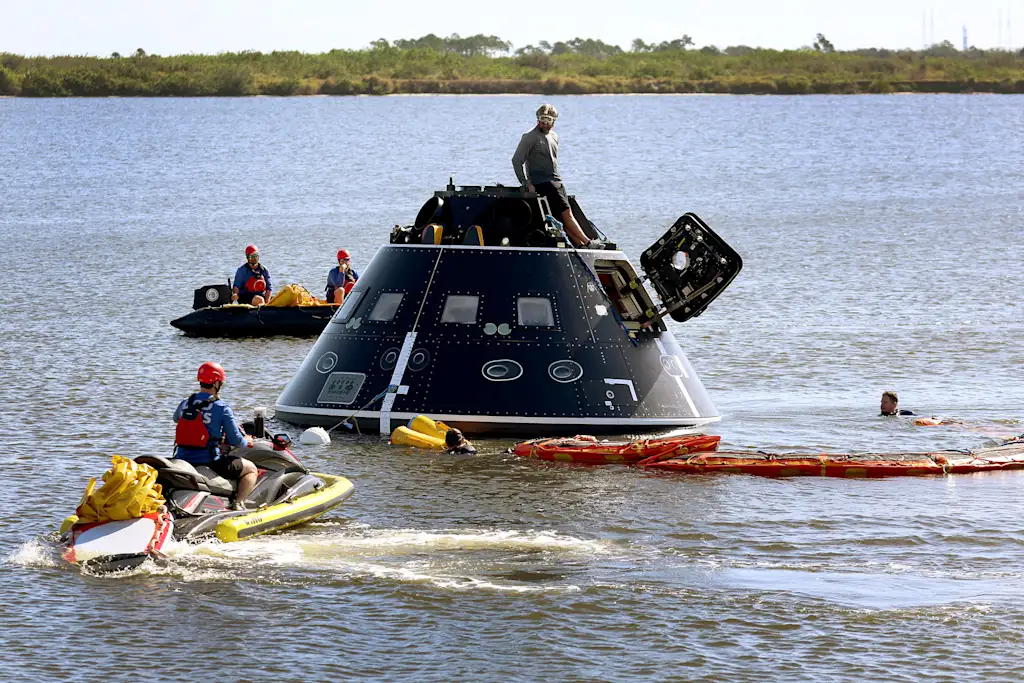
During an emergency ocean splashdown, the OCSS transforms into a heavy-duty maritime survival rig. It inherits its blazing pumpkin-orange hue from the old Space Shuttle Advanced Crew Escape Suit (ACES)—a color specifically chosen so pilots in rescue helicopters can easily spot a human bobbing in the open water.
But where the old ACES gear only provided roughly 10 minutes of bailout air for low-Earth orbit emergencies, the OCSS packs an automatically inflating personal flotation device right into the architecture. Tethered to this life preserver is a meticulously packed emergency kit containing a personal locator beacon to ping rescue forces; a specialized rescue knife; and a comprehensive signaling stash equipped with a mirror, strobe light, flashlight, whistle, and chemical light sticks.
But if the ECLSS collapses on the journey around the moon . . . that’s the end of the line for the crew. Which is why, when we’re reading or watching a report on how Artemis II is going, we need to pay close attention and think about the very real risks these four heroes are assuming, from the moment they strap themselves to a flying bomb full of 5.75 million pounds of explosive fuel all the way to the moment they blaze through the atmosphere and splash into the Pacific Ocean.