
The New York mayor wants to tackle everything from potholes to systemic racism.
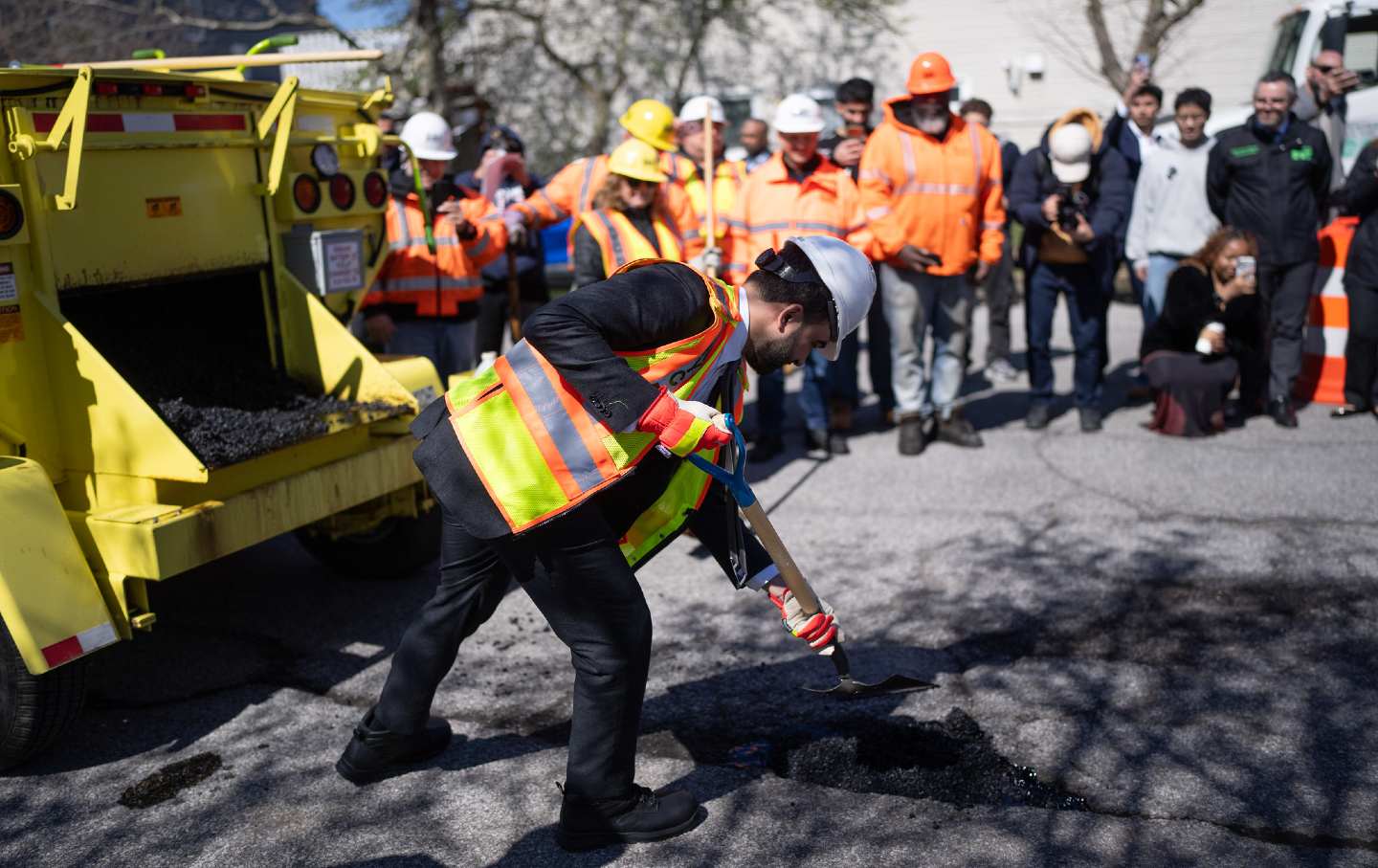
On the morning of his 96th day as mayor of New York, Zohran Mamdani filled the city’s 100,000th pothole. The ceremonial shoveling, on Olympia Boulevard in Staten Island, was emblematic of Mamdani’s do-everything, be-everywhere, all-at-once approach to the challenge of governing the nation’s largest city.
“There is no pothole too far, no trash pile too high, and no problem too big or too small for city government to address,” he said in a statement that went on to celebrate such accomplishments as “brought rat sightings down 30 percent” and “melted 783 million pounds of snow.”
A few hours later however, in a sparsely attended event at CUNY’s Medgar Evers College in Brooklyn, the mayor acknowledged two challenges that weren’t going to be amenable to quick fixes. The first was healing the deep scars from centuries of racism. As Julie Su, the deputy mayor for economic justice, explained in releasing the Preliminary Citywide Racial Equity Plan: “This country once embraced public investment, the GI Bill, affordable public college, [and public] housing…. But when Black Americans fought for access to those programs, backlash politics taught people to resent government programs instead of expanding them. And the result was a worse deal for everyone.”
Her summary may have lacked concrete details like the drained swimming pools in Heather McGhee’s The Sum of Us: What Racism Costs Everyone and How We Can Prosper Together—a 2021 bestseller published in the aftermath of the #BlackLivesMatter protests sparked by the police killing of George Floyd. But Su’s account of how “the same forces that drive racial inequity, exclusion, and economic security also helped produce a city that has become harder for New Yorkers of every background to afford,” was refreshingly direct, as was her declaration that “my job is to make sure…this story ends differently.”
Getting to that happier ending is a herculean challenge—a point driven home by the other item on that morning’s program: the release of New York’s first True Cost of Living (TCOL) Measure. Like the 375-page Equity Plan, the TCOL was the result of the November 2022 Charter Revision referendum. Approved by 81 percent of voters, the proposal mandated that the city report annually on the actual cost of meeting New Yorkers’ essential needs such as housing, food, childcare, and transportation—costs not accurately reflected in federal poverty measures. While the federal government puts any single individual earning more than $15,960 annually above the poverty line (the figure is $33,000 for a family of four), according to the TCOL a single adult would need $70,334 to meet the cost of living in New York, while a family of four would need a combined income of $166,279.
According to the Robin Hood Foundation and Columbia University’s Center on Poverty and Social Policy, some 2.2 million New Yorkers—including nearly 450,000 children—live below the federal poverty line. The city’s TCOL identifies an additional 3.58 million residents living above the poverty line, but who—even after accounting for tax credits and government programs such as housing subsidies and SNAP benefits—still cannot meet the true cost of living an economically secure life. To get by, this group—about 38 percent of the city’s population—-must rely on support from extended families or ballooning personal debt.
Current Issue
Mayor Eric Adams failed to release either of the two mandated reports issued this week, even though his administration oversaw the research. That may well have been because their findings wouldn’t have been welcomed by his patrons in the Trump administration. Acoording to City and State, the Adams administration also scrubbed all references to diversity, equity, and inclusion (DEI) from its Racial Equity Plan, with most of those omissions remaining unremedied in the draft version Mamdani released on Monday.
The TCOL headline figures are shocking enough—though, sadly, generating few actual headlines. But a deeper dive discloses the many ways in which New York’s affordability crisis and its history of racial inequality are bound together. A majority of all New Yorkers (61.8 percent) fall short of the resources required to live here. However, more than 77 percent of the city’s Hispanic population lives below the TCOL levels—the highest such level among any ethnic group in the city. But Black New Yorkers (65.6 percent of whom have incomes below the TCOL) and Asian and Pacific Islanders (63.3 percent) are not much better off. The only group with a majority earning an annual income above the TCOL are white New Yorkers, at 56.3 percent.
“These reports make one thing clear,” said the mayor. “We cannot tackle systemic racial inequity without confronting the affordability crisis head-on, and we cannot solve the cost-of-living crisis without dismantling systemic racial inequity.” Mamdani isn’t going to achieve either of these ambitious goals by the end of his first 100 days, of course. As he noted, providing free childcare would lift one of the heaviest burdens off the backs of New York’s working families. Yet even his much-ballyhooed $1.2 billion commitment from Governor Kathy Hochul includes only $73 million in new funding this year—enough to pay for just 2,000 places.
Still, if the mayor’s accomplishments so far seem more symbolic than substantial, he has shown no signs of slackening his pace—or of losing his gift for making the multifarious elements of his coalition feel both seen and valued. He named Rebecca Jones Gaston, a Black woman who was herself adopted from foster care as a child, as the city’s child welfare commissioner. Like Deputy Mayor Su, who was acting secretary of labor under President Joe Biden, Gaston has national experience; she served as Biden’s head of the Administration on Children, Youth and Families. (The New York Post immediately condemned her appointment as a ploy that “puts ‘racial equity’ above keeping NYC kids safe and alive.”)
The mayor ended his Monday whirlwind with a visit to Union Square, where he celebrated at yet another Passover seder—the “Seder in the Streets” held by Jews for Racial and Economic Justice. Candidate Mamdani had attended this event, which was first held in 2008, last year. “But this is the first time we’ve ever invited the mayor,” Sophie Ellman-Golan, a spokeswoman for the group, told me.
Calling on participants to “Melt Pharaoh’s ICE-y Heart,” this year’s theme focused on the need to protect immigrants. “We can’t really celebrate a liberation holiday when so many of our neighbors are trapped in captivity, either in ICE custody or hiding in their homes,” said Ellman-Golan.
Warming up for the mayor, former city comptroller Brad Lander, alluding to the news from Iran, and the continuing (though mostly neglected by the media) horrors in Gaza, asked, “Isn’t it wrong to kill other people’s children?” Mamdani took a lighter tone, thanking the group for its long record as one of the city’s most reliable progressive allies and urging “New Yorkers at large to celebrate the lessons Passover leaves all of us across these five boroughs.”
Popular
“swipe left below to view more authors”Swipe →
After the matzos were broken and distributed, and four cups of wine were blessed—one of them by Lander—a portion of the crowd marched to the Sixth Avenue office of Palantir, the AI company that supplies ICE with software to identify and track migrants. Fifteen of the protesters were arrested.
But by then the mayor was long gone.
More from The Nation
Party leaders have been doing everything in their power to avoid confronting the US-Israeli war in any meaningful way.
In his recent military budget, Trump is saying the quiet part out loud: Waging war is more important to his administration than providing for basic needs at home.
Dangerously wrong priorities will accelerate America’s decline.
Trump’s genocidal threat against Iran is one of the most vile and dangerous things an American president has ever done.