
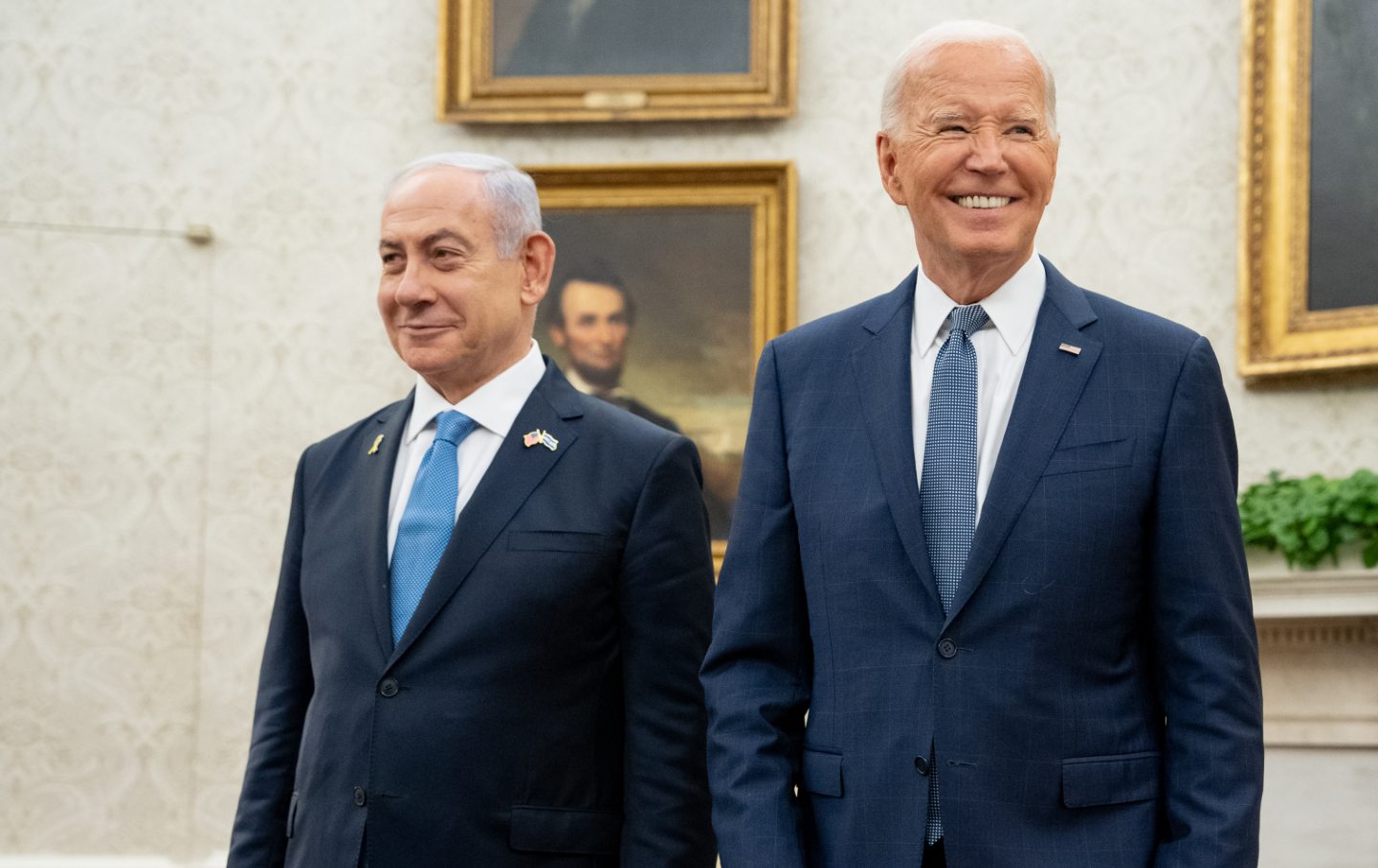
The Biden administration’s near-total support for Israel’s genocide in Gaza is a stain that can never be washed from Biden’s legacy—or from the legacy of the key figures who helped Biden fuel the genocide.
It is those figures—people like Biden’s national security adviser, Jake Sullivan; his Middle East coordinator, Brett McGurk; and his secretary of state, Antony Blinken—who loom largest in Crossing the Red Line: Biden, His Advisors, and Israel’s War in Gaza, a damning new book by journalist Akbar Shahid Ahmed. The book is a culmination of Ahmed’s years-long effort, first at HuffPost and now at The Washington Sun, to tell the story of how the genocide unfolded from deep within the bowels of official Washington. It tells a comprehensive, devastating story of the way that the Biden administration’s imperial hubris; disregard for both domestic and international law; insular, paranoid culture; emotional identification with Israel; and dehumanization of Palestinians combined to help commit one of the worst crimes of the 21st century.
I spoke to Ahmed on Wednesday. We talked about why understanding Biden’s approach to the genocide matters, why so few people within the administration spoke out against the government’s support for the genocide, the flagrant anti-Palestinian bias shown by Biden’s top aides, the media’s failure to accurately reflect what was happening inside the White House, and more.
Jack Mirkinson: We’re now almost two years into the Trump administration. Oftentimes over the past 18 months, you’ll see people going, “Why are people still talking about Joe Biden? Donald Trump’s in office now. Shouldn’t we be focusing on that?” What would your response be to people who say that?
Akbar Shahid Ahmed: The reason why we need to look at the Biden administration’s atrocious policymaking on Gaza is exemplified by this week at the UN General Assembly.
The biggest event yesterday, Tuesday, was Brett McGurk, Biden’s Middle East coordinator, hosting a high-profile event with Syrian President Ahmad Al-Sharaa for the Atlantic Council think tank—which shows you the architects of this policy are coming back to shape our era.
McGurk is someone who I’ve written about for years as, in the words of one official who spoke to me, “the prime example of a white man failing up.” This character has gone through Middle East policy in the Bush, Obama, Trump, and Biden eras, and, as I reveal in my book, tried to get a job in the second Trump presidency unsuccessfully.
We live in an elite foreign policy culture that, without a reckoning and without shining a light on decisions that enable atrocities, incivility, and chaos, is going to keep promoting and empowering the same people. And that’s alarming from a moral and small-d democratic standpoint of accountability.
It’s also relevant in the Trump era because so much of what has been normalized since October 7th and has gotten so much worse under Trump is rooted in decisions made by the Biden administration. And what I mean by that is policies like the US tolerance of a major and unprecedented Israeli blockade on any supplies going into Gaza. It was the Biden era that crafted those policies, not Trump. When we think about concerns like the potential permanent ethnic cleansing of Gaza, the alarm bells were being rung in the Biden era. Nothing was done. Allowing a bipartisan veneer over these policies is part of what allows them to persist.
JM: You place the Biden administration not only within a continuum stretching back to the outbreak of the Iraq War and the so-called War on Terror but also to conflicts as far back as Vietnam.
ASH: I’m glad you take the conversation back pre-9/11. Ceding more and more power to the White House, and what in Washington is referred to as “giving policymakers the space”—which effectively translates to being optional about the application of US and international law—predates 9/11. So does this culture of empowering and putting on a pedestal people who are treated as foreign policy mandarins. You see some of the same people from the Reagan era and the Clinton era who are associated with really alarming policies being brought back again and again. So there’s a recycling of figures, and also figures who come from a tradition of real American hubris—not wanting to look at the toll of American policies abroad.
What changes after 9/11 is the fixation on Middle East power projection and the real staggering comfort level with implicating Americans themselves in massive civilian harm. You never have challenges from [either Republican or Democratic administrations] of the military budgets that have become normalized. You have the normalizing of torture and rendition [without] any specific US official being held accountable. That’s the world that these people are coming out of.
JM: I want to turn to the unfolding of the genocide. The picture that emerges from your book is that in a lot of ways Joe Biden was the worst possible person you would want to be in the Oval Office when something like October 7th happened—that everything about his politics, his own personality, the way that he ran his administration, was hyper-calibrated to lead to the kinds of decisions that he wound up taking.
ASH: Who Biden is and the administration and culture that he creates are really important because it’s a culture of hubris, but also intense insularity—especially towards the latter half of his presidency as his cognitive decline is getting greater. And that’s all amplified when it comes to Israel-Palestine because Biden feels uniquely qualified to handle it. He feels that he has known Netanyahu for upwards of four decades. He understands this issue. He often references his meeting with Golda Meir—
JM: Oh God, the number of times he mentioned that meeting.
ASH: And so then you have, for the legal, the intelligence, the humanitarian, the military professionals, the diplomatic folks I talked to, a real struggle to convince Joe Biden to even get a clear picture of how Netanyahu himself has changed over the years and how Israeli society has shifted.
Then you have just the personality of Biden, which becomes one of anger and suspicion. People I talked to, as a way of covering themselves, would say, “How could you expect me to raise this with the president? He gets so angry.” And with that suspicion, with that instability, with that awareness that he’s not at his peak, there’s a real handpicking of who Biden trusts. It’s really notable that the inner [foreign policy] circle are all white men. And they almost all have a certain age gap between themselves and Biden. Several of his top advisers, particularly Brett McGurk and Amos Hochstein, were described to me as surrogate sons.
I will emphasize—Biden certainly made a lot of the decisions here. The people around him who are now trying to launder their reputations are saying it was all about him. But I really think we deserve more answers on how things were presented to him. When Jake Sullivan tells us, “Yes, I did raise to Biden the possibility of cutting off US weapons to Israel,” how did he do that? Was it presented as a feasible option, or was it presented as, “By the way, this is also being mentioned”? We simply don’t know. And again, because of that insularity of the White House, even many people in the administration who you would expect to know these things couldn’t tell me.
JM: There’s also the way that all of these people have been shaped by decades of Washington consensus around the US-Israeli relationship, the deep personal relationships that all of these people have with Israel and Israelis, and their simultaneous inability to see Palestinians as fully human in the same way.
ASH: The dehumanization and the questioning of Palestinian testimony and experience comes up so often in my reporting. And what’s incredible about it, and incredibly chilling, is it begins right after October 7th, when diplomats on the ground are telling me suddenly Washington cares about what life is like in Gaza. But it cares [so that it can] say, “Is it really that bad?” “Is what we’re hearing actually happening?”
And that continues after thousands of Palestinians themselves have livestreamed their experiences and are telling us what they’re going through, and after hundreds, at least, of foreign aid workers, including US officials, are reporting back what’s happening. You could explore the motivation of that—whether that’s to defend their policy and say it’s not that bad. There’s also a deep-rooted derision, frankly, towards Palestinians relative to Israelis, and an inability to see Palestinian thinking, choices, motivations.
I had this meeting described to me where people who attended were really horrified at what it revealed. Jake Sullivan and Jon Finer met with several folks working on foreign policy and were pushing the idea of this moonshot US-Saudi-Israel plan, which was a goal for the administration even when they were told, “Hey, this potentially drove the kind of desperation that maybe led to October 7th.” However, when these folks raised this to Jake Sullivan and Jon Finer, the response very quickly was, “How dare you? Are you telling me the Arabs are not going to accept a Palestinian state?” It’s an inability to see even their own Arab partners. The Saudi government in this period was repeatedly saying, “We’re not interested in this deal anymore. We’re not going to do it.”
Meanwhile, you had those same Biden administration officials repeatedly making arguments like Secretary of State Tony Blinken’s consistent line of, “The Israelis are so traumatized, we can’t tell them to rein themselves in,” or possibly, “You have to understand just where they’re coming from.”
I was told Blinken used that line in December 2023 when a bunch of State Department experts, including munitions experts, personally came to Blinken and said, “You cannot conceivably let the Israelis use these American bombs that are so devastating.”
JM: You write about Joe Biden’s infamous public declaration very early on that he had no reason to believe that the death toll coming out of Palestine was valid. But then you also reveal multiple instances of people within Biden’s inner circle, particularly people like Jake Sullivan and Brett McGurk, indulging in some of the most nauseating propaganda that was coming out about Gaza. There’s particularly this moment where Jake Sullivan and Brett McGurk were repeating the Israeli propaganda line about the famine in Gaza—basically saying, “Do Palestinians really look that skinny? Is this really happening?” Can you talk about that moment?
ASH: It’s staggering, and it’s also telling that skilled, longtime political operators think they don’t have to answer for these things. I described the Jake Sullivan statement in an interview on NPR earlier this week, and I was told that Jake Sullivan, after that interview aired, was messaging people saying, “This didn’t happen.”
I have given Sullivan every opportunity for years to talk to me. And what’s still happening is a behind-the-scenes laundering of reputations to enable what we discussed before, which is this continued prominence of the same figures.
JM: You write in the book about people having grave doubts about these policies at every level of government. But the one thing that you don’t see all that much of is people actually resigning from the government. In particular, you write about the UN Ambassador, Linda Thomas-Greenfield, and USAID chief Samantha Power thinking about resigning. Obviously, they didn’t. You broke the story of Josh Paul resigning from the State Department very early on in the genocide, and obviously that was a big deal. But there was never a mass movement within the administration, even among people who probably now would be very eager to tell you how horrified they were, willing to take that stand. What do you make of that?
ASH: It’s a very complicated question because it’s different at different levels. [There’s] one group of internal critics and skeptics in which I’d place someone like Jon Finer, the deputy national security adviser, who is in that category of very much being eager to say, “I did have doubts. We should have done things differently.” The Finer ethos, which was shared by several other high-ranking and, importantly, well-briefed—and to an extent sympathetic—officials, was a version of the same corrosive ethos that enabled the entire policy, which was, “Trust us.” It was, “If I’m not in this position, someone else worse is going to come in. I’m making a difference. It’s becoming better.” I challenge you to find Palestinians who felt that Biden was making a difference in their lives.
The flip side of that is there would be tremendous impact for someone with the stature of a deputy national security adviser [or] Linda Thomas-Greenfield or Samantha Power resigning. Josh Paul, nowhere near the level of these people, resigned, and it was global news for days. That power to speak out makes a tremendous difference, and it’s something that Power, Finer, [and] Thomas-Greenfield chose not to do.
I will give Power some kudos for being, of these top-level people, the only one willing to talk to me on the record. However, even she said to me in our conversations that she wasn’t willing to criticize specific colleagues for their decisions or choices. Until you’re willing to call out the choices that were wrong and question those around you, you’re sustaining the same culture that you say you’re so disturbed by.
And then the final category I’d put in, and I think this is a really important aspect of this whole thing, is that the Biden administration came in very proudly identifying themselves as the most diverse administration in history, some of whom [had never had] someone from those communities at these levels of government before. A lot of those people were the most disturbed and disillusioned and disappointed by how that range of expertise wasn’t tapped.
A lot of those people considered resigning. It tells us something about Washington culture that, for many of them, they felt if they did so, they would never, ever get a job again. That becomes especially concerning for people who are younger, maybe from more marginalized backgrounds. But the culture that makes that possible goes both ways. It’s both the culture that’s sustained around that and people choosing not to test the waters.
JM: This book stems directly from your reporting over the last few years about the inner workings of the administration. For a long time, it felt to me like you were the only person on this particular beat. I have written, and others have as well, about this genre of story that you reference a little bit in the book—the “Biden is privately mad at Netanyahu” narrative. What is your reaction both to the seeming lack of interest from a lot of your colleagues in pursuing this kind of reporting, and also in the willingness to regurgitate this narrative?
Popular
“swipe left below to view more authors”Swipe →
ASH: I appreciate you mentioning how solitary it feels sometimes. Colleagues I’ve known for more than a decade would quietly be sending me messages saying, “I’m so glad you wrote the story. I’m so glad you did this.” What is preventing you, from a much larger, much more resourced newsroom, and frankly, often with far more connections than me, from doing that?
Some of that is a desire to sustain relationships and shield sources, and frankly, a really excessive intimacy that reporters in Washington, particularly in national security, have with the people they cover. It’s often disturbing because it becomes a social relationship beyond a professional relationship, and that blurring of lines is what makes it possible to present some figures like Jon Finer, a former journalist, friends with a lot of journalists, as a sympathetic or lone hero fighting on the inside.
And I will say my reporting found that Biden certainly genuinely was angry and frustrated with this policy at various times, right? But it’s contingent upon us as the press to then say, “Biden is angry, but he’s approving this additional several billion-dollar shipment of bombs.”
JM: And also, “Biden is angry, but we also reported that he was angry three months ago, and nothing changed. So what’s the difference now?”
ASH: We don’t have to be goldfish as journalists. Our audiences demand more of us than being goldfish.
I talk in the book about an instance with fellow journalists at a briefing with the heads of aid groups, several of whom have had colleagues killed directly by the US-backed Israeli campaign. Some of these aid group heads had just come back from a visit to Gaza. They were describing the desperation and starvation they’re seeing. A veteran correspondent sitting next to me looks these aid group heads dead in the eye and says, “So do you want Hamas to win?”
I remember my stomach just falling out. That person, like, is operating in a culture where that’s somehow an acceptable question, and they think that’s journalism.It’s not. It’s really a cheapening of the entire profession.
I will say I was able to do the reporting I did at the time for HuffPost, and then for the book, and now for The Washington Sun with tremendous support from others. I’ve been really fortunate and grateful for the editors I had. And I know that a lot of people in newsrooms were pushing back and challenging the coverage and very often faced pressure. But they also sustained part of what was happening. The [Biden] White House called me a liar and claimed I made up quotes. That occurred after they had done that repeatedly to other journalists who did not publicly call them out for doing it and instead went along with the game—then messaged me and said, “I’m so glad you’re finally publicly calling out this practice.”
Why is it on me, at that point, the 32-year-old immigrant reporter for a shrinking digital newsroom, relative to some of the biggest news outlets in the world and reporters who have decades of experience on me, to call them out?
JM: To what extent do you think that there is any sort of genuine reckoning within official Washington, within the ranks of the people who might form part of the next Democratic administration, not only about the horror that was abetted by the last Democratic administration, but also the fundamental way that public attitudes have shifted around this issue? Do you think there’s any soul-searching going on that will actually yield anything different?
ASH: I’ve called the book Crossing the Red Line because I focus on that moment around the [2024] Israeli offensive on Rafah, which was Biden’s first clear demarcation of “If you behave in these ways, I will cut off weapons.” That was when he actually, for the only time in his administration, held up a shipment of bombs for Israel.
I raise that moment because what very quickly happened, as Netanyahu led a pushback, is that the Biden administration abandoned its hold on the bombs, and in fact began supporting the Israeli narrative that their red line wasn’t being crossed. So not only were they being humiliated, they were helping the Israelis do it to them.
That moment is instructive as to any lesson going forward because that hold on those bombs came out of the shifting moods of a couple of men, Jake Sullivan and Joe Biden, in April of 2024. It didn’t come out of a legal and deliberative process, right?
So I think, while there’s a soul-searching around how you talk about Palestine, any kind of different approach from a Democratic administration— or even if the Israel-skeptical Republicans want to be good on their promises—will only come from an actual adherence to the processes that are supposed to govern the US-Israel relationship. Those have been ignored repeatedly. [We have to] see candidates’ policy proposals say, “We’re actually going to treat Israel like we would other US-partnered countries, and we’re going to treat the testimony and the experiences of Palestinians the way we would in reaching a genocide determination or a war crimes determination elsewhere, like Ukraine or Sudan.”
That’s what has to change. And I’ve not seen that yet. I’m seeing certainly some genuine and some opportunistic efforts by politicians to attach themselves to this issue. But I don’t see an appetite for a real structural reckoning yet. And there’s a real pushback by those who would like to go back to an unconditional policy of support for Israel and see that as feasible—including other Democrats.
Between the reemergence of right-wing red-baiting and Donald Trump’s use of the chilling National Security Presidential Memorandum–7 to criminalize left political organizing, we’re seeing McCarthyism reborn before our eyes.
This assault on democracy cannot be ignored or wished away. Resisting it requires bravery in the face of threats and repression, a steadfast commitment to the truth, and the unwavering belief that we can—and will—overcome this darkness.
We must have an independent media that sets the record straight, unearths corruption and abuses of power, and advances a politics of justice and dignity for all if we’re to win this fight.
That’s why I’m writing to you today. This September, The Nation needs to add 100 monthly donors to sustain our progressive journalism. Your contribution makes the next investigative report, the next truth-speaking column, and the next pathbreaking essay all possible.
I hope you’ll support our work with a recurring donation today. If you donate $10 or more a month, we’ll send you a brand new “Hands Off the Free Press!” sticker to recognise your commitment to our cause. Please, donate today.
Onward,
Katrina vanden Heuvel
Editor and Publisher, The Nation
More from The Nation
If Democrats win the House in the midterms, as expected, Mike Johnson won’t hold the gavel in any meaningful way again.

Trans people must now live out another election cycle knowing our friends, family, coworkers, and neighbors are being flooded with agitprop designed to dehumanize us.
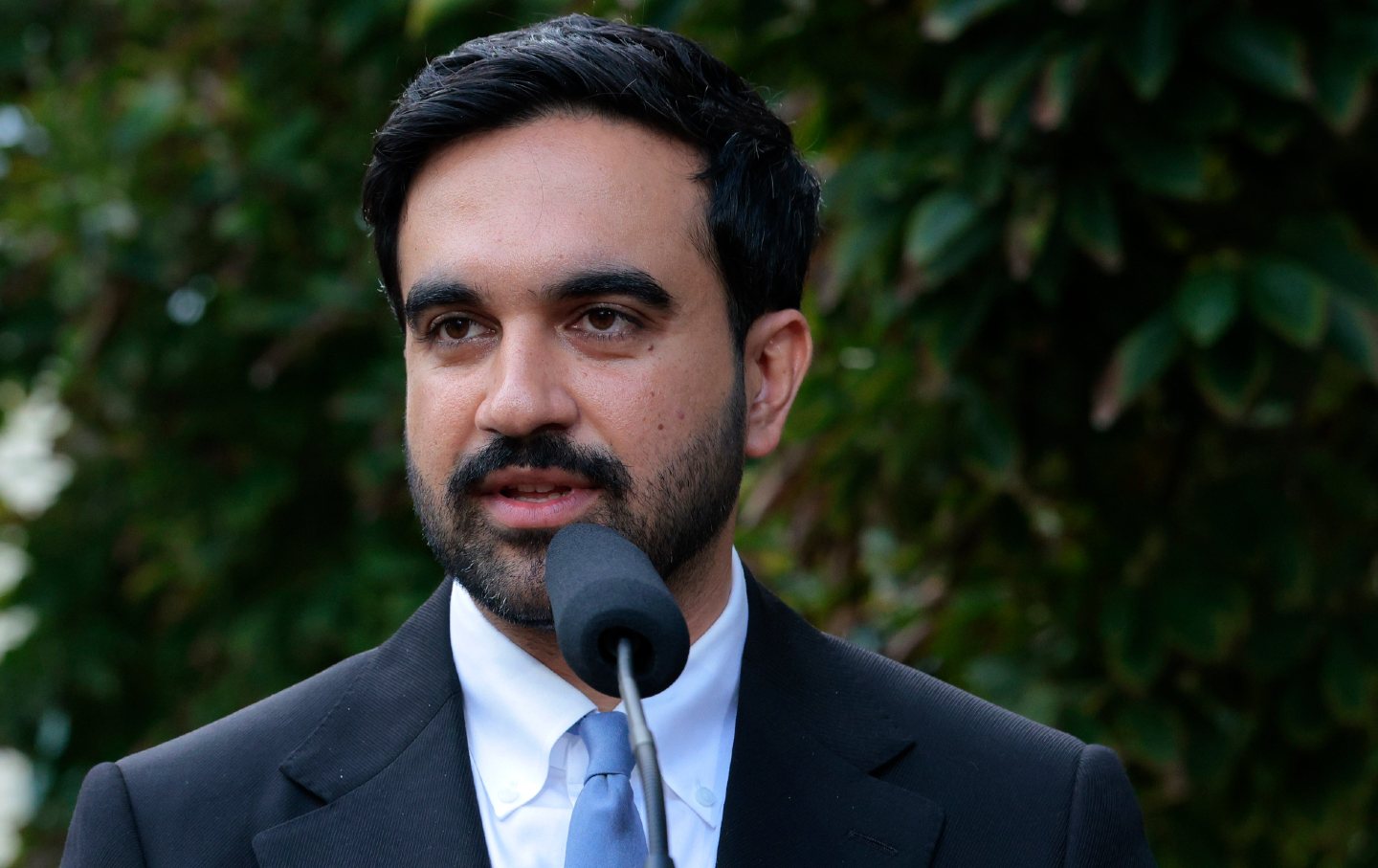
In a meeting with mayors from around the globe, Mamdani argued that the left must fix everyday problems—or the right will find someone to scapegoat for them.