
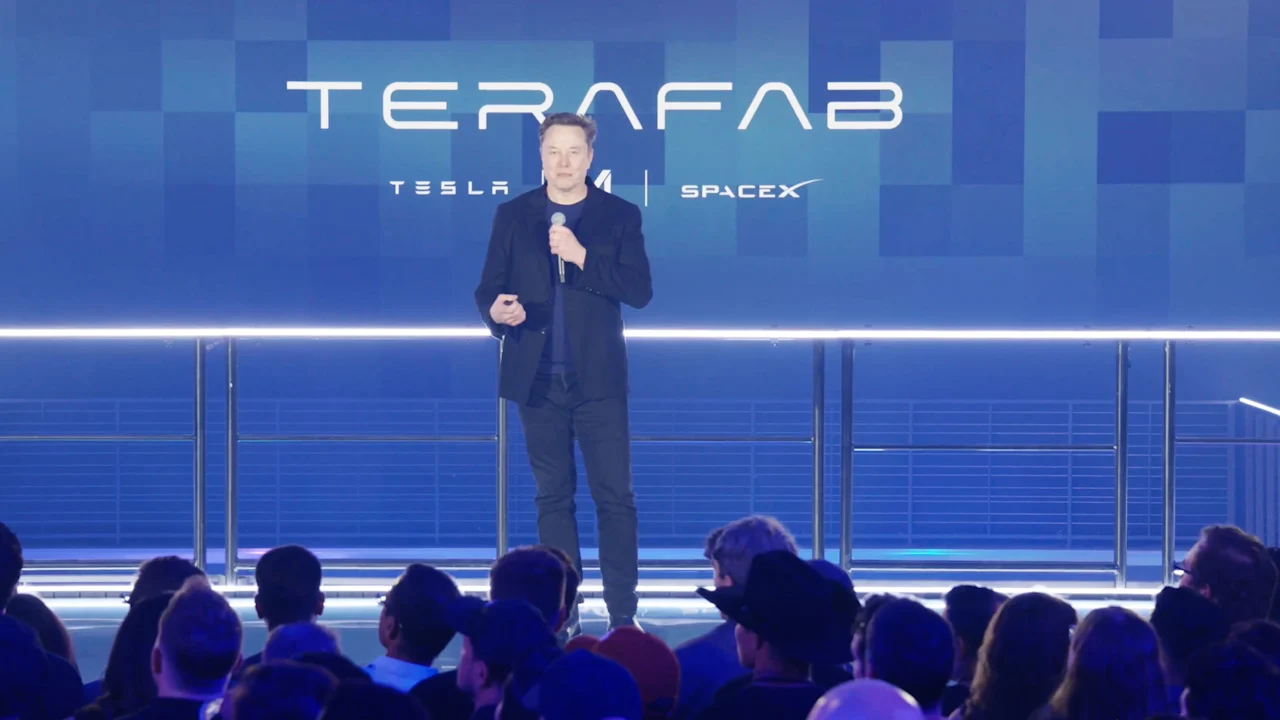
Elon Musk runs an auto company. He oversees an aerospace company. And he controls a social media outlet. Now he wants to add chipmaker to his resume.
The multi-hyphenate billionaire announced plans over the weekend to build a chip manufacturing factory in Austin, Texas, which will produce chips for SpaceX and xAI, which recently merged. Musk, at a presentation Saturday, said the project, dubbed Terafab, will be the “most epic chip building exercise in history by far.”
Musk has been talking about Terafab for a while, but the event on Saturday marked the official start to the project. While xAI and other artificial intelligence companies have largely depended on TSMC, Samsung and Micron for the chips that power their systems, Musk, however, said existing semiconductor manufacturers aren’t making chips fast enough for his needs. He also has indicated that by building his own chip factory, his companies would be less affected by geopolitical strife.
(Beyond building out Grok, Musk’s are also hopes Tesla will become a market leader in humanoid robots, which are powered by AI.)
“We’re very grateful to our existing supply chain, to Samsung, TSMC, Micron and others,” he said. “[However,] there’s a maximum rate at which they’re comfortable expanding. That rate is much less than we would like.”
Big ambitions are nothing new for Musk, but the world’s richest man has a history of being overly optimistic about those goals. Tesla’s full self-driving has been “one year away” every year since 2015. The Cybertruck was originally expected to begin production in 2021, but was delayed about two years. The Hyperloop has not materialized as a high-speed transport system and while Musk once said SpaceX would land humans on Mars by 2026, he now says a Mars mission would be “somewhat of a distraction.”
Terafab is being met with some skepticism as none of Musk’s companies have semiconductor manufacturing experience. Tesla, at one point, did have a chip design team, but most left the company after Musk killed the Dojo project, which was working on Tesla’s custom-built supercomputer. (And even if they had stayed, chip design is a much different job than chip manufacturing.)
Musk’s own comments about the process have fueled doubt. In January, he said the semiconductor industry is “getting clean rooms wrong,” betting Tesla would build a 2nm fab where he can “eat a cheeseburger and smoke a cigar.”
As high as Musk’s expectations are for Terafab, the price tag could be considerably higher. Analysts at UBS estimate the price for the factory to reach Musk’s goal for production capacity could reach as much as $300 billion. And that figure could escalate even further if Musk attempts to fast track the facility.
There’s reason to believe he’ll try to compress the timeline, too. Last November, when he began talking about developing a chip fabrication facility, he told investor Ron Baron “Five years for me is eternity. My timelines are one year, two years.”
(Musk gave no timeline for Terafab in his announcement Saturday.)
Chip making facilities take a long time to build. Micron began constructing one in Boise in 2022. It’s not expected to begin shipping chips until the middle of next year. And Micron is well-versed in the chipmaking world.
Assuming it does become operational, Terafab is expected to make two kinds of chips – one of which would be used for Tesla vehicles and Optimus robots, the other designed to be used in space, as part of the space-based data center Musk has previously discussed.
Terrafab, says Musk, will start with a smaller fabrication scale than the company’s ultimate vision, then ramp up from there. The end result, as he sees it, will be the world’s largest chip fabrication facility, with a production capacity that is 70% of TSMC’s total global output. Eventually, he says, the facility will support a terawatt of computing power per year.
“We either build the Terafab or we don’t have the chips, and we need the chips, so we build the Terafab,” Musk said.