
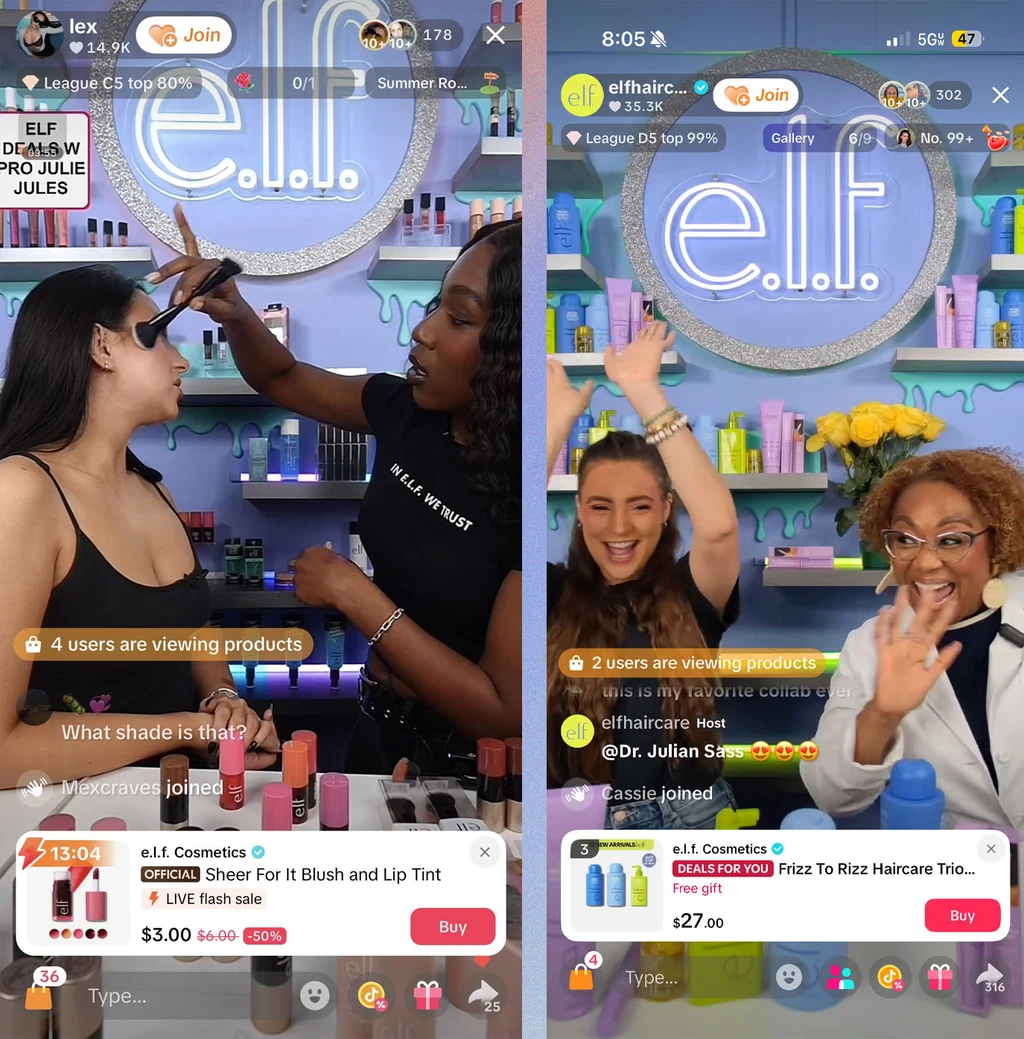
When cosmetics and skincare company E.l.f. Beauty debuted its new haircare line in June, it turned to the world’s fastest-growing online retailer for help. A week before the line landed at Target—E.l.f.’s official retail partner—it launched on TikTok Shop, via a four-hour livestream cohosted by beauty influencer Yonna Jay and cosmetic chemist Erica Douglas (aka Sister Scientist). The livestream netted hundreds of thousands of views and enough sales that E.l.f. Hair became the brand’s biggest day-one category launch in history.
TikTok Shop opened three years ago, ushering in a new era for e-commerce. U.S. consumers spent $15.8 billion on TikTok Shop in 2025 and another $11.8 billion in the first half of 2026, according to consumer intelligence firm Emarketer, buying everything from neck cream to cordless vacuums. TikTok has already claimed 2% of the U.S. online retail market (more than both Target and Costco), according to Consumer Edge, a consumer insights firm.
Users are increasingly shopping while watching TikTok livestreams (aka Lives), where creators and brands tout and sell products, QVC-style. TikTok says nearly a third of all U.S. adults have watched its live shopping content, and conversion rates for these streams hover around 10%, according to social media consultancy Social/Tale—higher than e-commerce sites (2% to 3%) and even in-feed TikTok videos (1% to 4%). In a sign of the times, QVC and HSN have started livestreaming on TikTok 24/7.
E.l.f. was the first big beauty brand to join TikTok, in 2019, and was early to start selling goods there, too. Now, with 3 million followers, the brand has made TikTok Live a centerpiece of its retail strategy. Each month E.l.f. broadcasts roughly 15 livestreams, which run from two to six hours.
Kelly Shah-McDonnell, E.l.f.’s vice president of global connected commerce, says the brand’s TikTok sales doubled year over year in the first half of 2026, and they’re on track to continue growing. “We see Lives as an ‘edutainment’ engine for E.l.f., where we can educate viewers on the products, sell in real time, and spark conversations in our community,” she says.
But that doesn’t mean every brand succeeds on the platform. TikTok Shop is notoriously full of low-quality, drop-shipped goods—and, increasingly, AI-generated influencers. As bigger and more established brands look to join TikTok Shop, standing out on the platform has never been more difficult. Here’s E.l.f.’s winning strategy.
Pick your partners and prep them for success
QVC may have pioneered shopping as entertainment, but TikTok has perfected it. Though it has a dedicated Shop tab in its app, TikTok also serves live shopping content to users right in their regular feeds, helping to surface products based on those users’ interests. At the same time, it leverages shoppers’ impulse-control issues by making it easy to check out within the app itself. (This stands in contrast to Instagram, where less than a third of shoppers use in-app checkout features.)
But brands still have to catch people’s attention. That starts with the length of a Live broadcast. The most successful ones last a long time, says Ajay Salpekar, TikTok’s general manager for beauty, food, and beverage. E.l.f.’s can stretch up to six hours, giving fans of the brand ample time to join whenever they’re free.
Finding the right content creators to host these marathon broadcasts is essential. E.l.f., which works only with human influencers, invites its Live partners to film in its offices in Oakland, California, and pays them a flat fee along with a commission per product sold.
E.l.f. decides in advance what products, giveaways, and promotions it plans to offer during a Live. E.l.f.’s Shah-McDonald says the brand also works with hosts to make sure they are deeply educated and knowledgeable about each product so they can answer viewer questions confidently. During the Live itself, E.l.f. is in constant contact with the hosts, messaging them and using on-site producers to manage the process and troubleshoot any issues.
One such collaborator is Lexi Rosenstein, a beauty influencer with more than 150,000 followers on TikTok and a talent for live broadcasts. After she started showcasing E.l.f. products in vlogs about her daily life, the brand took notice and began working with her. Most recently, they collaborated on some posts featuring limited-edition pickle lip balms.
Rosenstein, an animated and talkative performer, doesn’t allow for dead air during her broadcasts. She summons details about products and deals while responding to viewers’ comments and questions in real time.
“I think of myself as a modern-day Macy’s sales counter girl,” she says. “People go, ‘Hey, I have this type of skin, what should I use?’ Or maybe they want to know what colors are right for them. It’s your job to help them find what’s best for them, and to entertain.”
Get into people’s feeds with smart tutorials
On social media platforms like Instagram, users tend to follow specific creators. On TikTok, they engage with interest-based content served to them through the platform’s endlessly swipeable FYP (For You Page) feed.
“TikTok is a platform that can provide you great virality,” says LTK cofounder and President Amber Venz Box, whose company connects content creators with brands and shoppers. That means brands don’t have to spend as much time thinking about their TikTok profile.
“It’s not something they have to curate,” Venz Box says. But they do need to think about what kind of content lands naturally in people’s feeds—educational broadcasts, most notably.
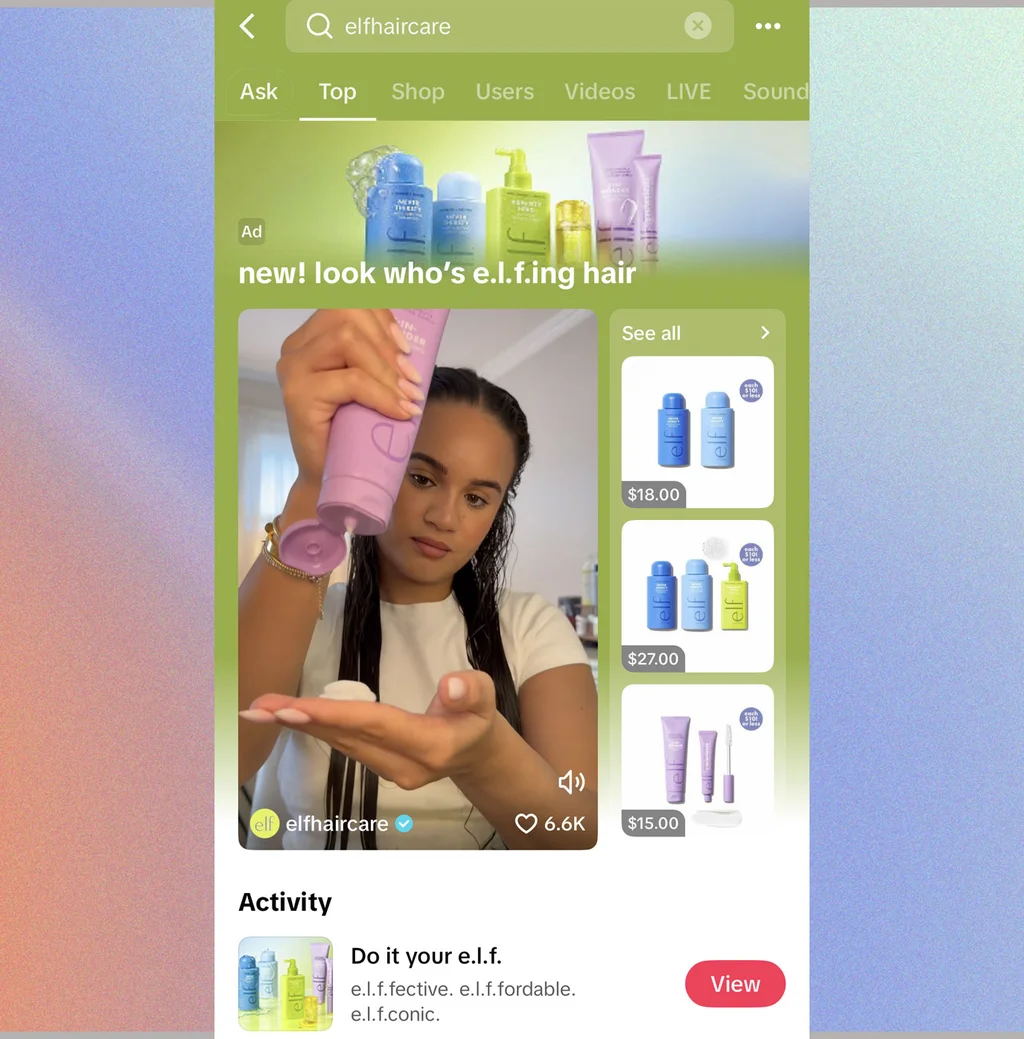
This was E.l.f.’s strategy when it debuted its haircare line. Throughout that first week, the brand’s new @elfhaircare account broadcast five shoppable livestreams, averaging two to four hours, with the first one guest-hosted by Jay and Douglas and also broadcast on their pages.
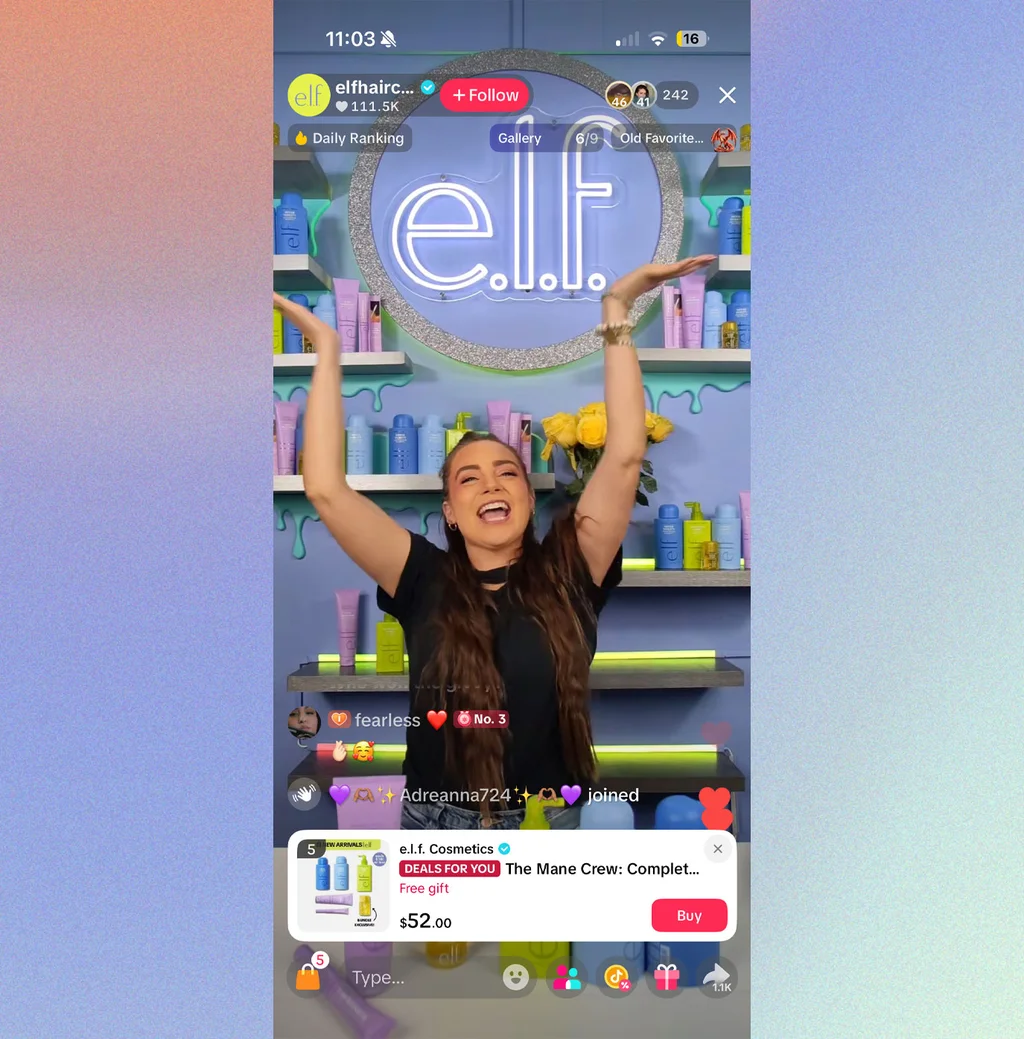
The duo, who chatted in front of a periwinkle wall with shelves full of products, focused on showing how the new line works on different hair types. Douglas drew on her chemistry background to unpack how the line’s shampoo forms suds and to break down the science behind its hydration benefits.
The pair also touted limited-time deals, displayed at the bottom of the stream, that users could take advantage of with just one click if their payment information was already saved to their TikTok account. A notice advertising how many viewers were looking at the deal gave shoppers a sense of urgency and scarcity.
Jay’s stream reached 250,000 views, while Douglas’s stream attracted 40,000 views. Even so, E.l.f. reports that Douglas’s page sold twice as many products as the average TikTok Live, thanks to her focus on education.
TikTok’s Salpekar says the show-and-tell approach has also helped fragrance purchases grow on the platform, even though viewers can’t smell the products.
“A lot of fragrance purchases are about how you layer scents together, how a fragrance makes you feel, what compliments someone got when they wore it, and what scenarios they would wear it in. All of that can be communicated in a TikTok Live,” Salpekar explains.
Create a sense of urgency
Teasing a limited-edition product is a long-standing retail strategy. On TikTok, it works remarkably well. Once a TikTok livestream ends, it disappears, which means brands can take advantage of its ephemeral nature to create a sense of urgency. The time pressure also encourages impulse buying: TikTok users often already have their credit card details saved on the platform and can make a purchase without leaving the app.
E.l.f. frequently creates limited-edition products for its TikTok Lives, as it did with a glittery version of the brand’s popular SPF stick for a broadcast by Rosenstein on July 24. Rosenstein used the livestream to demonstrate how the product looked on her face and collarbone, while reminding viewers that once it sold out, there was no chance it would come back.
“If you know, you know: The previous two launches sold out in like 24 hours,” she said. Just as she predicted, the Glitz Edition SPF stick sold out a couple of hours after her broadcast ended.
Brands have also seen success by offering discounts as a reward for viewer participation. Last year, E.l.f. drove interest in its Pout Clout lip plumping pen by dropping the price to $2 at various intervals throughout a six-hour stream. (Discounts seem to perform particularly well on TikTok: On E.l.f.’s May earnings call, CEO Tarang Amin said that a price reduction on the company’s Halo Glow Skin Tint lifted sales 36% across all retailers—and by triple digits on TikTok Shop.) The company also sprinkles in giveaways to a few commenters during its Lives, encouraging people to tune in.
Things don’t always go as planned. For a broadcast last fall, the company planned to tout a giant tube of its Power Grip Primer that held 50 times more product than the regular version. When it sold out in the first few minutes, executives had to come up with something else to tout on the fly. Shah-McDonnell says they ended up creating a buy-one, get-one free deal for the regular-size primer.
TikTok has made it even easier to create a sense of urgency with a new Auctions feature that lets users bid on products during Lives. They enter their payment details in advance and are automatically debited for an item if they win. E.l.f. hasn’t used the feature yet, but Shah-McDonnell says it’s in the cards.
Start a conversation
Since hosts can read and respond to viewers’ comments in real time, TikTok Lives are a great way to foster conversation between a brand and its biggest fans. E.l.f. frequently uses its broadcasts to ask viewers what product bundles and offers they’d like to see.
In one recent broadcast, its warehouse employees popped into the stream to ask viewers what lip products they wanted bundled. The warehouse employees then created unique bundles tailored to specific commenters—and packed them to be shipped during the stream.
The feedback a brand receives from a TikTok livestream can inform other parts of the business, too. E.l.f.’s haircare launch on TikTok Live informed the brand’s physical retail strategy. After launching its haircare line on TikTok, E.l.f. passed along viewer feedback and sales data to Target, which used the information to shape its merchandising strategy.
In addition to partnering with content creators, E.l.f. also features executives—including CEO Amin—on its Lives, giving viewers a sense of access and intimacy. But there was an added benefit to Amin’s December 2023 appearance: When 12,000 viewers demanded E.l.f. bring out bronzing drops, Amin realized it was time to fast-track its development. E.l.f. released the product four months later.
Rinse and repeat
According to TikTok’s Salpekar, repeat shoppers account for 75% of purchases made via TikTok Lives. To keep them coming back, the most successful brands broadcast on a regular cadence (two to three times a week) and tease their broadcast in advance on their handles. E.l.f. also gives people the option to subscribe to reminder alerts for upcoming Lives.
Experimenting is key, and getting Lives right can pay long-term dividends. “In the TikTok ecosystem, short videos tend to be great for discovery because those videos scale so well,” Salpekar says. “Live is particularly good at driving repeat behavior, and this is why brands should care about it.”