
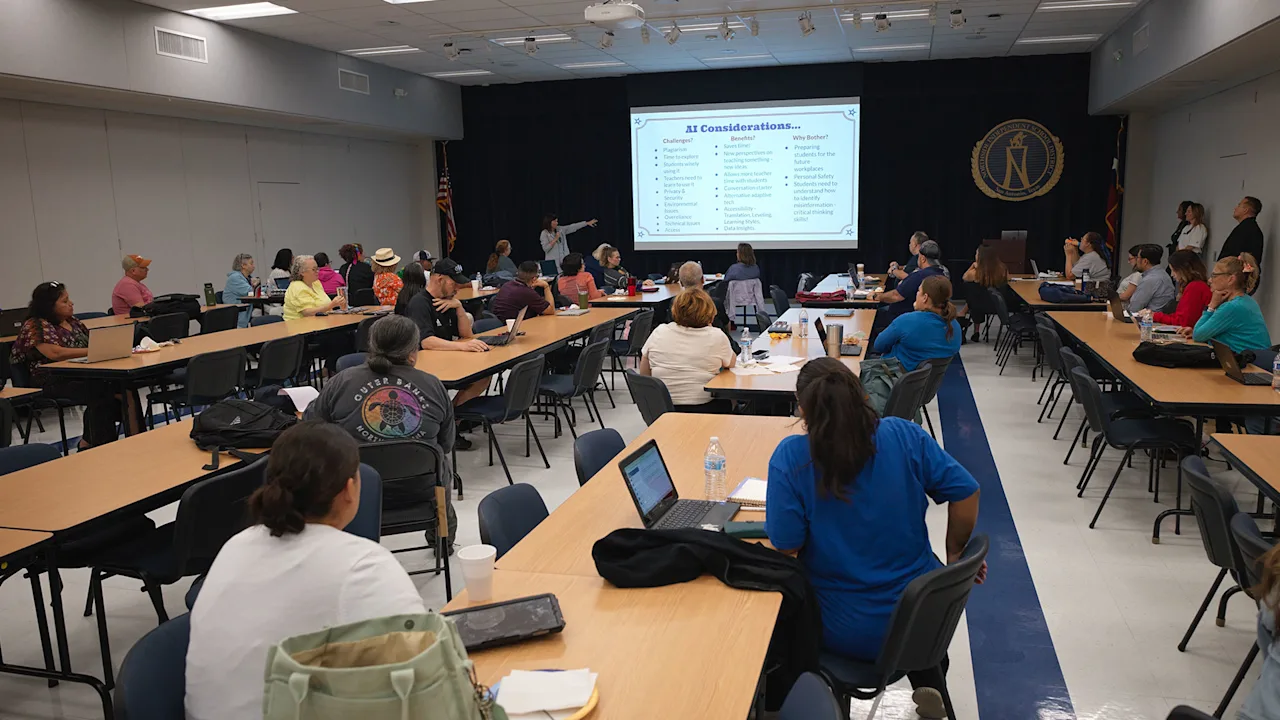
On a scorching hot Saturday in San Antonio, dozens of teachers traded a day off for a glimpse of the future. The topic of the day’s workshop: enhancing instruction with artificial intelligence.
After marveling as AI graded classwork instantly and turned lesson plans into podcasts or online storybooks, one high school English teacher raised a concern that was on the minds of many: “Are we going to be replaced with AI?”
That remains to be seen. But for the nation’s 4 million teachers to stay relevant and help students use the technology wisely, teachers unions have forged an unlikely partnership with the world’s largest technology companies. The two groups don’t always see eye to eye but say they share a common goal: training the future workforce of America.
Microsoft, OpenAI and Anthropic are providing millions of dollars for AI training to the American Federation of Teachers, the country’s second-largest teachers union. In exchange, the tech companies have an opportunity to make inroads into schools and win over students in the race for AI dominance.
AFT President Randi Weingarten said skepticism guided her negotiations, but the tech industry has something schools lack: deep pockets.
“There is no one else who is helping us with this. That’s why we felt we needed to work with the largest corporations in the world,” Weingarten said. “We went to them — they didn’t come to us.”
Weingarten first met with Microsoft President and Vice Chairman Brad Smith in 2023 to discuss a partnership. She later reached out to OpenAI to pursue an “agnostic” approach that means any company’s AI tools could be used in a training session.
Under the arrangement announced in July, Microsoft is contributing $12.5 million to AFT over five years. OpenAI is providing $8 million in funding and $2 million in technical resources, and Anthropic has offered $500,000.
Tech money will build an AI training hub for teachers
With the money, AFT is planning to build an AI training hub in New York City that will offer virtual and in-person workshops for teachers. The goal is to open at least two more hubs and train 400,000 teachers over the next five years.
The National Education Association, the country’s largest teachers union, announced its own partnership with Microsoft last month. The company has provided a $325,000 grant to help the NEA develop AI trainings in the form of “microcredentials” — online trainings open to the union’s 3 million members, said Daaiyah Bilal, NEA’s senior director of education policy. The goal is to train at least 10,000 members this school year.
“We tailored our partnership very surgically,” Bilal said. “We are very mindful of what a technology company stands to gain by spreading information about the products they develop.”
Both unions set similar terms: Educators, not the private funders, would design and lead trainings that include AI tools from multiple companies. The unions own the intellectual property for the trainings, which cover safety and privacy concerns alongside AI skills.
The Trump administration has encouraged the private investment, recently creating an AI Education Task Force as part of an effort to achieve “global dominance in artificial intelligence.” The federal government urged tech companies and other organizations to foot the bill. So far, more than 100 companies have signed up.
Tech companies see opportunities in education beyond training teachers. Microsoft unveiled a $4 billion initiative for AI training, research and the gifting of its AI tools to teachers and students. It includes the AFT grant and a program that will give all school districts and community colleges in Washington, Microsoft’s home state, free access to Microsoft CoPilot tools. Google says it will commit $1 billion for AI education and job training programs, including free access to its Gemini for Education platform for U.S. high schools.
Several recent studies have found that AI use in schools is rapidly increasing but training and guidance are lagging.
The industry offers resources that can help scale AI literacy efforts quickly. But educators should ensure any partnership focuses on what’s best for teachers and students, said Robin Lake, director of the Center on Reinventing Public Education.
“These are private initiatives, and they are run by companies that have a stake,” Lake said.
Microsoft’s Brad Smith agrees that teachers should have a “healthy dose of skepticism” about the role of tech companies.
“While it’s easy to see the benefits right now, we should always be mindful of the potential for unintended consequences,” Smith said in an interview, pointing to concerns such as AI’s possible impact on critical thinking. “We have to be careful. It’s early days.”
Teachers see new possibilities
At the San Antonio AFT training, about 50 educators turned up for the three-hour workshop for teachers in the Northside Independent School District. It is the city’s largest, employing about 7,000 teachers.
The day started with a pep talk.
“We all know, when we talk about AI, teachers say, ‘Nah, I’m not doing that,’” trainer Kathleen Torregrossa told the room. “But we are preparing kids for the future. That is our primary job. And AI, like it or not, is part of our world.”
Attendees generated lesson plans using ChatGPT, Google’s Gemini, Microsoft CoPilot and two AI tools designed for schools, Khanmingo and Colorín Colorado.
Gabriela Aguirre, a 1st grade dual language teacher, repeatedly used the word “amazing” to describe what she saw.
“It can save you so much time,” she said, and add visual flair to lessons. She walked away with a plan to use AI tools to make illustrated flashcards in English and Spanish to teach vocabulary.
“With all the video games, the cellphones you have to compete against, the kids are always saying, ‘I’m bored.’ Everything is boring,” Aguirre said. “If you can find ways to engage them with new technology, you’ve just got to do that.”
Middle school teacher Celeste Simone said there is no turning back to how she taught before.
As a teacher for English language learners, Simone can now ask AI tools to generate pictures alongside vocabulary words and create illustrated storybooks that use students’ names as characters. She can take a difficult reading passage and ask a chatbot to translate it into Spanish, Pashto or other languages. And she can ask AI to rewrite difficult passages at any grade level to match her students’ reading levels. All in a matter of seconds.
“I can give my students access to things that never existed before,” Simone said. “As a teacher, once you’ve used it and see how helpful it is, I don’t think I could go back to the way I did things before.”
The Associated Press’ education coverage receives financial support from multiple private foundations. AP is solely responsible for all content. Find AP’s standards for working with philanthropies, a list of supporters and funded coverage areas at AP.org. _
This story was first published on Oct 17, 2025. It was re-published on Oct. 20, 2025, to show Brad Smith is the president and vice chairman of Microsoft, not the CEO.
—Jocelyn Gecker, AP Education Writer