
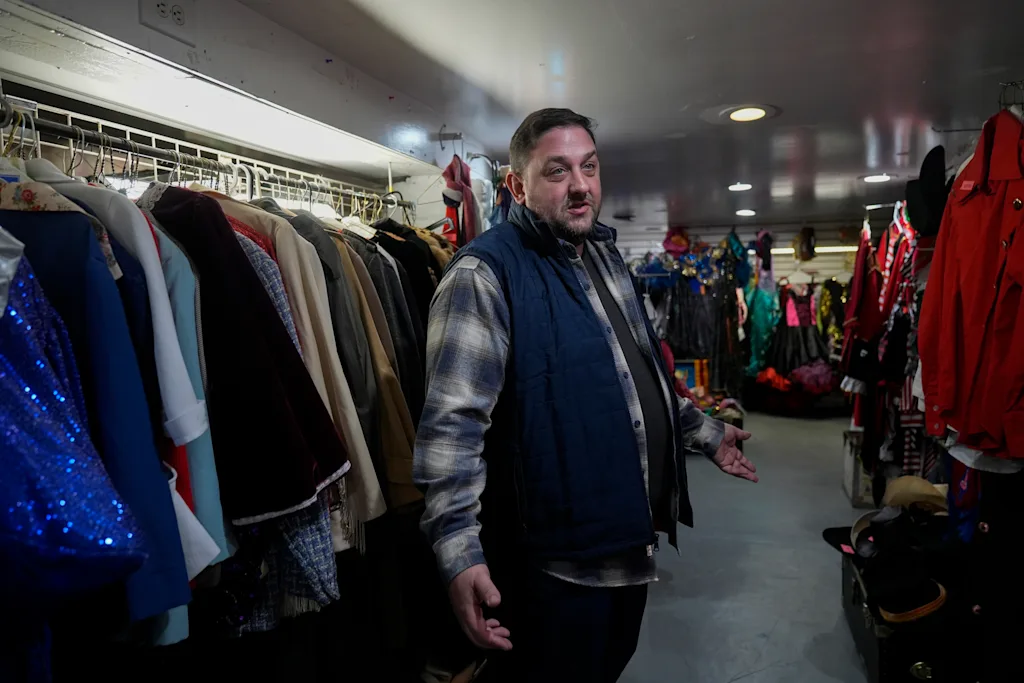
With Halloween on the horizon, Chicago Costume is stuffed. Packaged costumes, including superheros and Japanese animation characters in both kid and adult sizes, dangle near colorful wigs and bottles of fake blood. Downstairs, vintage clothes from the 1970s beg for one more boogie night.
The frightening possibilities mask the work that’s gone on behind the scenes to stock the family-owned shop and its sister store for the spooky season. Owner Courtland Hickey said he ordered 40% fewer costumes this year because of President Donald Trump’s tariffs on products from China.
To fill the gap, Hickey and his mother, Chicago Costume founder Mary Hickey Panayotou, looked to their decade’s worth of unsold costumes and accessories to see what could be repackaged or repurposed. The tariffs made new imports more expensive, and storewide price increases might spook customers, he said.
“If people have less money in their pocket to spend, … then costumes are going to be lower on their list,” Hickey said. “So the more we have to invest in new products, the riskier it is for the business because we aren’t going to sell it.”
Tapping the old inventory required sorting through several thousand items stored in backrooms and a warehouse. Vintage pieces once reserved for rentals combined with fresh items became sets. A surplus of black robes became the foundation for Halloween wizards, judges, choir members and graduating students, Hickey said.
“They’re a staple piece that gets transformed by the accessories we pair with them,” he said.
Some of Chicago Costume’s 35 employees also got busy sewing fabric scraps and foam material into imitations of the miter headdresses worn by high-ranking Catholic clergy. Paired with a robe, the headwear would let someone dress up as Pope Leo, a Chicago native.
Panayotou founded Chicago Costume in 1976 by custom-designing and renting costumes for the Windy City’s theater companies. It fast became a destination for non-actors looking for Halloween outfits.
Commercially made children’s costumes followed, and a stockpile of capes, masquerade masks, “Star Wars” kits and other leftovers grew from there.
“I’m kind of a hoarder,” Panayotou said. “I didn’t want to throw stuff away. So there’s a lot of accessory items and pieces. Here’s the dress, but we have only one glove.”
Having excess inventory typically is avoided in retail, but the practice has given Chicago Costume a supply cushion during what has been an unpredictable 2025 for import-reliant segments of the industry, including toy manufacturers and stores.
Hickey said tariffs weren’t on his radar until he and and other Chicago Costume staff members met with suppliers at the Halloween & Party Expo in January. Whether Trump would impose duties on Chinese goods after his inauguration the following week was a big topic of conversation at the Las Vegas event, he said.
On Feb. 1, the president signed the first tariff order of his second term. Hickey already had ordered his usual number of new costumes but put fulfillment and delivery on hold when the tariff rate on imports from China ballooned to 145% in April. Nearly 90% of the costumes Chicago Costume sells in stores and online are made in China, in line with the costume industry average, he said.
Some suppliers already had products ready and said they would not charge him extra, Hickey said. Others said he would have to pay more to cover the cost of tariffs. “Take it or leave it,” he recalls being told. “I pretty much left it.”
Other small businesses that rely on Halloween describe similar their own tariff-related woes. Trick or Treat Studios, which designs masks based on characters from popular horror movies as well as costumes and props, laid off 15 employees, one-fourth of its staff, in May, co-founder Christopher Zephro said.
Zephro uses factories in China to make plastic masks but said he is reducing the amount of work done there and shifting it to Mexico, where his latex masks are manufactured. In the meantime, he raised prices by 15%.
At Chicago Costume, which generates well under $1 million dollars in annual sales, shoppers will see fewer sales promotions and discounts, Hickey said. Children’s costumes of officially licensed characters and bulky sets will cost at least 25% more, he said. A lederhosen costume, for example, is priced at $49.99, or $10 more that it did a year ago.
Hickey, who has served on the board of the National Costumers Association for 20 years, initially saw a silver lining in Trump’s tariffs. Big retail chains have siphoned sales from independent costume shops with the help of cheap costumes from China, he said.
In May, Hickey published a column on the National Costumers Association’s website that outlined Chicago Costume’s can-do, environmentally superior approach this year. He hoped it would galvanize the trade group’s 100 independent store members — a group that numbered 220 a decade ago — to dust off old stock, reorganize their shops and prepare for “a potentially great Halloween.”
Tariffs have “peeled back the curtain on just how deep our reliance on cheap overseas manufacturing has become,” he wrote. “If this shift hurts Amazon dropshippers, Spirit Halloween, or Walmart’s over-imported costume lines, I’m not going to mourn. In fact, I see it as a chance for us to reclaim what made local retail special.”
Some of Hickey’s idealism has since faded. The impact of tariffs on Halloween played out differently than he expected. The largest retail chains doubled down, flooding the market with cheap costumes and dropping prices to hold onto customers.
“It’s been a lot harder than I hoped, but I still believe that optimism, adaptability, and differentiation are what will keep independent costume shops like us alive,” he said.
Chicago Costume is used to embracing challenges. To keep revenue flowing year-round, the stores cater to cosplay fans and themed parties. The Hickey-Panayotou family has a separate business making mascot costumes for the Chicago Bulls and other professional sports teams, and acquired a theatrical services company founded in 1886 along with its collection of period pieces.
Diversifying made it easier to rotate and refurbish old stock instead of slashing prices after Halloween or throwing pieces away, he said.
For a customer who wanted to be a Hollywood diva, his wife, Erin, who handles social media for Chicago Costume, paired a robe trimmed with feather boas from the vintage collection with a new cigarette holder, hat and pair of sunglasses. Total cost: $65.
Damien Johnson, 53, is a longtime Chicago Costume patron whose birthday is Oct. 31. He has spent as much as $300 on his Halloween getups and said he would never shop online or at discount stores.
Despite his loyalty, Johnson delayed his costume-buying by a month this year. He also gave himself a spending cap. Transforming himself into the clown-faced Pennywise character from Stephen King’s “It” will come to $90, including hair and makeup.
“I always overbought.” he said. “This year, I am good.”
Terry Chea contributed from Santa Cruz, California.
—Anne D’Innocenzio, AP Retail Writer