

Flying often first requires crawling, in a car, in slow or stopped traffic that eventually treats you to a view of airplanes soaring away from your ground-anchored vehicular misery. After decades of hype about flying cars, the past 10 years have seen a pivot to something of a car-plane hybrid: an electric vertical takeoff and landing (eVTOL) aircraft that provides taxi-like service.
In concept—all we have to go by, since the only way to watch an eVTOL speeding somebody to LAX is in a computer-rendered video—this can look appealing. But after years of promising services that have yet to take off, eVTOL startups need to go beyond impressing investors. They need to prove to regulators that they can deliver safe, reliable service in already-crowded airspace. And then they need to earn the business of paying customers who have other transportation choices. Their basic bet that enough people will spend potentially large sums of money to save time is not crazy. But it’s hardly a sure thing, either.
To understand the gap between a private demo and public service, consider Joby Aviation, a Santa Cruz, California, firm that says it’s within months of launching commercial operations. At November’s Web Summit conference in Lisbon, Portugal, the company pitched its vision for the eVTOL future. “This is not just a rendering, this is not just an idea,” vouched Eric Allison, chief product officer.
But the first use case he laid out did not involve whisking people to San Francisco International Airport. Instead, he talked up how Joby’s six-rotor eVTOL aircraft—which seats four passengers and a pilot, can hit 200 mph, and offers a maximum range of 150 miles on a charge—could replace the driving commute he endured from Mountain View to downtown San Francisco. “That trip that took me one and a half hours on a daily basis could maybe take 15 minutes if we don’t go on the road but we fly,” he said.
Outside of the opening credits of Futurama, however, the idea of large numbers of people packing into air taxis to get to a crowded business district doesn’t scale. Plus, we already know how to upgrade a commute like that: not with expensive aircraft transporting a few people each but with fast and frequent train service. Like, for example, the quick, quiet electric-powered trains now plying Caltrain routes up and down the peninsula.
Product-market fits
Allison expanded on Joby’s plans for service to airports—destinations that already feature landing facilities and have traffic spread more evenly throughout the day—and its partnerships with Delta Air Lines, Virgin Atlantic, and All Nippon Airways (ANA). Predicting passenger service in Dubai next year, Allison emphasized that Joby isn’t flying vaporware: “This is something that we are executing on.”
In an interview after his presentation, he offered a more grounded version of Joby’s pitch for its S4 battery-electric air taxi. The company’s ambitions for its eVTOL do include speedy aerial commutes for the well-heeled, something Joby is already exploring via the Blade Air Mobility helicopter service it bought in August in a transaction valued at $125 million.
In November, Blade announced the start of weekday helicopter commuting flights between Westchester County Airport and Manhattan at fares of $125 to $225 per ride. Allison said the company aims to beat those rates with its eVTOL service and instead roughly match Uber Black pricing on a per-seat basis. “We think there’s a ton of potential in most of the highly congested big cities, not just in the U.S. but around the world,” he said.
Uber isn’t merely a comparison point but a partner; in 2021, Joby bought the ride-hail company’s Uber Elevate division while Uber deepened its investment in Joby from $50 million to $125 million and agreed to integrate Joby’s future services into its apps.
Joby’s business model doesn’t assume software will replace a human pilot, although Allison allowed that “in the long run, we think autonomy plays a big role in this.”
Competing costs
But airport trips constitute the bulk of Joby’s pitch. On that front, Allison acknowledged that the company will have to compete with existing transit options. That’s a reality often left out of eVTOL pitches that pretend single-seat airport rides like Chicago’s CTA Blue Line to O’Hare, San Francisco’s BART to SFO, and Washington’s Metro to Dulles International Airport don’t already offer traffic-immune service between city centers and international airports at fares as low as $2.50. “We’re not looking to replace public transport,” Allison said. “We’re creating a new option that has unique features that you can’t get through any of the other modes.”
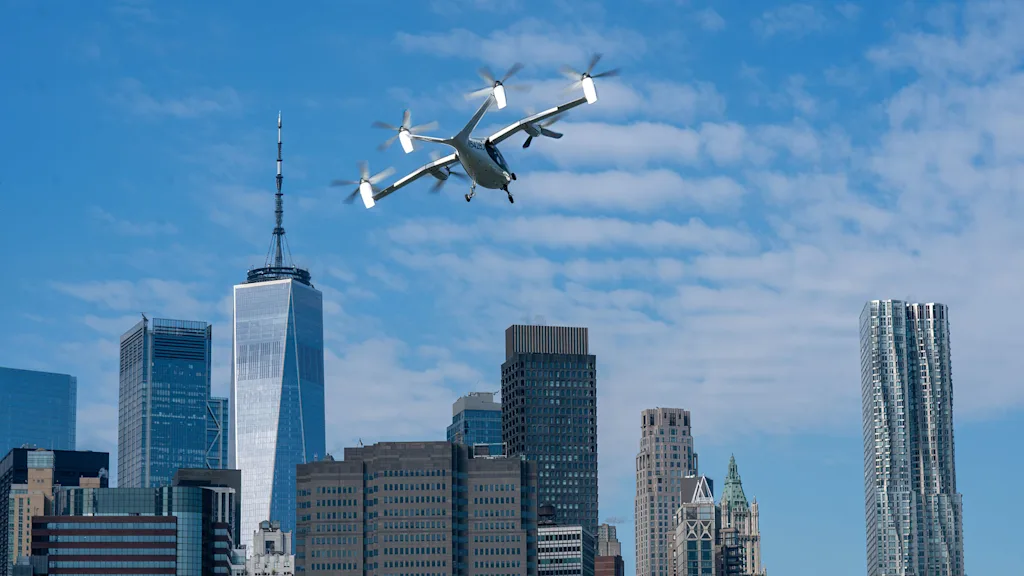
First among them is speed, but there’s also the view that Blade passengers enjoy today: “You just get this fantastic view of the skyline as you’re flying down the river and swinging over to go to the airport,” Allison said. For what Blade charges—its site lists fares from $195 to $295 for flights from Manhattan to JFK—that view had better be exceptional.
Uber, meanwhile, quoted about $145 for an Uber Black ride from midtown Manhattan to JFK and $100 for UberX early on the Tuesday afternoon of Thanksgiving week. Taking New York’s subway or the Long Island Rail Road to the AirTrain that links those transit systems to JFK (a two-seat itinerary less convenient and pricier than the airport-rail options in Chicago, D.C., or San Francisco) costs $11.40 to $15.50 for most riders.
Infrastructure weaknesses
Efficient eVTOL rides will demand a long series of sign-offs from local infrastructure operators and authorities. The easiest looks to be agreements with airports to streamline a passenger connection apart from the usual passenger entrances. Joby is working with Delta and other airline partners on that, Allison said. He added that Joby is assuming airport transfers will need time for travelers to clear security at their departing terminal. Its eVTOL, meanwhile, will need time for a quick, 10-minute battery charge.
Joby will also need to build out vertiports for its aircraft across its target markets, which will be a lot more involved than clearing space for its operations at airports. A lawsuit the company filed against its rival Archer Aviation offered a peek at one part of that strategy: exclusive deals with property developers, one of which Joby alleges its former executive George Kivork disrupted by taking sensitive data about that deal to Archer.
Archer denied the allegations in a statement from Eric Lentell, chief legal and strategy officer, that read, in part: “Joby alleges we used their trade secrets to win a ‘deal’ with a developer but the reality is that Archer has no deal with this developer and Mr. Kivork did not bring any Joby confidential information to Archer.” Joby, in turn, declined to comment beyond the details of its complaint, filed in Santa Cruz Superior Court on November 19.
The regulatory road ahead
Getting this far has not been cheap for Joby. On November 5, the firm reported a Q3 loss of $401 million, versus $144 million in the year-ago quarter, with $978 million in cash, cash equivalents, and short-term investments.
Securing U.S. regulatory approval of its eVTOL will clear the company’s path to revenue service. On the day of its earnings release, it announced that it had begun powered-up testing of the first aircraft built to the final design that the Federal Aviation Administration will need to certify. Joby aims to have test flights, conducted by its own and FAA pilots, start later this year. Allison declined to predict when the FAA will issue a type certification for its eVTOL.
The company is exploring ways to launch pre-commercial operations in Dubai ahead of that certification. In the U.S. it plans to apply for a new eVTOL pilot-operations program announced by the FAA in September—the latest in a series of moves by the air-safety agency to adapt its regulations for this new category of aircraft.
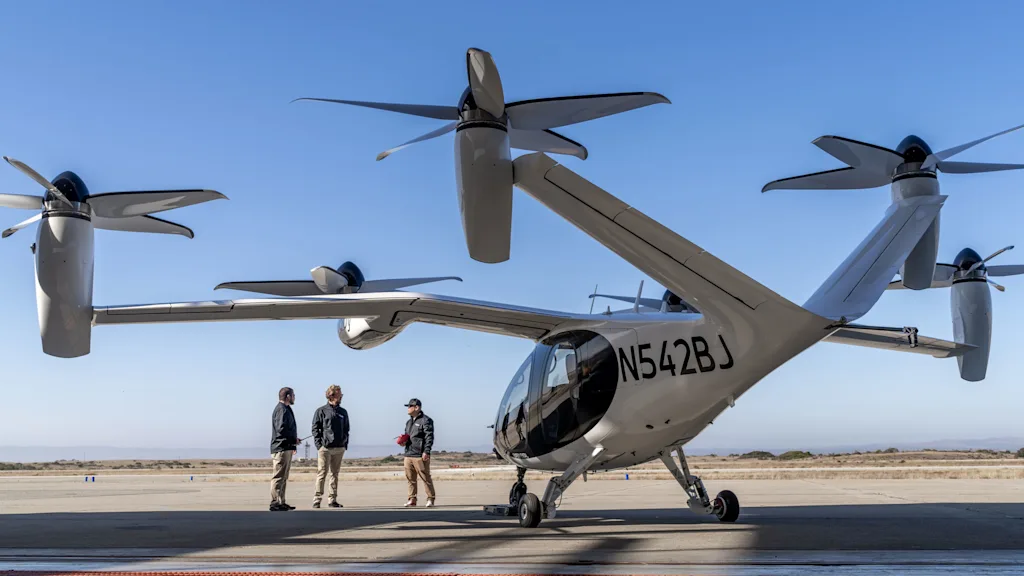
But overall, Joby’s plans envisage FAA certification serving as a runway for flight-safety sign-offs elsewhere. In the U.S., any eVTOL firm will have to work with an air traffic control system that’s already under strain. Allison said that Joby’s simulations with the FAA show that its operations are doable “with minor tweaks to procedures today.” But after a year of air traffic control mishaps that include a deadly midair collision near Washington, D.C.’s National Airport in January of this year, Joby shouldn’t assume a quick clearance for its service and would be wise to stick with a mindset that Allison defined as “crawl, walk, run.”
Disclosure: I moderated three panels at Web Summit, in return for which the event’s organizers paid for my hotel and are reimbursing my airfare.