
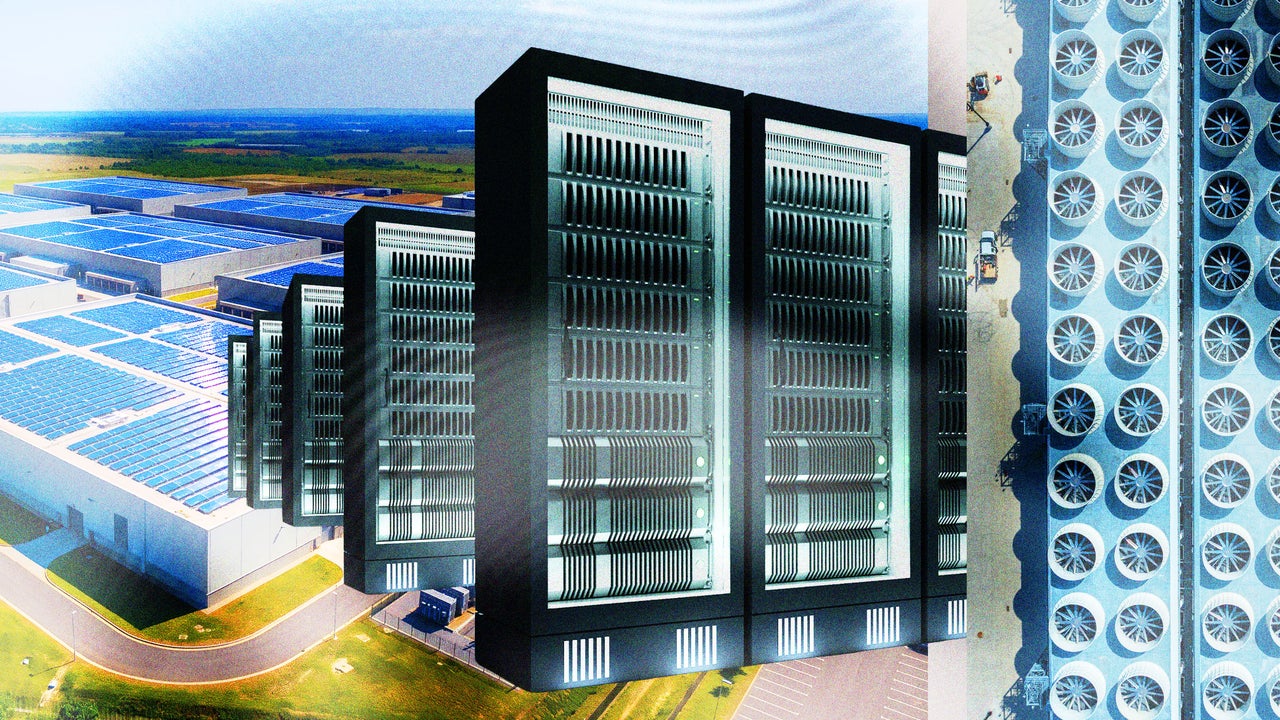
For the past few years, the AI infrastructure race has been driven by the assumption that larger artificial intelligence models require larger data centers. That idea has fueled an extraordinary wave of spending.
In rural Richland Parish, Louisiana, for example, Meta is building one of the world’s largest AI infrastructure projects. Its Hyperion campus is expected to cost more than $50 billion and run on about 5 gigawatts of power, roughly the output of five nuclear reactors.
But as these facilities grow, so does the resistance to them. Across the country, communities are pushing back over data centers’ demands on power and water, and the impacts they’re having on rural and suburban areas. The bigger the project, the more likely it is to become a political target.
But Tom Leighton, cofounder and CEO of Akamai, the $18 billion content delivery network company that powers a significant share of the world’s web traffic, would argue that’s not even the worst part. The Meta project, like so many others, rests on the assumption that companies able to concentrate the most computing power will be best positioned to build the next generation of AI systems. And Leighton believes that assumption applies more clearly to AI training than to AI inference (the “thinking” that AI does when applying its training to real-world data).
“The next challenge for AI is what it will take to run those models and their derivatives everywhere,” he tells Fast Company, sharing his belief that the industry may be trying to solve too many problems with the same enormous building.
Leighton’s 28-year-old company has spent the past several years expanding into a cloud platform for AI. Rather than trying to match the hyperscalers data center for data center, Akamai is betting on a different approach offer a less disruptive path for expanding AI infrastructure, one that relies more heavily on a network of existing facilities instead of concentrating enormous demands for land and power in a single community.
“Agentic AI needs low latency, high performance, and affordable economics that giant, centralized data centers cannot provide,” Leighton says.
His proposed solution is also inspired by what made Akamai a player in internet infrastructure to begin with during the dot-com era. In the late 1990s, Leighton helped address the web’s growing pains, when every request going back to a handful of centralized servers was choking the internet’s growth. Now, Akamai is attempting to bring a version of the architecture that saved the web to AI.
And Leighton’s got the AI kingmaker Nvidia backing him.
Bigger AI data centers won’t solve every AI problem
Leighton’s proposed solution is partly an economic one. Running an AI model is a different problem from training one, and many inference tasks do not require the largest model, the most powerful chips, or a request traveling thousands of miles to a massive centralized campus.
For enterprises pursuing agentic AI, the debate extends beyond securing graphics processing unit (GPU) capacity. Companies increasingly need to decide where inference should run, where enterprise data is processed, how quickly AI agents must respond, what it costs to move data across regions, and how security policies are enforced once those systems move into production. In other words, deploying AI agents increasingly becomes an infrastructure design problem—not just a model selection problem.
Leighton argues those operational decisions, not raw compute alone, will determine whether AI applications deliver acceptable performance, reliability and economics at scale.
Inference performance depends partly on how quickly an AI system can respond when a decision is required. Network distance, data location, tool calls, and application design can all affect response time.
“If an AI request has to travel thousands of miles, touch data in another location, call tools, and then return an answer to a user in real time, the speed of the data center is only one part of the equation,” Leighton says. “Proximity matters. In fact, it may matter even more as AI evolves.”
Leighton’s view draws on Akamai’s experience with web infrastructure during the late 1990s.
As the web expanded, centralized origin servers struggled to handle global demand. “Websites were built around centralized origin servers. As demand went global, every user request had to travel back to a small number of central places,” Leighton recalls. “The result was slow performance, websites would go down or freeze up during traffic spikes, and there was a lot of frustration for users.”
The industry called the problem the “World Wide Wait.” Leighton, an MIT applied mathematician, helped develop an alternative based on distributing content and computation closer to users. Algorithms determined where requests should be served.
Nearly three decades later, Leighton believes AI infrastructure now faces a related distribution problem, and argues that a major engineering challenge will be coordinating inference across thousands of data center locations while maintaining consistent performance, security, and reliability as a unified system.
“Anyone can build a data center, but making many locations act intelligently together, under changing demand, with consistent performance and trust, is another challenge altogether,” he says.
Can distributed AI outperform centralized clouds?
The central component of Akamai’s strategy is AI Grid, an orchestration layer developed with Nvidia. AI Grid determines whether an inference workload should run in a centralized AI factory, a regional cloud, or one of Akamai’s edge locations. The decision depends on latency requirements, operating costs, and performance needs.
Leighton argues that routing decisions can materially affect inference performance. GPU cost and availability remain significant constraints, but the industry is asking step-one questions in a step-two market.
“The bigger questions are around where inference should run, what data it needs, how quickly the response must come back, what it will cost to move the data, and what security policy has to be enforced along the way,” he says. “The answers to those questions will have a much bigger impact on whether AI reaches its potential.”
For Leighton, the definition of scale itself is changing. During the training era, scale meant concentrating as much compute as possible inside a single AI factory. In the agent era, he argues, scale increasingly depends on how effectively infrastructure can distribute inference across many locations while keeping latency, data movement, and costs under control.
“GPU availability is a major issue today, but GPUs are not the solution to every AI problem,” he argues. “Many inference tasks do not need the largest model or the largest cluster or the most expensive compute. What they need is the ability to marry the right model, in the right place, data and moment, at the most effective cost.”
Akamai says customer demand is beginning to reflect this approach. Earlier this year, the company disclosed a four-year, $200 million agreement with an unnamed major U.S. technology company to deploy one of the world’s largest clusters of Nvidia RTX PRO 6000 Blackwell GPUs on its platform.
Three months later, Akamai announced a seven-year, $1.8 billion cloud infrastructure commitment from a leading U.S. frontier AI model developer. Insider reports identified the company as Anthropic. The agreement is the largest contract in Akamai’s 28-year history.
Together, the two agreements represent roughly $2 billion in committed cloud business from customers Akamai did not have two years ago. Akamai’s cloud infrastructure revenue has also grown 40% year over year.
Leighton declined to identify the companies or discuss the workloads behind the agreements. He says customer evaluations now include a broader set of operational questions. “When customers evaluate AI infrastructure, of course they look at scale and performance,” he says. “But they’re also asking how workloads perform in production, how costs evolve over time, how reliable the infrastructure is, and whether it gives them the flexibility to adapt as AI usage changes.”
Without naming additional customers, Leighton says Akamai is supporting production AI deployments for an AI-powered video intelligence platform in India and a U.S.-based consumer AI company. Both require low-latency inference and do not depend on large centralized training clusters.
The real cost of AI goes far beyond GPUs
Many companies evaluate AI infrastructure through token prices, GPU usage, and model endpoint costs. Production systems also create costs related to context retrieval, API calls, storage reads, and network traffic across zones and regions.
Akamai claims its architecture can reduce inference latency by as much as 2.5 times compared with traditional hyperscaler infrastructure, and lower inference costs by up to 86%. Its published benchmarks, conducted using Nvidia’s methodology, show RTX PRO 6000 Blackwell GPUs on Akamai’s cloud delivering up to 1.63 times the inference throughput of Nvidia H100 GPUs. The system sustained roughly 24,000 tokens per second per server under 100 concurrent requests.
Leighton says the commercial viability of AI infrastructure will depend on whether those systems can deliver acceptable performance, reliability, and cost.
“As a CEO, I am always skeptical of vague economics,” he says. “It is easy to say the future is bigger data centers and more GPUs. It is harder to show how that architecture delivers the right performance, reliability, and cost when AI is running everywhere, all the time. Inference is where AI must show profitable ROI.”
Leighton’s background includes work as a theoretical computer scientist. He holds more than 50 patents and has served as Akamai’s CEO for more than two decades.
“As a mathematician, I am skeptical of straight-line thinking. The fact that one architecture worked for the first phase of AI does not mean it will work for every phase that follows,” he says. “As a theoretical computer scientist, I am aware that what ignites a technological revolution is rarely the thing that lets it survive in the real world. The early promise of AI is no exception. The massive centralized clouds that started this boom aren’t built for the highly distributed reality of what comes next.”
Wall Street is still pricing AI like the cloud era
Wall Street has spent much of 2026 evaluating how Akamai’s cloud business fits with its legacy operations. The company’s content delivery network business has been shrinking for years. Its AI cloud expansion has also required substantial spending on hardware and infrastructure.
Rising memory prices, driven by strong demand for AI hardware, increased component costs as Akamai purchased thousands of Blackwell GPUs. Margins compressed, and earnings per share declined even as revenue grew. Investors continued to value the company largely as a mature infrastructure provider.
The $1.8 billion commitment led to Akamai’s largest single-day stock rally in more than two decades. The agreement provides evidence of demand for Akamai’s distributed AI infrastructure. It also underscores the amount of capital required to build and operate that infrastructure at scale.
“It highlights both the opportunity and the discipline required to pursue it,” Leighton says. “We are making significant investments because we believe AI will be a major driver of cloud demand, but we are not trying to simply copy the hyperscaler model. Our advantage is that we already operate one of the world’s most distributed platforms, and power and protect large parts of the internet. The investments we are making are about extending that platform for cloud and AI.”
The AI industry has invested heavily in GPUs, large clusters, and more powerful models. Leighton argues that inference will require additional infrastructure designed around distribution, latency, and cost. “In the early days of the web, many people assumed the answer was just more central infrastructure. It was not. AI is reaching a similar point,” he says.
Whether Akamai’s distributed model can compete effectively with centralized cloud providers will depend on customer demand, technical performance, and the economics of operating the network at scale.