
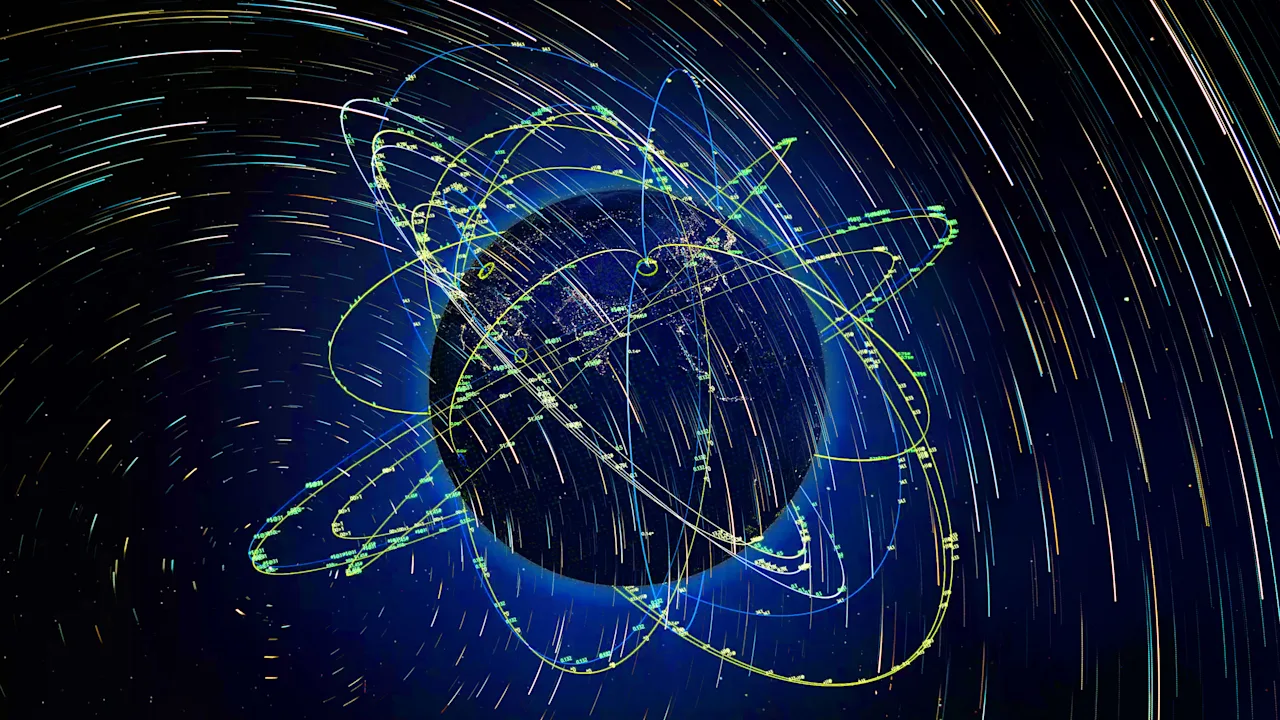
Low Earth orbit is already getting crowded. Around 14,500 active satellites are circling Earth, and roughly two-thirds of them are run by SpaceX. Now, in filings connected to Elon Musk’s plan to fold SpaceX and his AI firm xAI together ahead of an IPO, the company has asked the Federal Communications Commission (FCC) for permission to launch up to one million more.
The figure is so large it would dwarf the number of satellites currently in orbit. In fact, it is more than every object ever sent into space by every nation combined. So why is Musk planning it, and what would it mean for the rest of us?
In a public update posted on the SpaceX website as part of the merger process between SpaceX and xAI, Musk wrote that “Launching a constellation of a million satellites that operate as orbital data centers is a first step towards becoming a Kardashev II-level civilization.” The Kardashev scale is a measure of technological development first outlined in the 1960s by Soviet astronomer Nikolai Kardashev, who died in 2019.
While the scale of the proposal may have impressed Kardashev, many experts are far more skeptical. A million new satellites would represent roughly a 67-fold increase over today’s orbital population. “Proposals on the scale being discussed—up to one million satellites—represent a step change that deserves the same level of scrutiny we would apply to any other major global infrastructure project,” says Ruskin Hartley, CEO of DarkSky International, a nonprofit focused on preserving night skies and mitigating the impacts of light pollution.
Satellite deployment at such a scale would have huge knock-on effects. “The consequences extend well beyond astronomy,” Hartley says. “They include cumulative impacts on the night sky, increased atmospheric pollution from satellite launches and re-entries, and a sharply elevated risk of orbital congestion and collision cascades that could impair access to low Earth orbit for all nations.” When satellites burn up, they release metals such as aluminum into the upper atmosphere, a process scientists and the U.K. Space Agency warn is still poorly understood but likely accelerating as megaconstellations grow.
There is also the question of safety. Space is already crowded with satellites that power communications, enable GPS navigation, and support countless services we rely on every day. Adding vastly more objects increases the chances of close approaches, which, if not monitored and avoided, can result in collisions and cascading debris. “SpaceX will say they can do that stationkeeping successfully, but it doesn’t take many failures to have you end up in a bad situation,” says Jonathan McDowell, an astronomer and space sustainability analyst based in London and Boston and formerly at the Center for Astrophysics. “The SpaceX satellites will be in the higher part of low Earth orbit where it will take a long time for failed satellites to re-enter.”
Hartley, for his part, argues that these risks demand far more scrutiny. “Decisions made now will shape the near-Earth environment for generations,” he says.
Not everyone believes the million-satellite figure is even realistic. “As to the question of if it’s practical, I would think not,” says Caleb Henry, director of research at Quilty Space. “Filing for 1 million satellites is probably a way for SpaceX to push the envelope before accepting whatever fraction regulators deem acceptable.”
That tactic may already be working. The FCC initially rejected a 2022 SpaceX proposal to launch 30,000 satellites, before later approving it in 25% tranches. “The commission authorized another 7,500 satellites this January, for a total approval of 15,000 satellites from that filing,” says Henry. SpaceX is also asking the FCC to waive standard deployment milestones, and says the economics of the plan depend on Starship becoming fully reusable, a goal it has not yet reached.
In that sense, the million-satellite request is not a signal of imminent growth, but a bid to stake out spectrum and orbital real estate for a future that Musk is already trying to define.