
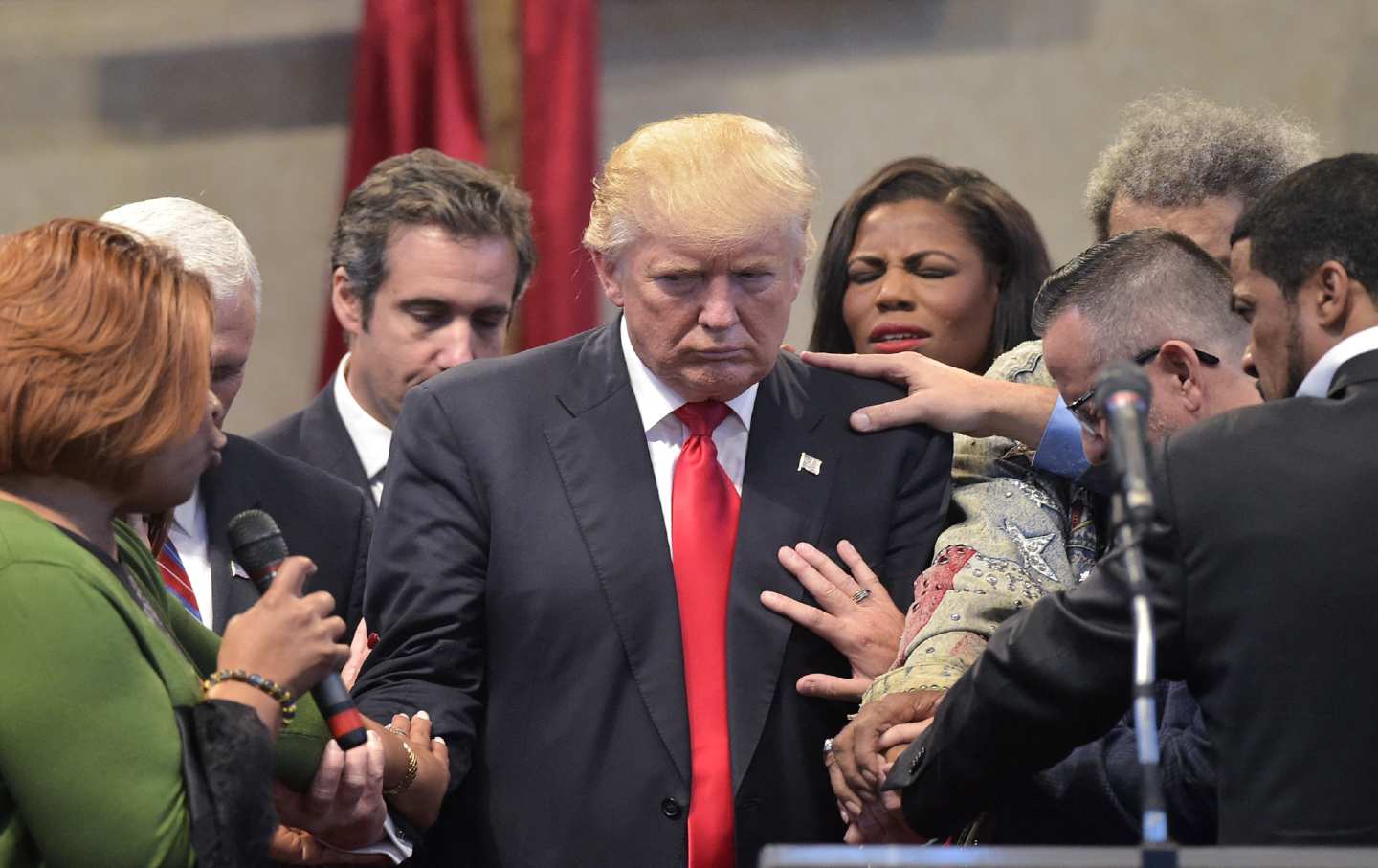
This week, President Donald Trump will be reading aloud from 2 Chronicles, as part of a week-long nationwide streaming event called “America Reads the Bible.” Trump’s participation is widely seen as an effort to shore up his standing among his evangelical base after a rocky few weeks of controversy. In recent weeks, Trump’s Christian right supporters have had to reckon anew with the fact that their purported values and those of their president are deeply misaligned. Whether Trump is chastising the pope, mocking Allah, or posting memes of himself as Jesus, he is a man who believes he is above faith and superior to those who profess it.
Yet, as we can see from Trump’s tour in the virtual pulpit for an event intended to showcase the scriptural unity of the evangelical right, he’s not a figure that the movement can readily disown. Indeed, this latest bout of cognitive dissonance on the evangelical right serves chiefly to remind us how far American evangelicals have already gone toward elevating the unlikely figure of Trump as the vessel for their mission to revive Christian nationalism, and to place it at the forefront of the American right’s governing agenda. That’s the clear reason that one of the most worldly and gleefully depraved figures in American political life has managed to draw the support of and then maintained his hold on religious people—especially white evangelicals. Pundits and religious observers have been asking themselves since the dawn of the MAGA movement more than a decade ago just how a thrice-married casino owner who mocks opponents, savors vengeance, and revels in cruelty could become the hero of millions of devout Christians.
The short answer is that he seized on a central truth about evangelism in the postmodern age: It is a style, not a theology. Trump did not convert evangelicals. He mastered their techniques of revivalism—emotional intensity, apocalyptic urgency, charismatic authority, and a stark division between the faithful and the damned—and translated them into politics. His appeal was never about substance or theology but spectacle and performance. In short, Trump is the ultimate American televangelist.
In 2016 the former real estate baron and reality-TV star earned 81 percent of the white evangelical vote, a higher percentage than previous GOP front-runners George W. Bush, Mitt Romney, and John McCain. In 2020, Trump secured the votes of 85 percent of Americans who both self-identified as evangelicals and attended church regularly. In 2024, he again secured over 80 percent of the evangelical vote.
What evangelicals have mostly received in exchange for their unyielding support is a Trumpian variation on the same wrenching dilemma that’s dogged them throughout the past half century of spiritually minded political activism: the inherent contradictions between faith and policy. The teachings of Jesus seem unmistakable. Care for the poor and the downtrodden—Trump cuts social services. Welcome the stranger and the outsider—Trump drives them out of the country. Offer mercy and grace—Trump spews contempt and vows revenge. Bless the peacemakers—Trump thrives on discord and promises annihilation. In his searing criticism of the unprovoked US/Israeli war on Iran, Pope Leo, like Francis before him, made clear how far out of line Trump’s policies are with traditional Christian values.
But Trump’s theological aberrations don’t matter—it’s his personalist message of cultural domination that attracts his evangelical base, even when his actions and pronouncements defy the basic precepts of gospel belief.
Still, Trump’s repudiation of theological substance in mimicking an evangelical style isn’t just another feature of his own omnivorous attention-seeking ego: It’s actually deeply rooted in the traditions of American public religion. The unique role of religion in American history has made Trump’s seamless merger of religion and politics possible. We too often imagine the First Amendment’s strictures against a religious establishment as the product of high ideals blended with deep Enlightenment philosophy and careful, rational thought. It actually grew out of crass pragmatism—the need to secure claimants to religious truth on a roughly equal standing lest they revert to the violent premodern European habits of using the state to promote religious warfare—or vice versa, in many cases.
The founders recognized they needed a unified nation—meaning they could not afford to have Congregationalists killing Baptists killing Anglicans killing Presbyterians killing Catholics. They could not choose a single establishment religion and instead pledged to support its free exercise. Thomas Jefferson wrote more than a decade later that the amendment had separated church from state, but it often failed to realize that ideal in practice.
America’s bewildering new spiritual marketplace meant that religious leaders had to find a way to compel audiences to come to church. They had no pope or bishop or king to legitimize them; their spiritual authority had to come from the people.
The First Amendment forced religious leaders to become entrepreneurs of faith. To survive, they had to be on the cutting edge of both popular entertainment and communications technology.
Christianity forged many new modes of mass appeal in the United States, but its most popular and effective form was the revival. American revivals were first and foremost pietist spectacles; they thrived on intense public expression of religious sentiment. No creeds, no deep theological reflection, no careful catechisms.
Revivalism touched spirit, emotion, and feelings. It promised secret knowledge—the revelation of fact found only in one’s heart. Truth came through feeling, not thinking. The body, its tears, its shouts, its gyrations all provided evidence of sincerity. It was a style of worship that accommodated many different theologies.
The leading revivalist of the early 19th century, Charles Grandison Finney, recognized how well-suited revivalism was for the American context. Finney claimed that revivals had nothing to do with divine mystery. He treated conversion as a process that could be engineered, staged, and repeated. He pioneered new techniques such as the anxious bench to discipline bodies and emotions in real time and to produce submission. He ranged over this audience in every way—emotionally, physically, and metaphysically.
Audience members described the emotional intensity of Finney’s services. They felt God speaking through him, which produced powerful physical reactions: weeping, crying, and sometimes screaming. The force of the services, which believers attributed to the Holy Spirit, was overpowering.
Mindful that their ministries rested on closing the deal with convicted sinners, revivalists always confronted listeners with explicit choices. Audience members could either accept what a revivalist was offering, or they were relegated to the spiritual wilderness. The choice was always clear: heaven or hell.
Revivalists made the choice easy—intentionally so. Opting in required almost nothing but a pledge of loyalty to God (and often his earthly emissary, in the person of the revival preacher). Revivalists offered cheap grace for the taking. In endless cycles of sin and repentance, they emphasized that no one was ever beyond redemption. No matter how many times you screwed up, you could always come back.
Revivalists like Finney grounded their authority in their charisma—their ability to hold a crowd. It had nothing to do with their level of education, theological expertise, or institutional position. Indeed, a key revolution engineered by the early republic revivals was the repudiation of “the learned clergy” as the apostles of a stiff-necked and desiccated theological elite.
Revivalism worked because it created in audiences a sense of certainty and provided a feeling of community. Through revival, individuals could become part of God’s elect, securing eternal life in his holy kingdom. Their feelings and emotions served as all the proof they needed that they had found the right path. They had received entrée into a select club.
Revivalism also had an authoritarian side. Revivalists often claimed to have God’s anointing; they were convinced that they were special and that God had called them to represent him. They believed that they needed to be followed, not challenged or questioned.
When opposition arose, revivalists blamed Satan. They told their audiences that they were the embattled faithful, surrounded on all sides by the evil forces of a secular and libertine culture—or in what was worse for many 19th-century Protestant believers, the corrupt canons of Roman Catholicism.
In the late 19th century, most revivalists built into their rituals a sense of an imminent apocalypse. One of the greatest millennialist preachers of that era, businessman turned evangelist Dwight Moody, attracted a new mass urban following to his stark message that the end of the world was near.
Moody used apocalyptic ideas to foster in the faithful a powerful sense of purpose and personal identity. The conviction that they were securely on the right—i.e., the divine—side of history helped them interpret the often brutal challenges of individual advancement in America’s impersonal new industrial order. It also imbued them with a triumphant vision of the future. They believed that no matter how dire the circumstances, they were sure to be in God’s preordained saving remnant.
Rather than fostering a sense of indifference to the coming of the end of days, revivalism served as a call to battle. God, evangelists insisted, had given them much to do and very little time in which to do it. They had to act—now.
In the 20th century, revivalists drew on the latest technology, exponentially increasingly their effectiveness. New communications techniques allowed them to reach ever greater numbers of believers while collapsing the distance between the preacher and the audience. Radio rewarded precisely the powerful spiritual themes that earlier revivalists had already honed—emotional intimacy, arresting spectacle, charisma, and a clear choice between heaven and hell.
The enormously successful radio ministry of Aimee Semple McPherson allowed her to speak to her followers as if she were in their living rooms. Like her predecessors, she played on emotions, conveyed unquestionable authority, and offered secret knowledge.
The advent of television marked a new stage in the evolution of the revivalist style. Image began to matter more than ever. A key element in the mass appeal of evangelical preacher Billy Graham, the most effective revivalist of the 20th century, was his movie-star looks.
As the media landscape evolved in the latter part of the century, Pat Robertson recognized the value inherent in building an alternative Christian communications universe. The son of a right-wing US senator, Robertson began buying up local television stations in the 1960s, forming them into the influential Christian Broadcasting Network. In 1977, Robertson made an even bolder move, launching a satellite into space, which allowed him to create a national Christian cable television network. Revivalism now had its own broadcasting empire. Christian revivalist leaders understand more than ever that their success rested on direct, unmediated communication with the masses.
Two revivalists in particular harnessed the power of this communications revolution to ply a new gospel of success that directly appealed to Donald Trump’s protean grasp of the evangelical style: Norman Vincent Peale, and more recently, Paula White-Cain.
In the mid-20th century, Peale was one of the nation’s most popular ministers. He served as the pastor of Fifth Avenue’s Marble Collegiate Church in Manhattan and was a regular fixture on television—and in right-wing Protestant activism. He counted Fred and Mary Trump, parents of the future president, among his congregants. Donald was also a member, getting a firsthand look at Peale’s wildly successful formula for marketing Christianity to the masses.
Like generations of revivalist preachers before him, Peale disparaged rationality. He gained national fame through his 1952 bestseller The Power of Positive Thinking. In this book, Peale offered a unique blend of traditional Christian concepts, ideas from psychology, and elements of the proto–New Age strain of speculative Protestantism known as New Thought. He encouraged readers to discover self-confidence and pursue worldly goals. He promised them that they need not be defeated by anything; in following his catechistic formula of reciting Scripture-adjacent success mantras to themselves, they could attain peace of mind, improved health, and “a never-ceasing flow of energy.” The Christianity he hawked to the masses promised bliss based on the use of religion to construct alternative mental realities. He masterfully integrated a new, consumer-based version of the prosperity gospel pioneered by influential Pentecostal “seed-faith” ministers into his work.
A new generation of evangelical preachers tied Peale’s ideas even more directly to financial success. Oral Roberts, Jim and Tammy Bakker, and later Fred Price and Benny Hinn perfected a form of televised revivalism that further blurred the lines between religion and entertainment. Today, Joel Osteen preaches a soft version of the same success-minded gospel. These ministers all taught that material success signaled divine favor—and that, as an inevitable corollary, poverty was the hallmark of an adverse judgment from on high.
They also developed a new revivalist aesthetic fitted to the modern media landscape. Their hair was always perfect—resistant to both time and sweat. Most of the time it was big and ostentatious; sometimes it was just weird—see, for example, Benny Hinn’s grandiose combover, or the late Jimmy Swaggart’s New Southern tonsure, which was a slicked-back Sunday version of the wilder mane of his double-first cousin Jerry Lee Louis. Their makeup, regardless of their gender, was overdone, and always susceptible to running with tears. The men were always tan. White suits and glittering gold jewelry were customary.
Their language was always exaggerated, full of superlatives, absolutions, and total confidence. Their sermons were more sales pitch than biblical homilies.
Televangelists also gilded their studios, which typically featured lots of gold trim, glass pulpits, plush furniture, and soft backdrops. Rober Schuller’s own enormous positive-thinking temple in Southern California, known as the Crystal Cathedral for its all-glass façade, was an early exponent of this aesthetic—though after his death and the bankruptcy of his estate, it was sold to a Catholic diocese in 2012, in another telling indication of how universal the televangelist style has become.
And like many of their forebears, from Finney to McPherson, televangelists conveyed latent sexuality. They performed ecstatic religious rituals, moaning and groaning and babbling in tongues. Their pulpit performances, combined with their lavishly appointed megachurches, which conjured the believer’s eternal repose in a gilded penthouse, produced a verbal and visual grammar that at every point equated material prosperity with spiritual authority.
Trump encountered this evangelical style directly through Paula White-Cain (who is married to a member of the 1980s prog-rock group Journey). In 2002 Trump saw White-Cain on television. She had started a thriving Florida megachurch preaching the prosperity gospel. Trump told her she had the “it” factor, and that he loved her sermons on “riches.” Trump also apparently told White-Cain that he had learned the basics of evangelical preaching not just from her but also from Peale, Graham, and Swaggart.
The minister purchased an apartment in Trump Tower and spent more than a decade advising and counseling Trump before his 2016 run for president. She introduced Trump to a menagerie of like-minded revivalists: televangelists, faith healers, prosperity preachers, and messianic rabbis. They validate Trump, and cheer his style, and he does the same for them.
When Trump entered politics, the evangelical masses fell right in line behind him and his now-influential coterie of tongues-speaking, prosperity-preaching, Gucci-wearing, sun-tanned evangelists. They can often be seen leading prayers at rallies or praying over Trump in the Oval Office.
Trump did not have to bring evangelicals into his coalition. To those who had witnessed a Billy Graham crusade, or heard Oral Roberts promise health and prosperity, or cried along with Tammy Faye Bakker, Trump was a familiar figure. He moved into the world they had created. Much more than a Jeb Bush or Marco Rubio, Trump had made the evangelical revivalist style his own.
Trump even runs his rallies to rehearse a narrative arc that revivalists had perfected over centuries. He deploys warm-up speakers to set the emotional register of anxious anticipation of the headliner’s saving message. His audiences engage in calls and responses. He uses music to cue anticipation. When he appears, he demands adulation. He vacillates between promises of success and threats against the forces aligned against him.
Popular
“swipe left below to view more authors”Swipe →
This litany of peril, judgment, and redemption follows the patterns established by the 18th-century preachers of the civic-castigating public sermons known as the “American jeremiads.” He regularly warns of an imminent apocalypse. He demands loyalty. He testifies. He reassures the devout. He promises blissful passage into the millennium—or the Golden Age, as he called the fruits of his second-term agenda on the 2024 campaign stump.
He also names his enemies, who happen to be the same groups that have dogged televangelists through the modern era: faithless academics who lead children away from God; “fake news” journalists who question his spending habits and lifestyle; and “deep state” government agents who seek to ensure that he is following the law.
Trump does not argue policy. He does not try to persuade with logic. He uses repetition over explanation and emotional intensity over coherence. He prefers “the weave” over exposition, and the invocation of culture-war fearmongering over the wonky details of accountable governance. His favorite callout to such fears is the refrain that if some part of his agenda—mass detention of immigrants, or the carpet-bombing of Iranian targets—isn’t met with complete deference, “you won’t have a country anymore.” It’s a line that would likely have resonated with Dwight Moody, who called the world “a wrecked vessel” and described the preacher’s mission as akin to that of a lifeboat pilot who must “save all you can.”
Other parallels between the president and the preacher are abundant. Revivalists have long promised that if you follow God’s law, he will reward you with abundance and riches. Trump tells us that if we follow his law, he will do the same—even as key economic indicators such as unemployment and inflation have taken dire turns on his watch. But like any good prosperity minister, Trump assures the faithful that their privation will only yield greater worldly returns in the long haul. To quote one of Robert Schuller’s pet taglines, “Tough times don’t last, but tough people do.”
Evangelical leaders have told us that we have nothing to fear if we follow their simple rules—that God will protect us. And perhaps we should drop something in the offering plate as a sign of our faith. Trump makes identical promises, only he stands in for the Almighty. And purchasing his cryptocurrency or NFT trading cards or his meme coins serve as the necessary evidence of our faith.
Millennial preachers in the Dwight Moody vein have assured us that the faithful are going to be victorious, that they are going to have the last laugh over the sinners and the scoffers. Trump says likewise—and brandishes variations of the QAnon end-time faith to invite his followers to imagine the most gruesome varieties of cosmic comeuppance on offer.
Secular observers treat all of these rhetorical flourishes from the presidential bully pulpit as radical departures from the norms of statesmanship. That may be so—but they are also deeply burnished in the grain of mainstream evangelical belief. Trump has tapped into a vision of the world established not by political actors but by generations of revivalists.
Trump did not invent our supercharged particularly American religious culture. He absorbed it and became its greatest champion. He did not invent a new political style; he refashioned a religious style to transform politics. He merged his idiosyncratic form of pseudo-populist authoritarianism with classic revivalist evangelicalism. He has perfected the evangelical style in American politics. The two are now indistinguishable. Donald Trump may have erred in promoting himself as a latter-day messiah, but one thing is clear: He is the televangelist meme incarnate.
More from The Nation

The damage he and his cronies have wrought could take decades to repair, particularly when it comes to science and public health.
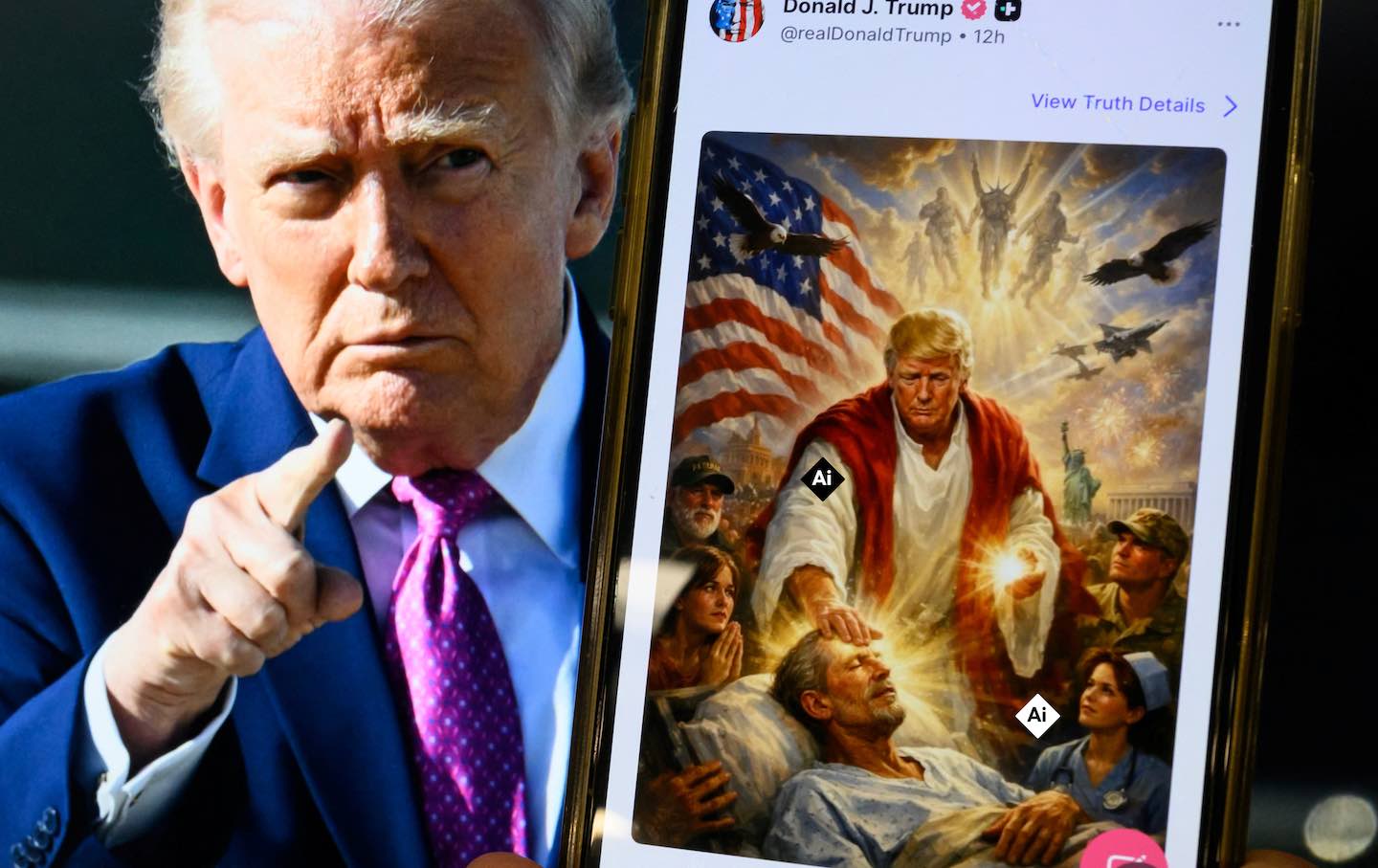
Liberals struggle to understand why the president’s evangelical supporters never seem to mind his sacrilegious tendencies. They’re missing the point.

Liberals are delighted by the MAGA titan’s opposition to the Iran War. All they’re doing is boosting the credibility of an unrepentant, pathologically dishonest, bad-faith bigot.
The Twitch streamer’s invitation to debate at the Yale Political Union drew the ire of Laura Loomer, Rick Scott, and Turning Point USA.
In an election year under an administration that has wreaked record-setting havoc, journalism is more important than ever—and we need to act like it.