
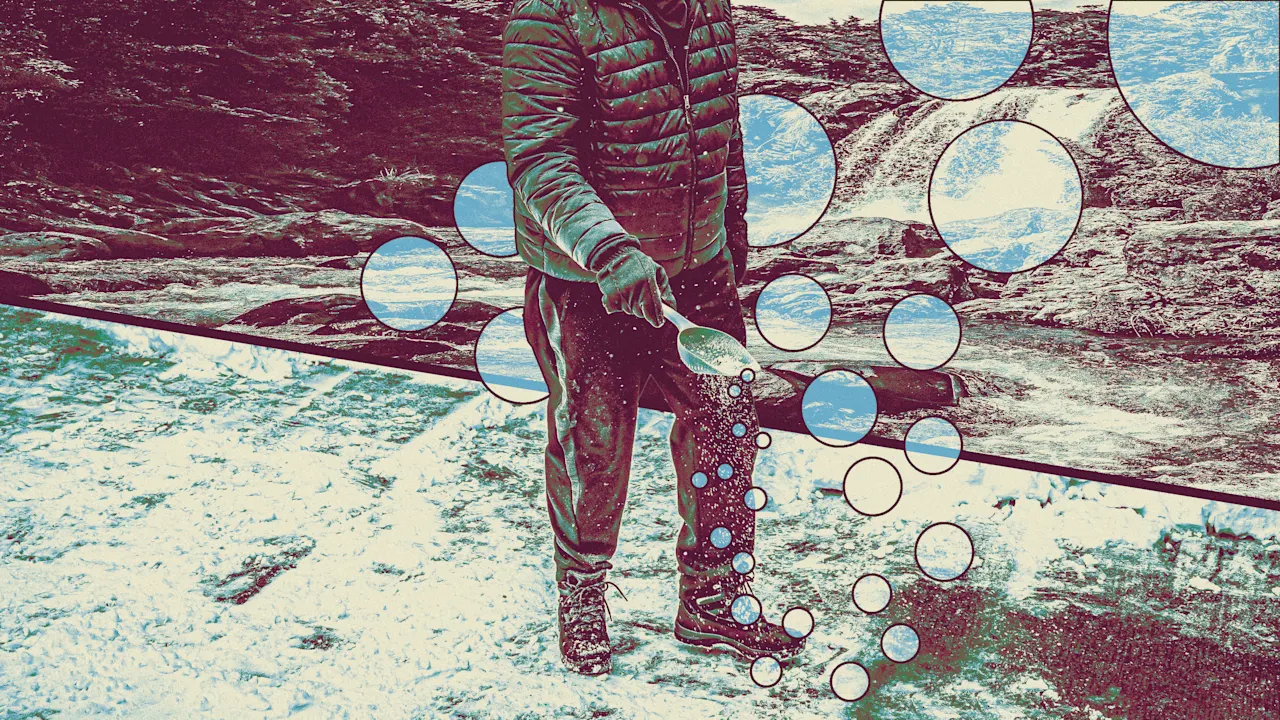
Snow has returned to the Philadelphia region, and along with it, the white residues on streets and sidewalks that result from the overapplication of deicers such as sodium chloride, or rock salt, as well as more modern salt alternatives.
As an environmental scientist who studies water pollution, I know that much of the excess salt flows into storm drains and ultimately into area streams and rivers.
For example, a citizen science stream monitoring campaign led by the Stroud Water Research Center in Chester County (about 40 miles west of Philadelphia) found that chloride concentrations in southeastern Pennsylvania streams remained higher than levels recommended by the Environmental Protection Agency not only after winter snowfalls but also in many cases during some summer months—showing salt persists in watersheds year-round.
Once there, it can have a profound impact on fish and other aquatic life. This includes a decrease in the abundance of macroinvertebrates, which are small organisms that form the base of many freshwater food webs, and reductions in growth and reproduction in fish.
Increased salt concentrations can also degrade and pollute the local water supply. Working with other researchers at Villanova University, I have measured spikes in sodium levels in Philadelphia region tap water during and immediately after snow melts. These spikes can pose a health risk to people on low-sodium diets.
What local governments can do
In recent years, many state and local governments nationwide have adopted best management practices—such as roadway brining, more efficient salt spreaders, and improved storm forecasting—to limit damage from salt to infrastructure, including roads and bridges.
Roadway brining works by applying a salt solution, or brine, that contains about 23% sodium chloride by weight prior to a storm. Unlike road salt, brines adhere to all pavement and can prevent ice from sticking to the roadway during the storm. This potentially reduces the need for subsequent road salt applications.
The environmental benefits of these best practices, when properly administered, are promising. The Maryland State Highway Administration reduced its total salt usage on roadways by almost 50% by using multiple best practices.
The extent to which these strategies will continue to reduce the salt burden on roads and, by extension, improve the water quality of streams elsewhere will largely depend on political will and corresponding economic investments.
Yet, roads are not the only source of salt to our streams. Recent studies have suggested that the cumulative amount of salt applied to other impervious surfaces in a watershed, such as parking lots, driveways, and sidewalks, can exceed that applied to roads.
For example, one survey of private contractors suggests their application rate can be up to 10 times higher than that of transportation departments.
I do not know of any studies that have been able to determine a household application rate.
How to salt at home
To better understand how individuals or households deice their properties, and what they know about the environmental impacts of deicing, I collaborated with a team of environmental scientists and psychologists at Villanova University and the local conservation-focused nonprofit Lower Merion Conservancy.
In winter 2024-2025, the Lower Merion Conservancy disseminated a survey in a social media campaign that received more than 300 responses from residents in southeastern Pennsylvania. We are completing the analysis to determine a household application rate, but some of our initial findings provide a starting point for engaging households on how to limit the environmental impact of deicers.
One key finding is that only 7% of respondents reported being aware of municipal ordinances regarding deicer use on residential sidewalks.
Of those who applied deicers to their property, 55% indicated they were unsure whether they used them in a way that would reduce environmental harm.
About 80% of all respondents indicated interest in learning more about the environmental impacts of road salt.
Based on these survey results, here are several actionable steps that homeowners can take to reduce their deicer use.
1. Check your local municipal ordinance.
Most municipalities in the greater Philadelphia area do not require deicer use but instead require clearing a walkable path—in most cases, 3 feet wide—free of snow and ice within a certain time frame after a storm event ends.
For example, the city of Philadelphia requires this to be done within six hours, the borough of Narberth within 12 hours and Lower Merion and Haverford townships within 24 hours.
Narberth and Lower Merion specify which abrasives—such as sand, ashes, and sawdust—or deicers, like rock salt, can be used if ice persists.
2. Use rock salt and other deicers judiciously.
The recommended amount from conservation organizations is one 12-ounce coffee mug of deicer for every 10 sidewalk squares. Keep in mind that “pet-friendly” deicers are not necessarily environmentally friendly. Many of these deicers contain magnesium chloride, which is harmful to plants and aquatic life.
Deicers coupled with dyes might be a good choice to visually prevent over-application. They can also temporarily reduce concrete’s surface reflectivity, thereby increasing its warming effect and enabling melting.
Finally, it’s important to know that many deicers become ineffective at or below certain temperatures. Rock salt/sodium chloride loses its effectiveness at 15 degrees Fahrenheit (minus 9 Celsius), magnesium chloride at 5 F (minus 15 C) and calcium chloride at minus 20 F (minus 29 C). If temperatures are expected to fall below those numbers, it might make sense to skip the salt.
3. Sweep up after.
We have all seen rock salt on sidewalks for days on end, especially when a storm never materializes. If the next storm brings rain, this leftover salt will form a concentrated brine solution that will wash down the nearest storm drain and into a local waterway.
Leftover salt can be swept up and reapplied after the next storm event, saving money and supplies.
Read more of our stories about Philadelphia and Pennsylvania, or sign up for our Philadelphia newsletter on Substack.
Steven Goldsmith is an associate professor of environmental science at Villanova University.
This article is republished from The Conversation under a Creative Commons license. Read the original article.