
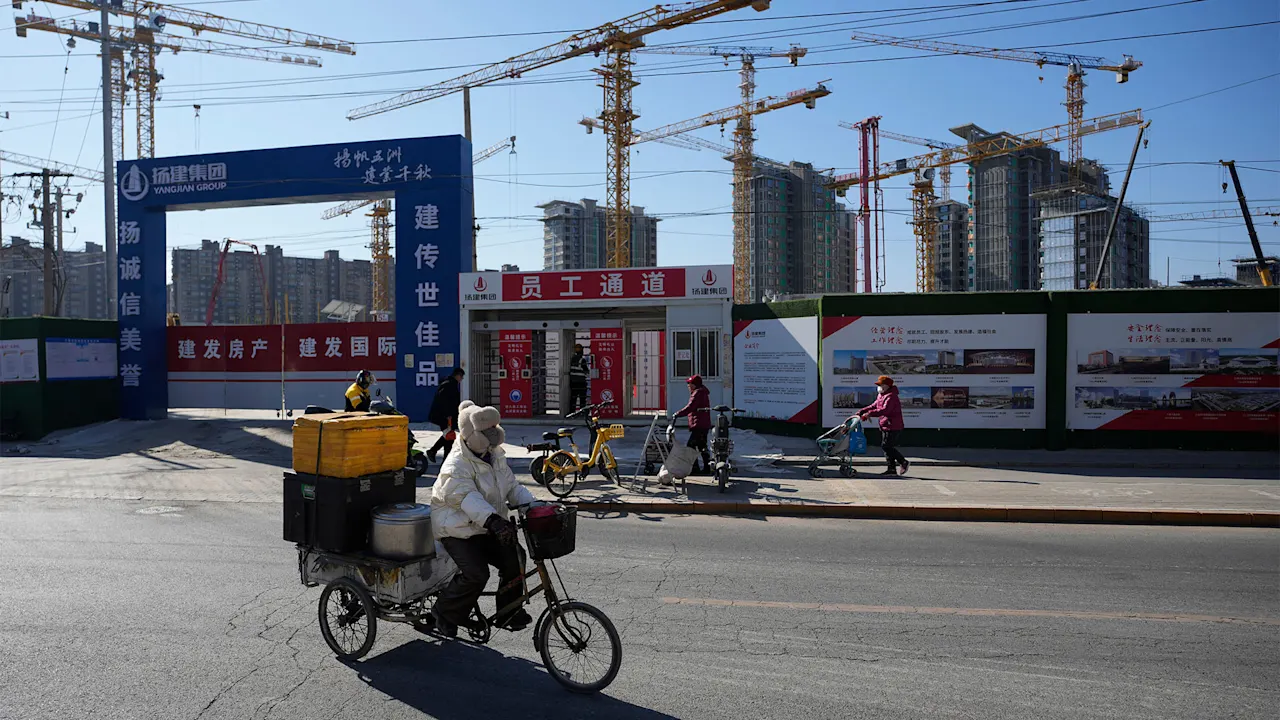
China’s progress in building a modern economy, evident in its kung-fu fighting robots and self-parking cars, is hitting limits as a downturn in its housing industry drags on, small businesses suffer and young people struggle to find jobs.
The gap between Chinese leader Xi Jinping’s high-tech, artificial intelligence-driven ambitions and the hard realities of slowing growth is the backdrop for the annual meeting of the country’s largely ceremonial national legislature, the National People’s Congress, which begins Thursday.
During the meetings, which draw about 3,000 deputies to Beijing, top leaders will outline China’s annual target for growth and the congress will endorse a five-year blueprint of policy priorities until 2030.
“What we’ll see is the trade-off between whether it’s going to be industry and tech, or looking after domestic demand,” said Alexander Davey, an analyst at the Mercator Institute for China Studies. “These are the two priorities that are juggling for Xi Jinping right now.”
China’s economy is losing momentum
In a city in southern China’s Guangdong, families were cutting back on big purchases during last month’s Lunar New Year holidays. Even for auspicious houseplants like orchids, used as a symbol of abundance and prosperity, prices were slashed by as much as 40% from last year.
The penny pinching has small business owners complaining about hard times.
China reported it reached “around 5%” economic growth in 2025, but economists question some official data.
The relatively robust pace of growth was supported by strong manufacturing as exports surged, despite U.S. President Donald Trump’s tariff hikes and other disruptions to trade.
“Hitting the 2025 growth target is hardly reassuring as the Chinese economy is losing growth momentum, with rising imbalances and enormous structural problems being papered over by a surge in export-driven growth,” Eswar Prasad, a professor of economics and trade policy at Cornell University, told The Associated Press in emailed comments.
Property slump persists
A downturn in China’s housing market began several years ago and piecemeal efforts to revive the industry have made only fitful progress. Dozens of property developers defaulted on their debts as authorities cracked down on excessive borrowing. With overall home prices down 20% or more from 2021, a recovery remains elusive.
The meltdown in one of the country’s biggest industries eliminated hundreds of thousands of jobs and with 12.7 million graduates entering the job market this year, more than 16% of young Chinese are unemployed. Some just are giving up and opting out of the rat race, or “lying flat.”
Families whose main assets are their homes have grown cautious about spending, weakening consumer demand and confounding longstanding efforts to shift the economy to greater reliance on domestic investment.
The congress may bring some fresh moves to beef up social welfare and other support, measures economists say are overdue and necessary for sustained, steady growth.
China sticks to exports
Reliance on exports is what help keeps China’s economy buzzing, at least for now. China recorded a $1.2 trillion trade surplus in 2025, as exports kept its factories humming. Despite the China-U.S. trade war, it has been shipping more to regions including Europe and Latin America. But it’s facing pushback from its trading partners.
Under leader Xi, China has prioritized developing advanced technologies such as AI, robotics, computer chips, electric vehicles and renewable energy. Massive state support has companies churning out more EVs, TVs, solar panels and other products than China and its trading partners need.
“To achieve those goals, the government is going to have to continue to provide subsidies and preferential support for high-tech and strategic industries,” said Leah Fahy, a China economist at Capital Economics. “(That) will, in turn, continue to fuel overcapacity.”
In a recent report, the International Monetary Fund urged China to cut massive state subsidies and other support for industries that many Western countries say give its companies an unfair advantage over foreign rivals. At the same time, social welfare and other areas of the economy lag behind.
The focus on what the ruling Communist Party has dubbed “high quality development” is bound to continue under the five-year plan for 2026-2030 that lawmakers are due to endorse at the congress.
Over the past few decades, China’s transformation into a manufacturing superpower was underpinned by booming construction of homes, office buildings, roads, ports and railways. But tech supply chains are narrower, providing fewer jobs. So the trickle down effect is much weaker, said Lynn Song, chief economist for Greater China at ING Bank.
“If anything, the more successful the so-called future industries become, the more they will draw resources away from the traditional sectors that still provide the bulk of employment and livelihoods for most people,” said Henry Gao, a professor of law at Singapore Management University.
Xi is expected to consolidate more power
The annual congress is an impressive show. Thousands of delegates fill the Great Hall of the People in central Beijing. A military band performs and delegates from various ethnic groups attend in traditional clothing.
For all the pomp, the meeting is largely a set piece. The congress lasts only one week and its near-unanimous votes on the final day formalize decisions made ahead of time by party leaders. It’s a show of unity reaffirming the polices and direction they have set.
Increasingly that leadership has centered on one person, Xi, who has consolidated power since taking the helm in 2012. Now 72, he is one of modern China’s most powerful leaders. Some analysts think Xi will emulate Mao Zedong, the revolutionary leader who founded communist China, and rule for life.
Annual reports presented at the congress are replete with references to the party’s crucial role, “with Comrade Xi Jinping at its core.”
Xi’s military purge is under the spotlight
After ascending to power, Xi doubled down on longstanding anti-corruption campaigns, forcing many officials to step down to face investigation and prosecution, including top military brass.
Days before the congress opened, the national legislature removed nine military officers from its ranks, widening a years long military purge. Last month, Gen. Zhang Youxia, the highest ranking military member just below Xi, was ousted over suspected disciplinary violations.
Xi’s actions may weaken China’s military readiness in coming years, but he is also ensuring the force would be more politically reliable in the longer run, a report by Center for Strategic and International Studies think tank suggested.
The anti-corruption drives have eradicated potential political rivals, and his iron grasp on power makes it much less likely other officials will challenge his vision to build China into a self-sufficient tech leader and 21st-century global power.
AP Business Writer Elaine Kurtenbach contributed.
—Chan Ho-Him and Ken Moritsugu, Associated Press