
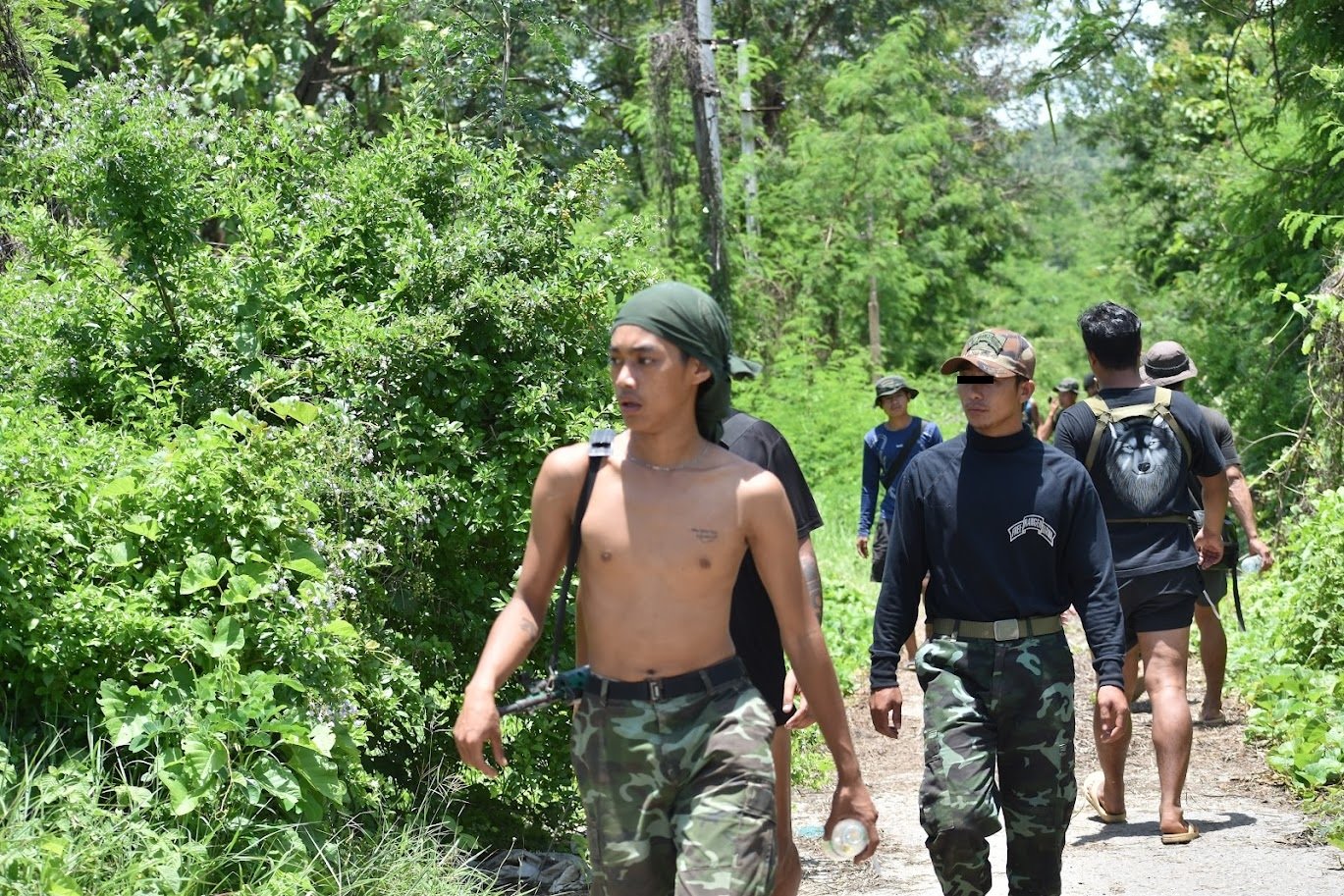
In July of this year, at the battlefront in Pasaung, Karenni State, I followed a coalition of pro-democracy ethnic resistance forces as they struggled to capture the remaining half of the city still occupied by the Burma Army.
At the casualty collection point, only a few hundred meters from the front line, I watched medics carry in the dead and wounded. The Free Burma Rangers (FBR) medical teams had set up a makeshift surgery in a drainage ditch beneath a roadway. Overhead, planes crisscrossed the sky, barely visible through the jungle canopy. The sounds of artillery and drone strikes were constant, as government forces targeted resistance fighters at the front while also dropping exploratory bombs in search of the casualty collection point. The junta knows that if you kill the medics, fewer wounded soldiers will survive. For this reason, they regularly bomb hospitals and clinics, even those in civilian areas.

Just a few months earlier, I accompanied resistance forces as they evacuated a hospital while the junta bombed another hospital and a school. The next day, they dropped thirteen pieces of ordnance around a clinic. Miraculously, no one was hurt. All of that bombing took place in civilian areas.
In the liberated areas of Karenni State, where more than 80 percent of the population has been displaced at least once since the 2021 coup that ousted the democratically elected government and sparked a full civil war, people have learned to live with explosions. But the jets, with their 500-pound bombs, represent a destructive force unparalleled on the battlefield. Every makeshift bamboo school, every village, and displaced people’s camp has a trench that even children know to dive into when they hear the jets coming.
At the front, by contrast, it would be impossible to function if you ran and hid every time a jet flew overhead. Most soldiers simply listened for the change in pitch that inevitably came when a jet was about to dive for an attack. The junta pilots know this and often dive without actually attacking, just to disrupt operations, forcing soldiers to run for cover. Other times, they dive and drop bombs. Another difference between the civilian areas and the front lines is the strafing runs, jets diving low and firing their 30 mm autocannons.

The resistance captured half of Pasaung in March, at great cost in lives, but both soldiers and civilians were encouraged. It seemed that liberation might finally be within reach. Pasaung is crucial because the city lies on the border between Karenni and Shan States and represents one of the few remaining areas of Karenni still held by the junta.
Until February and March 2025, the tide of war appeared to be turning. Across Burma, resistance forces were gaining momentum, seizing jungle areas, countryside, and small to medium-sized towns and cities, while junta troops clung only to the largest urban centers in each state. In all seven of Burma’s ethnic states, resistance armies are linked to civilian administrations, and by this year, many military leaders had begun handing authority to civilian governments, allowing the military to focus on driving out junta forces.

In Karenni State, officials were conducting a census, developing an ID system, and preparing to hold elections next year, a remarkable example of grassroots statecraft emerging from the ground up.
Kun Bedu, vice chair of the Karenni State Interim Executive Council (IEC), the provisional government established by the Karenni resistance, told me about the early days after the coup. “The first time we went into battle, we had about twenty untrained volunteers and only three weapons, two of which were .22 caliber,” he said. From those humble beginnings, the Karenni Nationalities Defense Force (KNDF) has grown to thousands of soldiers, established a functioning civilian government, reclaimed most of its state, and was now preparing to hold elections.
Unfortunately, two forces have converged to cause tremendous setbacks for the resistance. The first is Chinese intervention, and the second is the junta’s upcoming national elections.
China has long been the financial backer of the junta and, along with Russia, remains the primary supplier of weapons, aircraft, drones, and fuel. The resistance has no aircraft and no air defense systems, leaving the Burma Army with complete air superiority.
In the early phase of the revolution, the resistance was first to adapt drones, manufacturing their own or modifying civilian models in jungle camps. This innovation was one of the key reasons they achieved such success in capturing territory. However, over the past year, that advantage has evaporated. China is now supplying the junta with drones, including more advanced models and drone jammers. There have even been isolated reports of fiber-optic-controlled drones, which are more precise and nearly impossible for the resistance to hack or jam.

At the battle for Pasaung, only two of the many casualties I witnessed appeared to be from gunshot wounds. The rest were victims of drone and air strikes, for which China bears responsibility.
Beyond providing the junta with weapons, China has also managed to cut off weapons and ammunition flowing to the resistance. The junta has a decided advantage because it can purchase seemingly unlimited quantities of weapons from China and Russia and have them flown into the country or delivered overland and by sea in bulk.
The resistance cannot buy weapons on the open market because that would violate international law. It is ironic that the junta, which regularly slaughters civilians, is protected by international law, while men have gone to prison in foreign countries for trying to smuggle weapons or even drone jammers to the resistance.

Smuggling is costly, and the resistance has very little income, relying mostly on donations from Burmese nationals overseas or from people inside government-controlled areas who secretly make small contributions. Consequently, black-market weapons can only be bought in small quantities, and a percentage of smuggled munitions are often seized by authorities in neighboring countries. Weapons and bullets trickle into the resistance while the junta has an abundance.
Another source of weapons for the resistance, apart from capturing them from the junta, has been purchasing weapons from other ethnic armed organizations, such as the United Wa State Army (UWSA), which manufactures and sells weapons to revolutionary forces. However, the United Wa State Army, officially in a ceasefire with the government, is the closest business partner China has in Burma. Recently, China told the Wa and other ethnic armed organizations under its influence to stop selling weapons to the resistance. Instantly, the supply lines went dry.
In March, I witnessed firsthand, how weapons and ammunition shortages would change the course of the war. The resistance captured half of the city of Moebye, a crucial town located in a Karenni-majority area inside neighboring Shan State. However, two days later, when the Burma Army launched a counteroffensive, the resistance withdrew because they lacked the ammunition to hold it. Now, Moebye is back under government control.
Similarly, at Pasaung, one soldier showed me his weapon, a pocket-sized .22 automatic with only three bullets. Another carried a Turkish copy of a Russian pistol with thirty rounds of ammunition. Several soldiers had no weapons at all. Most had no body armor, and helmets were scarce. When the government launched its air and drone strikes, there was little the resistance could do. At least, one group managed to fight its way into government lines, but in the end, most gained no ground. After taking heavy casualties, the resistance disengaged.

Government forces continue to control the state capital, Loikaw, while Demoso has become the de facto capital of the resistance. Like Pasaung, Demoso is divided, one side held by the junta, the other by the resistance. Between March and July, government artillery and drone strikes intensified, landing as close as one kilometer from internally displaced persons (IDP) camps and villages, with occasional strikes hitting civilian targets. While I was there, a school was hit by a mortar round, and the sound of explosions was relentless.
This escalation in fighting is directly tied to the upcoming elections. The junta seeks not only to demonstrate its strength but also to seize as much territory as possible before the vote so it can claim to the United Nations and international observers that most of the country participated in the election and voted for military-backed parties.
