
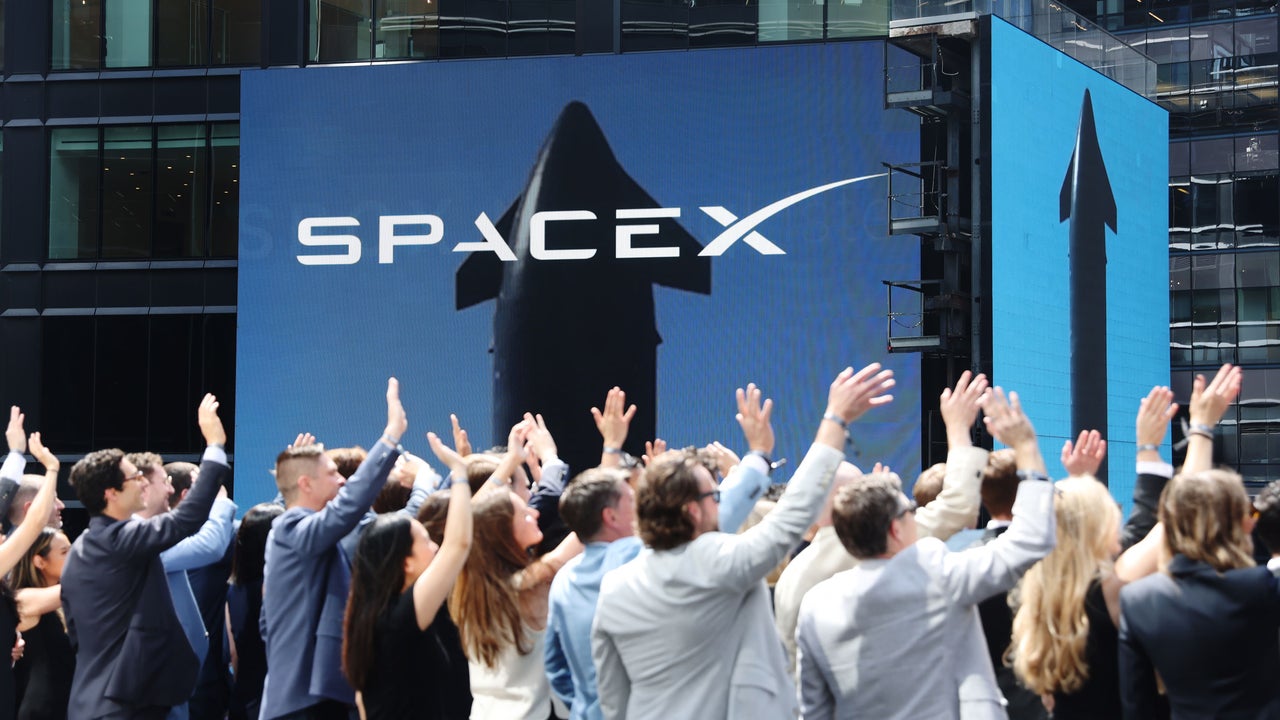
SpaceX’s initial public offering lived up to expectations, making Elon Musk the world’s first trillionaire and minting more than 4,000 millionaires in an instant as the stock price blew past its asking price and kept rising—up 27% in the first few hours of trading.
While the firm sought $75 billion from the public market, there was reportedly more than $250 billion in demand.
Jay Ritter, director of the IPO Initiative at the University of Florida’s Warrington College of Business, tells Fast Company he heard from one colleague who requested 100 SpaceX shares through Robinhood and received just one. Another colleague requested 1,000 shares and also received only one.
Part of the problem is that retail investment platforms are hugely popular with the public but represent only a tiny proportion of the overall market.
Ritter says platforms like Robinhood and Fidelity are now a fixture in the IPO process, but retail investors still appear to be getting only a sliver of the shares they want. He heard, for instance, that Fidelity gave one customer just 10 shares after they requested 300. Even with Bloomberg reporting $100 billion in retail demand for SpaceX shares, Ritter says “mom-and-pop retail investors are only getting a tiny fraction of what they asked for.”
Retail investors are being squeezed from both sides: Stock allocators prefer and prioritize institutional investors over Johnny-come-lately, gamified apps. At the same time, unprecedented interest in public-friendly stocks is pushing retail investment apps’ infrastructure to the breaking point—and beyond.
Robinhood, the retail trading platform founded in 2013, which boasts 27.7 million customers trading 231 million options contracts in a normal month, said in a post on X that “some customers experienced latency and intermittent issues” because of record-breaking traffic driven by interest in SpaceX. Those customers were not happy.
Bybit, another upstart trading platform, also struggled to allocate any SpaceX shares to its customers. The firm blamed xStocks, a tokenized equities platform, for the hitch and said it would refund all of its customers who tried. “We apologize for the inconvenience and appreciate your understanding,” the company said.
Both episodes highlight how mass interest in a single stock on a single day can strain the system. And while stock market launches like SpaceX’s don’t exactly come around every week, they are becoming more common.
Anthropic and OpenAI are equally big names in AI—with the wattage of their leadership perhaps not shining quite as brightly in the public consciousness as SpaceX’s, but their positions within the buzzy AI space more assured—and have both filed S-1 documentation ahead of IPOs in recent weeks. Interest in their IPOs is likely to match or outstrip that of SpaceX.
That’s something Sarah Friar, OpenAI’s chief financial officer, knows all too well. She told CNBC earlier this year that “everybody wants to own part of a rocket company.” The question is whether the infrastructure will enable retail investors to do so when the time comes for its IPO.