
The federal government has a chatbot.
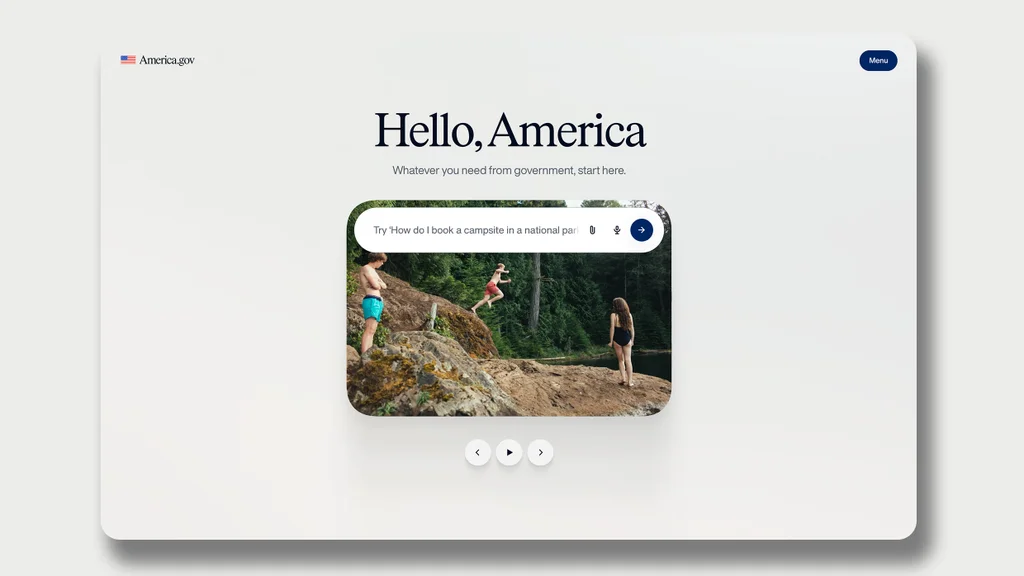
President Donald Trump launched america.gov on Tuesday, a new site that looks like ChatGPT or Claude with a prompt box to query the federal government. The underlying LLM draws its responses from official state sources.
“With america.gov, the federal government no longer stands in your way, and it stands only at your service, and that’s what we’re doing,” Trump said at the unveiling. “We’re simplifying it, we’re glamorizing it, we’re making it what it should be.”
Trump signed an executive order Tuesday establishing the site, and according to the executive order, it excludes tax filing services provided by the Internal Revenue Service as well as services provided by the intelligence community and the Defense Department.
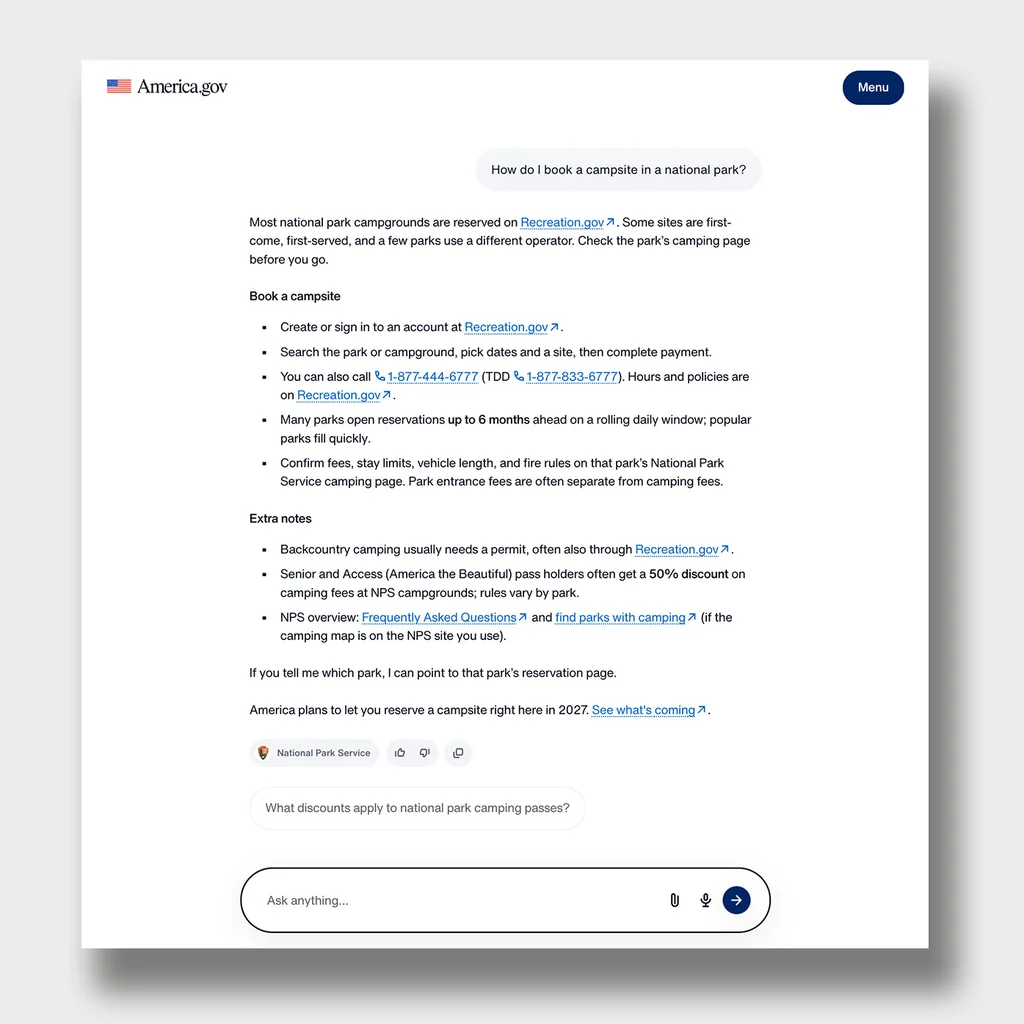
The site features a prompt box under a welcome message that reads, “Hello, America” and “Whatever you need from government, start here.” Suggested prompts include “How do I register my new business?,” “How do I replace my Social Security card?,” and “How do I book a campsite in a national park?”
The idea is that citizens can simply ask the chatbot for answers instead of navigating digital government bureaucracy online. The site says by next year people will be able to use it to enroll in Medicare, apply for a passport, find a federal government job, and more. The White House did not respond to a request for comment.
“You’ll now have one front door for every single question,” Trump said. “Everything will be answered easily and quickly.”
The National Design Studio, Trump’s government design office staffed by former DOGE staffers and headed by Airbnb cofounder and Chief Design Officer Joe Gebbia, designed the website. Like other sites the the studio has worked on—Realfood.gov and TrumpRX.gov, for example—the chatbot site is designed with a consumer sheen, with information laid out like an Apple product page in graphics inside squares with rounded corners. America.gov represents the office’s most ambitious rollout yet.
In an introductory message on the homepage that says in part that the site “uses AI to get simple answers only from official government sources,” in-line images and symbols are used like glyphs, a trend called Nouveau Rebus. The symbols are interactive. Click an arrow icon and it turns into a U.S. flag. Tap a trio of federal government seals and it shuffles into different agencies.
For all its gloss, America.gov is powered by an LMM, and comes amid rising public adoption of and worries over AI, including in government. A recent move to automate U.S. Web Design System accessibility testing has experts concerned it will hurt progress in making federal sites more accessible.
The website’s frequently asked questions page notes that “AI can make mistakes, so check the sources included with each answer before making an important decision.” There’s a feedback button to report a problem.
The FAQ also says the site doesn’t provide campaign or party information and “answers are based on published government sources.” The chatbot correctly identifies former President Joe Biden as the winner of the 2020 election, for example, instead of parroting Trump’s false claims. Using official government sources is great in theory for getting accurate, neutral government information from the source, but since this administration deletes government sites and scrubs information it doesn’t like, it also raises concerns about the potential to manipulate it.
America.gov doesn’t require a login to use, and according to its privacy policy, the site claims it collects no personal information, tracks no analytics nor locations, and keeps no conversations. A Guardian investigation this summer found National Design Studio has run commercial visitor-tracking software on sites that didn’t meet federal privacy standards.
While the website represents an innovation in digital government services, it’s part of a wider AI boom that’s seeing chatbots stuffed everywhere, and part of a larger bet that prompt boxes and AI responses are increasingly the way people interface with information today.
Pew Research Center found the percentage of U.S. adults who use AI is up from a third to nearly half since 2024. Even still, 71% believe the increased use of AI will make their personal information less secure, while 40% believe AI will have a negative impact on society over the next 20 years compared to just 16% who believe it will be positive.
Bringing government services into the AI age is a tall order ripe with challenges, but a successful chatbot could prove what’s possible. The federal government’s newest website represents a major public-facing test.