
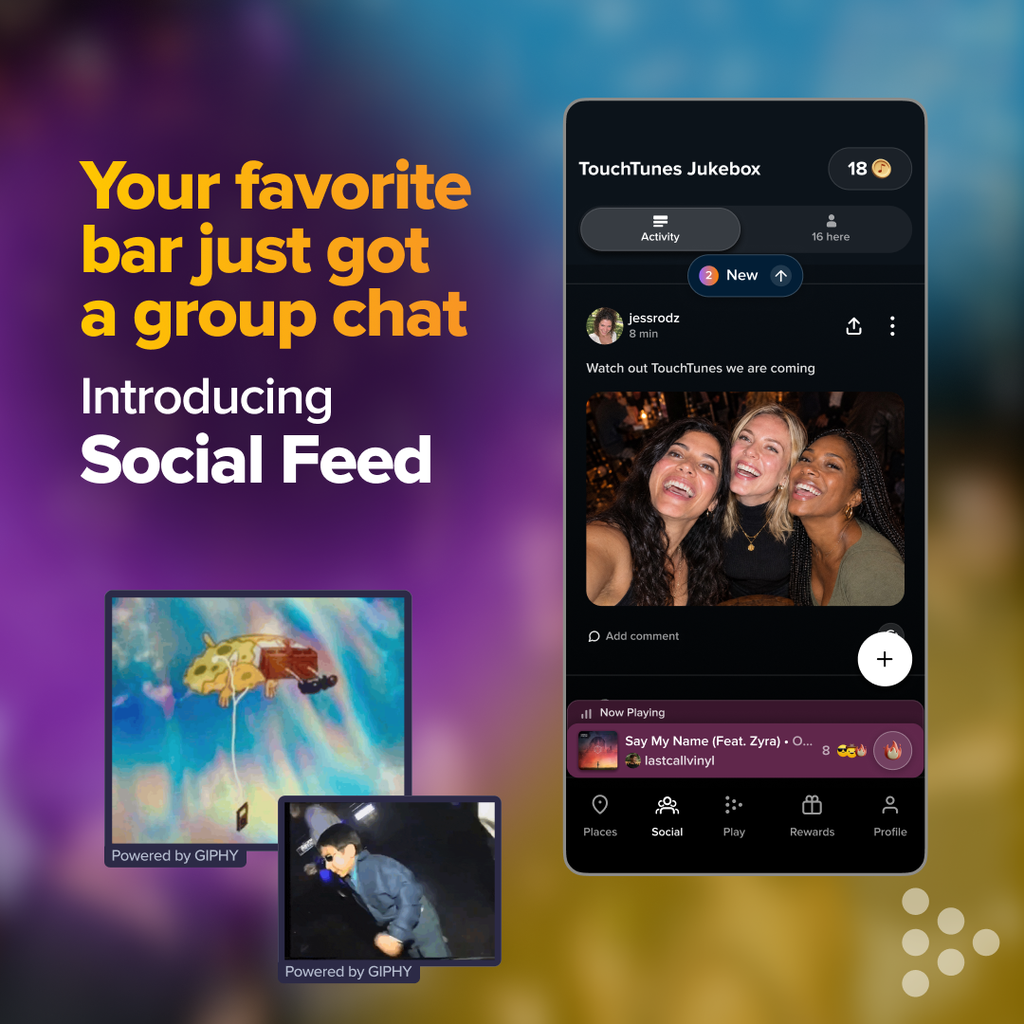
The streaming jukebox giant TouchTunes wants to be the online social hub for your local bar.
The New York-based company boasts jukeboxes in more than 60,000 locations that users can control through touch screens or apps on their own smartphones. Now, it has added a “social feed” that lets users of its apps communicate with each other and see who’s connected to the jukebox in a particular establishment, even when they’re not physically there. App users can add comments and emoji-style reactions to recently played songs or share their own text posts, photos, and GIFs to a shared feed for a particular bar, restaurant, or other site with a TouchTunes jukebox.
“We’re trying to transform from just the jukebox company to being the center of in-person social entertainment, and this is the natural next step of that,” says Scott Levine, the TouchTunes CEO.
The company envisions that in addition to complimenting—or teasing—whoever’s playing the current song on the jukebox, users could visit a location’s feed for other discussions relevant to that spot, like planning to watch a game, recruiting players for a darts league, or sharing photos of a memorable night out. While Levine acknowledges TouchTunes is unlikely to replace existing group chats, and it’s not intended to compete with general-purpose social media apps, he anticipates the feed helping break the ice between fans of a particular venue and serving as a hub for good-natured discussions of what goes on there.
“Maybe you have a smaller list or group of people—you’re going to communicate using message, or WhatsApp, or whatever,” he says. “But then when you’re there, you’re going to post a photo and your buddy that’s not there [will say] ‘oh man, I wish I was there.’”
Already, the company sees reactions being posted roughly every 15 seconds, and Wednesday, when young people traditionally return to their hometown bars the night before Thanksgiving, will likely make for a test of the new features. TouchTunes celebrates Thanksgiving Eve as National Jukebox Day, and Levine says it’s among the company’s biggest sales days, at least on par with St. Patrick’s Day.
When jukebox fans first use the TouchTunes app to connect to a jukebox after the social feed is enabled, a pop-up message discloses the new feature and invites users to visit the app’s settings menu, where privacy options include opting out of having their usernames visible in the list of people at a venue and the list of songs being played. That’s intended to make sure that users feel in control of their privacy options, even if that leads to making themselves less visible, Levine says.
“We bring you right to the screen to toggle it off,” he says.
But privacy experts question whether users will make informed decisions about what they’re sharing, particularly if they simply tap through the pop-up to access the normal jukebox menu, potentially while distracted—or intoxicated—in a busy bar.
“I think a lot of times people are going to be at a bar, and they want a song being played,” says Sara Geoghegan, director of the consumer privacy program and senior counsel at the Electronic Privacy Information Center. “That is not the scenario that is best suited or most apt to understand your data and how it’s being used.”
Privacy concerns may naturally be greater for certain groups, like domestic violence survivors or immigrants, she says. They may also arise if someone encounters a creepy person at a bar who can use TouchTunes to figure out when they return or where they head next. In general, she says, tech companies rolling out new features can help mitigate concerns by ensuring that settings default to those maximizing privacy.
“If they had the default [as] that privacy-protective option, we would have all of the benefits of the social media feed, and bringing people together, and having people enjoy music together in a shared space without the privacy concerns,” says Geoghegan.
Still, Levine emphasizes that users can adjust their privacy settings—and block particular TouchTunes users from seeing information about them—whenever they choose. They can also report inappropriate posts that appear on particular venues’ feeds, similar to the options from other social media companies, and change their displayed usernames at any time.
“We’re giving privacy controls on every single thing, and we’re trying to remind users, ‘Hey, you have control,’” he says. “And if you don’t like what somebody’s talking about, you can block them.”
Some TouchTunes users appear to use usernames derived from their real names or screen names they also use on other services. But others use what appear to be anonymous strings of words or characters that would make it difficult for strangers to identify them and link them to their lives outside the jukebox.
“The first line of defense is to choose something like, I don’t know, HappySquirrel23,” says Jelena Mirkovic, a principal scientist at the University of Southern California Information Sciences Institute and research associate professor at USC’s Department of Computer Science who has studied privacy issues in social and payment apps. “And so now no one knows it’s me, but I can still use the app and have full functionality.”
In general, she says, app developers can help by considering privacy trade-offs, like whether information about someone’s location should be visible publicly or only to friends, and prompting users to reevaluate their privacy settings over time once they’ve become familiar with an app’s features. “Then you know people have a way to act on that, and that would be informed consenting at that time,” she says.
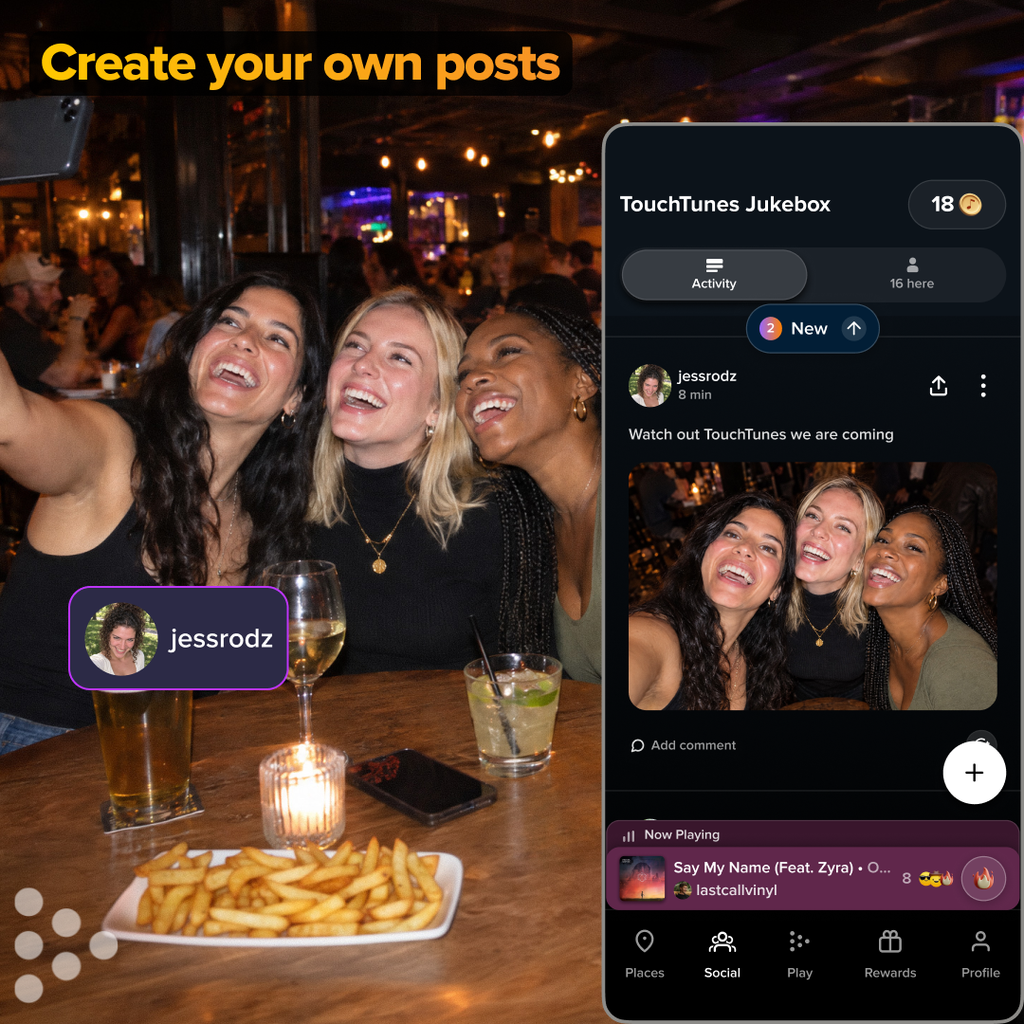
Since the TouchTunes social feature is still new, it’s likely too early to say how jukebox fans and the bars and restaurants that serve them will use it in practice, versus sticking to existing social and location-sharing platforms. Levine envisions the company releasing additional tools to make it easy for venues to communicate with customers, such as publicizing specials or events, and leaderboards that could reward users who play crowd-pleasing songs as determined by reactions and likes. TouchTunes is also testing a feature that would let users dedicate a song to another user, or to a location at large, he says.
Already, the TouchTunes app allows users to customize their profiles; they can add a brief bio and profile photo, select their favorite music genres, and even specify what they’re looking for, from “new tunes” and “pool players” to a “drinking buddy” or a “relationship.” Future versions of the app may include the ability to add other users as friends and potentially receive relevant notifications, says Levine.
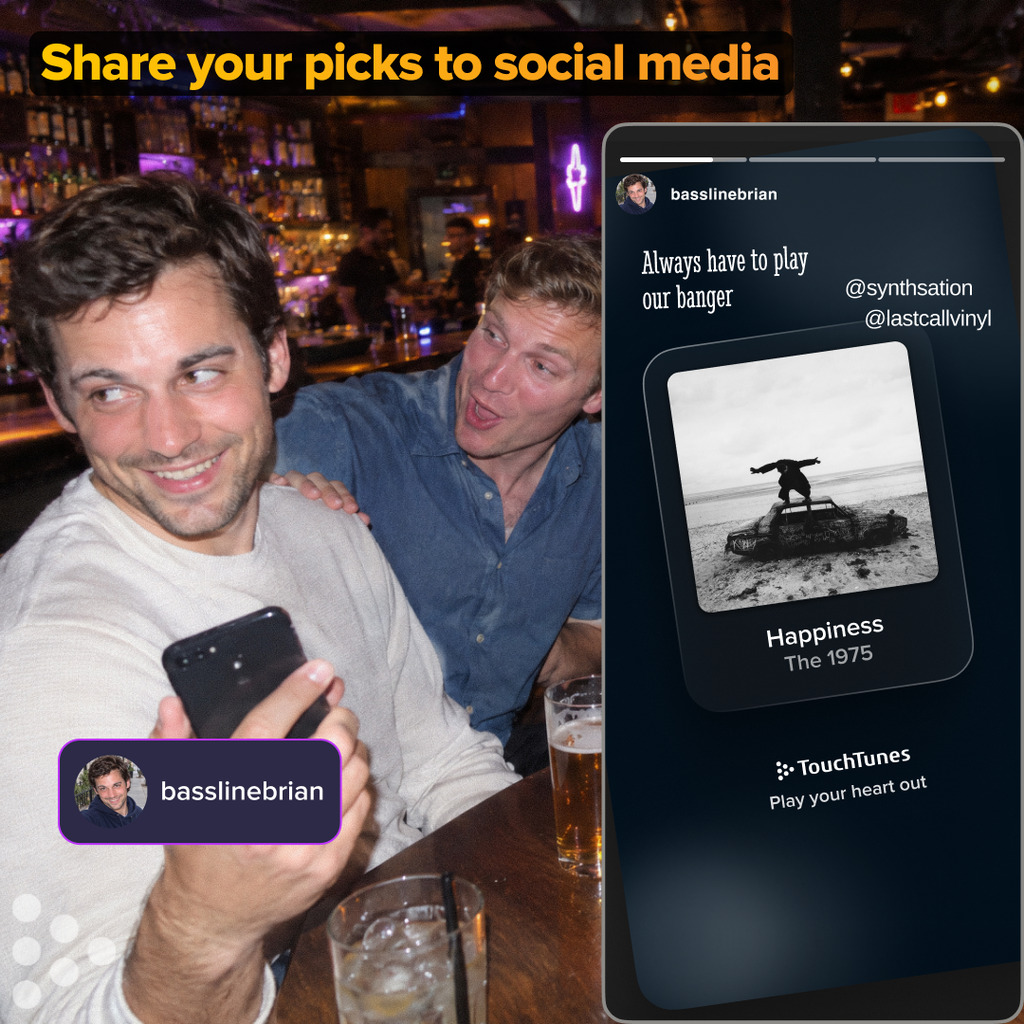
“If my buddies are all going out to the pizza restaurant down the street, and I want to go play a song for them because I know they’re there, I’ll be able to do that and join in,” he says.
While cynics might argue TouchTunes is building digital infrastructure for conversations bar-goers used to have in person—such as when gathered around old school, physical jukeboxes with coins or dollar bills in hand—Levine argues the app can indeed help bring people together within venues, to applaud each other’s selections or offer to buy a round for someone playing fun songs. “They’re using their phones to do it, but it’s not about living in the phone,” says Levine.
The app can also potentially let people participate in the community at a particular spot even if they’re not present, spotting photos of their friends at a particular bar, figuring out where to grab a meal or drink, or even playing a song from afar. Even before the social feed launched, Levine says he heard from a business associate who used the app to pick bars to visit, looking for venues where jukeboxes had a long queue of songs, since they were likely to be lively. The feed will only make it easier for music fans to find venues that match their wants and needs and play the jukebox once they get there, he says.
“Users win, a location wins, TouchTunes wins,” he says. “It’s this nice, simple, synergistic triangle.”