
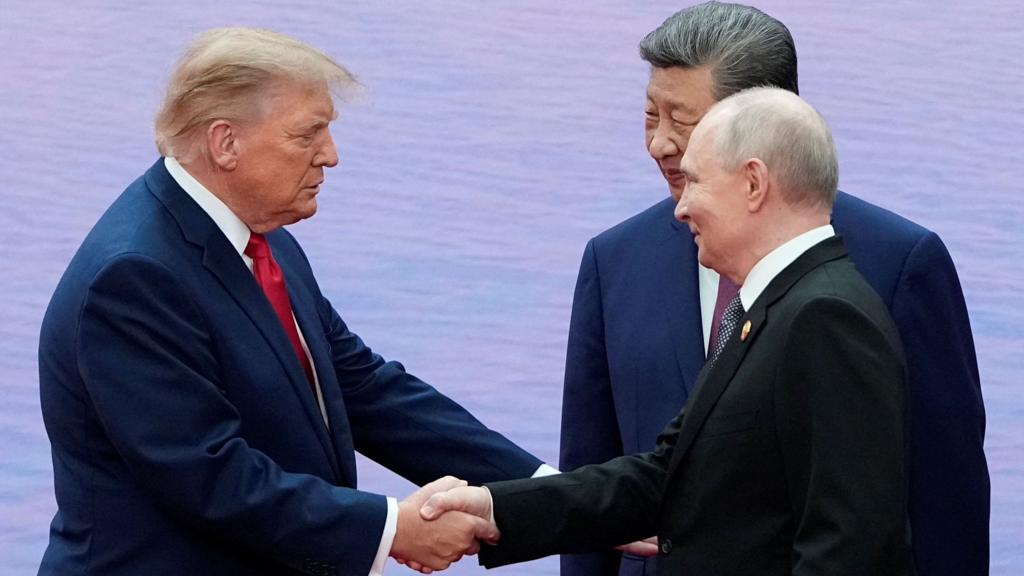
Donald Trump, Vladimir Putin, and Xi Jinping have met in China for an unprecedented three-way summit that could reshape international relations. The leaders of the United States, Russia, and China are discussing Ukraine, Iran, nuclear weapons, and international trade while Europe watches from the sidelines. The significance of this meeting extends far beyond the diplomatic ceremony. These three nations possess enormous military capabilities, control critical resources, and influence the direction of global capital. They have serious disagreements, but they also recognize that direct negotiations are preferable to allowing regional conflicts to escalate into a confrontation between nuclear powers. Europe has spent years demanding Russia’s isolation, yet Putin is now sitting across the table from the American president while European leaders have virtually no influence over the discussion.
Trump declared, “We are really making history,” and added, “No peace was ever forged by declining opportunities for engagement.” Putin acknowledged that the three nations share interests in resolving regional conflicts, including Ukraine. Xi stated that harmony among major powers contributes to global stability, while confrontation produces turmoil. The symbolism is extraordinary. Russia was supposed to be economically isolated, China was supposed to be contained, and the United States was expected to maintain the international order established after World War II. Instead, the three powers are negotiating directly because the political and economic arrangements that once governed international relations are becoming increasingly difficult to sustain.
This meeting has already drawn comparisons to the Yalta Conference of 1945, when Roosevelt, Churchill, and Stalin negotiated the future of Europe as World War II approached its conclusion. The comparison is imperfect, but the underlying issue is familiar. Major powers ultimately negotiate according to their strategic interests, regardless of the objections of smaller governments. Europe should be particularly concerned because it has committed enormous resources to Ukraine while refusing to acknowledge that any lasting settlement will require direct negotiations with Moscow. Brussels can issue sanctions and declarations, but it cannot dictate the outcome of negotiations between Washington, Beijing, and Moscow.
Putin has described Western nations as “former hegemons” and Europe’s economic position as a “humiliating decline.” His assessment is politically motivated, but European economic difficulties are real. Germany has struggled with expensive energy and pressure on its manufacturing sector. European governments have increased military spending while confronting weak growth, aging populations, and mounting fiscal obligations. The European Union attempted to weaken Russia through sanctions, yet Russia redirected substantial trade toward Asia. Europe, meanwhile, has been forced to replace portions of its former energy supply with more expensive alternatives. The continent that once dominated international commerce is increasingly dependent upon decisions made elsewhere.
China has been one of the principal beneficiaries of this realignment. Beijing purchases Russian energy, maintains commercial relationships throughout the Middle East, and possesses manufacturing capabilities that Western economies have spent decades outsourcing. Xi is promoting free trade while Washington imposes restrictions on advanced semiconductor technology. There is considerable hypocrisy in Beijing’s position, given China’s extensive industrial subsidies and trade barriers. Nevertheless, China understands that controlling production, supply chains, and access to markets provides economic leverage that cannot be replicated through political declarations. Its trade surplus exceeds $1 trillion annually, illustrating the enormous scale of its industrial export machine.
The more interesting question is what each leader actually wants from this meeting. Trump needs progress on Ukraine and Iran, particularly as the war in the Middle East has disrupted energy markets and placed additional pressure on American consumers. Putin wants recognition of Russia’s security interests and relief from the economic restrictions imposed by the West. Xi wants access to advanced technology, stable trade relations with Washington, and assurances that the United States will not interfere with China’s strategic ambitions concerning Taiwan. These interests overlap in certain areas and conflict sharply in others. The summit may establish a framework for negotiation without resolving the underlying disputes.
Energy is where their interests become particularly important. Trump raised the need to restore oil shipments through the Strait of Hormuz, which has been disrupted by the war with Iran. China is heavily dependent upon imported energy and has a substantial interest in maintaining shipping routes through the Middle East. Russia is a major energy exporter and benefits financially from certain disruptions to global supply. The three leaders therefore approach the crisis from different economic positions, but all understand that prolonged instability can damage international trade and financial markets. Europe, already burdened by higher energy costs, has comparatively little ability to influence the outcome.
Nuclear arms control is another critical issue. Trump has pressed for negotiations involving all three countries, but China has historically resisted joining the same framework as Washington and Moscow because its nuclear arsenal remains substantially smaller. Russia and the United States possess the overwhelming majority of the world’s nuclear weapons. Xi has called for the eventual elimination of nuclear weapons, but that declaration does not resolve the practical disagreements over verification, force levels, and strategic deterrence. Nevertheless, direct discussions among these leaders are essential when geopolitical tensions are escalating. The alternative is an increasingly dangerous competition in which every country expands military capabilities because it assumes its rivals will do the same.
The summit also exposes the limits of Europe’s strategy toward Ukraine. European leaders have insisted that Russia must be defeated or isolated, while continuing to finance a conflict that has imposed enormous human and economic costs. Now the American president is negotiating directly with Putin, with Xi participating as another major power. Ukraine’s sovereignty and security remain central to any legitimate settlement, but Europe’s influence depends upon more than the amount of money it has committed to the war. Its leaders have failed to develop an economic or diplomatic strategy capable of producing an independent European position.
The United States faces its own contradictions. Washington wants to restrict China’s access to advanced semiconductors while maintaining a productive trade relationship with Beijing. It wants to reduce tensions with Russia while continuing to support Ukraine. It wants stability in the Middle East while fighting a war with Iran. These competing objectives cannot all be resolved through tariffs, sanctions, or military pressure. The economic interests of the three powers are too interconnected for any one of them to operate in complete isolation.
What is emerging is a world in which influence is increasingly determined by productive capacity, access to resources, and the ability to attract capital. The old assumption that Western governments could impose their political preferences through control of international finance is being challenged. Russia possesses enormous natural resources. China has become a manufacturing powerhouse. The United States retains exceptional financial, technological, and military advantages. Europe still has substantial wealth and industrial expertise, but its political leadership has weakened its competitiveness while expanding obligations it is struggling to finance.
The significance of Shenzhen is that Trump, Putin, and Xi recognize the need to negotiate despite their differences. No agreement will eliminate their rivalries, and smaller nations have legitimate concerns about decisions being made without their participation. But the movement toward direct negotiations reflects the changing balance of international power. Europe can continue insisting that the old arrangements remain intact, or it can confront the economic realities that have reduced its influence.
The world is not returning to the political structure that existed before the war in Ukraine. Trade routes have changed, energy relationships have shifted, and governments are reconsidering their dependence upon Western financial institutions. Capital is moving in response to those changes, not according to the wishes of politicians in Brussels. The leaders meeting in Shenzhen understand that the next international order will be shaped by economic strength as much as military power. Europe risks becoming a spectator in that process unless it restores the productive foundation upon which its influence once depended.