
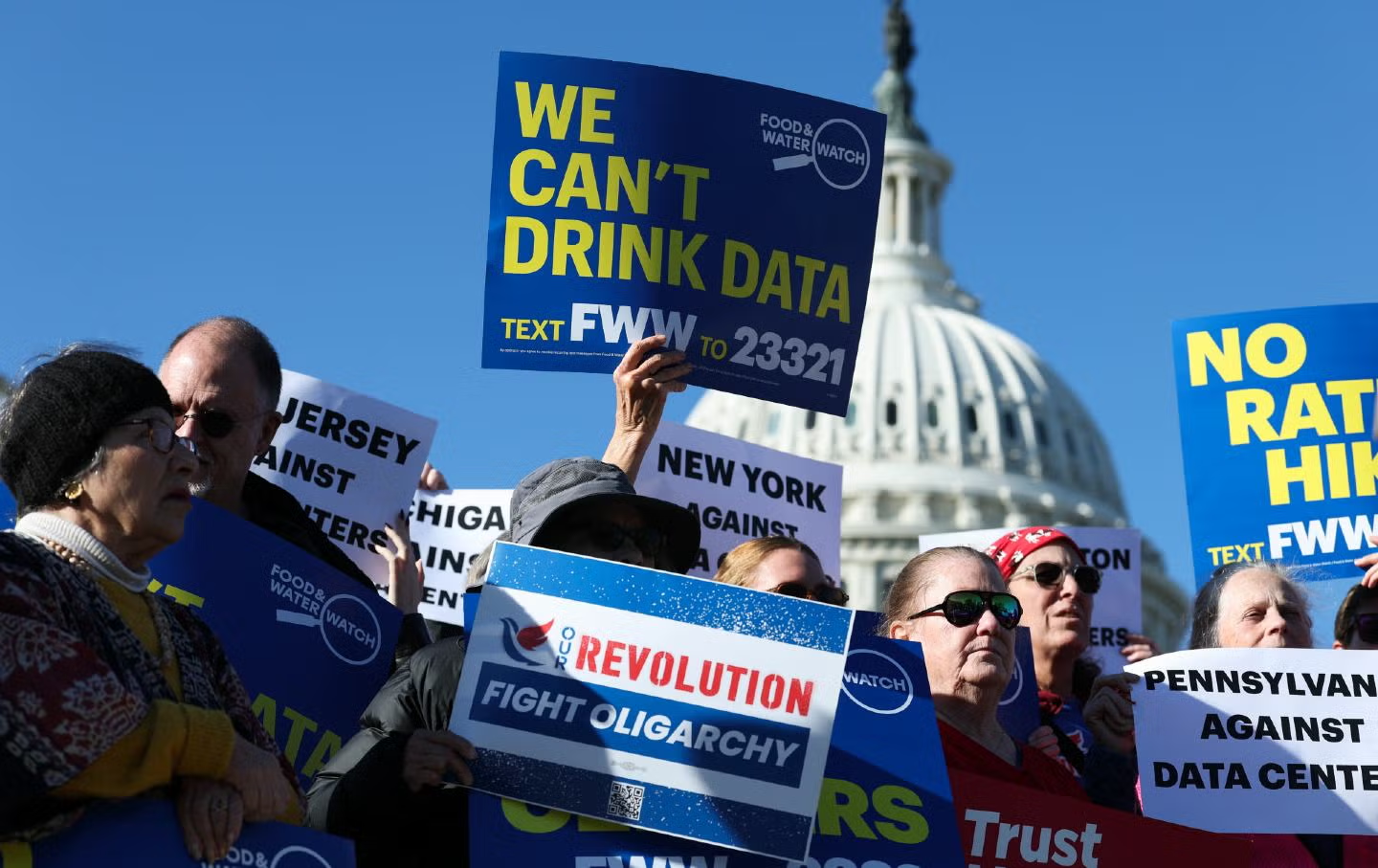
A look at the forces driving the rush for “permitting reform” before a new Congress starts its term.
Despite a populist midterm wave driven by outrage over corruption and inequality, the lame-duck Senate has rushed to advance a bipartisan “permitting reform” bill perpetuating much of what voters just rejected. Instead of waiting for new members to be sworn in, the bill’s bipartisan backers have opted to skip even a committee hearing, rushing it straight to the floor.
Officially called the Bipartisan American Affordability and Jobs Act (BAAJA), the bill will deregulate environmental permitting laws to ease the construction of energy projects. Among other changes, it will restrict states from imposing more rigorous standards than the federal government under the Clean Water Act and make it easier for developers to sue the government if their permits are denied for environmental reasons.
This massive giveaway to the polluting fossil fuel and data center industries is bad policy. It will lock in new fossil fuel infrastructure at a time when we need to be cutting back. It will facilitate the buildout of data centers. And it will not reduce energy bills—and may even raise them instead.
Data centers are widely hated nationwide and across partisan lines. Local initiatives to put serious regulatory restrictions on data centers, or outright ban them, passed with wide margins almost everywhere they were on the ballot this November.
Indigenous tribes, environmental justice communities, immigration justice advocates, and historic preservationists are all part of the broad civil society coalition that has formed in opposition to this disastrous bill.
So why are elected officials pushing this bad, unpopular policy? Money is part of the answer, but not the whole thing.
Current Issue

Three of the four senators sponsoring the bill—Senator Shelley Moore Capito (R-WV), Mike Lee (R-UT), and Martin Heinrich (D-NM)—receive large campaign contributions from the oil and gas and utility industries. The fourth, Sheldon Whitehouse (D-RI), does not, but he and his wife have large holdings of stock in Big Tech companies behind the data center boom.
But there are factors at play as well. The idea that our environmental permitting system is failing to do its job by blocking or delaying too many projects appears to have become conventional wisdom among influential sections of the political, policy, and media elite.
But rigorous, peer-reviewed evidence does not support this conclusion. The available evidence suggests that the primary reasons for permitting delays are understaffing or communication errors, not stringent regulations. Instead, it appears that a kind of mass hysteria has gripped our elites.
Another factor behind the support for BAAJA is deference to corporate agendas. Being “pro-business” is a default ideological position for many US politicians. The American Petroleum Institute, the American Coal Council, and other polluting industry lobby groups support this bill.
So does the tech industry, in spite of strenuous efforts by some to deny it. BAAJA facilitates the buildout of fracked gas infrastructure that the tech industry needs to power its energy-hungry data centers. It also facilitates the buildout of data centers on federal lands, which triggers federal environmental review.
An industry-aligned consulting firm points to provisions in BAAJA that require data centers to pay for their share of the costs of increasing grid capacity. Similarly, an industry-aligned think tank is claiming that BAAJA will protect utility ratepayers from rising bills attributable to data centers.
But this is misleading. It doesn’t account for the fact that many data center developers are already bypassing grid connections altogether and building their own captive gas power plants. The purported ratepayer protection provisions in BAAJA incentivize more off-grid gas-powered generation for data centers, and the permitting deregulation provisions make it easier to build the ancillary gas infrastructure.
Even if they aren’t connected to the grid, these projects can still increase utility bills by driving up demand for natural gas—a potent greenhouse pollutant often obtained by fracking.
It’s noteworthy that the data center industry is not vociferously arguing against BAAJA provisions requiring data centers to pay for the grid updates they need. On the contrary, tech industry interests and business associations with tech industry membership have come out in favor of the bill, giving the game away.
Popular
“swipe left below to view more authors”Swipe →
No self-interested, powerful corporation would push for legislation that actively harms their self-interest. The reasonable conclusion is that BAAJA is backed by—and serves the interests of—Big Tech.
Finally, there’s one more constituency pushing for BAAJA: the far right.
The bill faithfully implements the Project 2025 deregulation agenda developed by the Heritage Foundation. It is part of the far-right agenda to gut landmark environmental laws such as the National Environmental Policy Act, the Clean Water Act, the Endangered Species Act, and the National Historic Preservation Act.
Unsurprisingly, President Trump and his newly elevated extremist chief of staff Stephen Miller are both pushing for the bill’s passage. They obviously support making it easier for their Big Oil and Big Tech friends to ram through polluting pipelines, LNG export terminals, and data centers. They may also recognize that BAAJA will make it harder to block construction of the ICE concentration camps they want to build.
For Democrats to be supporting a bill that benefits Big Oil and Big Tech, silences impacted communities, expedites detention center construction, promotes the Project 2025 deregulatory agenda, and aligns with Trump’s goals—immediately after voters resoundingly rejected Trump and Big Tech in a landslide—is nothing short of a betrayal.
It’s now up to us to stop BAAJA from ever becoming law. If your senator was among the 73 who voted to advance the bill, please call them to voice your displeasure and urge them to oppose it in the next vote. And tell your representative in the House to pledge to oppose the bill, should it be passed by the Senate and go on to the House.
More from The Nation
Before the balance of power shifts in Congress, the president hopes to ram through the appointment of a MAGA crony to federal office.

After years of Republican dominance, Texas Democrats won statewide with overwhelming support from young voters.
Indian Americans seemed to be trending towards the GOP. Then came a ton of racism.
Who is going to fix all the things the Republicans, corporations, and tech titans broke?