
November 19, 2026
As Los Angeles’s mayor-elect, Raman is in the perfect position to raise major questions about the Olympics. Before the election, she seemed ready to do so. Now, it’s not so clear.
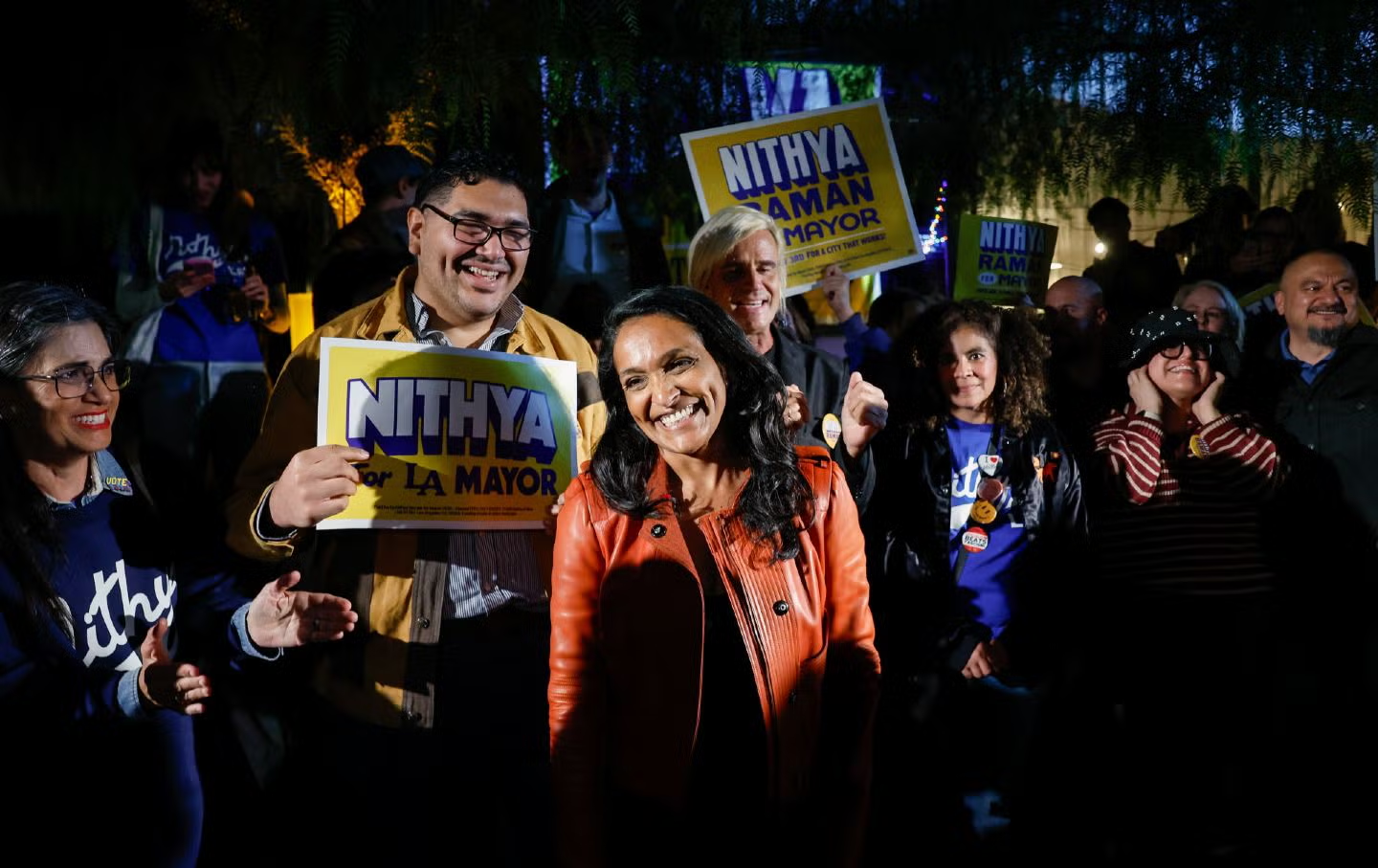
Nithya Raman speaks during an election eve party in the North Hollywood neighborhood of Los Angeles, California Nov. 2, 2026.
(Caroline Brehman / Bloomberg via Getty Images)
Nithya Raman’s ascension to mayor of Los Angeles, part of a coast-to-coast surge of winning candidates aligned with the Democratic Socialists of America, has filled many in LA with the hope of political possibility. It also puts her on a one-way collision course with the Los Angeles 2028 Summer Olympics—and that’s a confrontation Raman does not appear eager to have.
In the past, Raman openly critiqued the Olympics machine. In fact, in 2020, when running for the Los Angeles City Council, Raman straight-up opposed hosting the 2028 Olympics. Explaining her opposition in a questionnaire circulated by the Democratic Socialists of America, she stated, “There was no vetting of this process, extremely rushed budgeting outreach, and the residents of our city had no say in any of it.”
Raman was right. Back in 2017, the LA City Council jammed the Games through a high-speed political process that sidelined any feedback from concerned Angelenos. Community activists were prevented from issuing public statements during the City Council meeting that approved hosting the Games. During that meeting, then-City Council President Herb Wesson had the gall to say that “public comment on this item has been satisfied.” The response? A raucous chorus of boos that echoed through the council chambers.
Among the activists that day were members of NOlympics LA, the anti-Games coalition that formed in 2017 to fight against the Olympics machine. It emerged from DSA-LA’s Housing and Homelessness Committee before becoming an independent entity, and one with staying power. Locally, NOlympics LA has built a coalition that includes groups like the LA Tenants Union, KTown for All, and Strategic Actions for a Just Economy (SAJE). Internationally, NOlympians have helped organize a multi-country coalition that takes an abolitionist stance against the Games. Its slogan is “No Olympics Anywhere.”
Like NOlympics LA, Raman has been consistently critical of the Los Angeles 2028 Olympics and those in charge of it. Earlier this year, when a new tranche of Epstein files revealed scandalous correspondence between LA28 Organizing Chair Casey Wasserman and Jeffrey Epstein’s co-criminal Ghislaine Maxwell, a slew of elected officials in Los Angeles, including Raman, demanded that Wasserman resign. Then, in August, she was one of four City Council members who voted against the Enhanced City Resources Master Agreement, a document that delineates the City’s deeply suspicious reimbursement process for services that it provides during the Olympics. As LA-based journalist Alissa Walker noted in her Torched newsletter, “By approving Raman, LA voters were simultaneously registering their disapproval of the city’s alliance with LA28.”
But since her election, Raman’s team has struck a conciliatory tone, one that makes her seem more attuned to LA residents who are excited by the hosting possibilities than those advocating for a new direction. In late October, spokesperson Liz Garcia said her boss “supports a successful Olympics that showcases the best of Los Angeles and delivers the economic boost Angelenos deserve: more customers for local businesses, opportunities for workers, and lasting improvements in our neighborhoods.” Garcia added that Raman “wants residents to share in the excitement and the benefits long after the closing ceremony, but not left to cover the bill unfairly,” though it’s unclear what “benefits” she’s referring to.
Current Issue

This is the sort of cut-and-paste comment that host-city mayor after host-city mayor has issued around the world. For someone who had previously offered principled, poetic criticism of the Olympics, it’s conspicuously milquetoast prose.
In a collective statement, NOlympics LA told The Nation:
Regardless of who the mayor is when the Olympics touch down, the problem remains the same — there is an artificial deadline to disappear poor people. Mayor-elect Raman has promised to reduce street homelessness by 50% by summer 2028, and the real question is how this will happen without adequate permanent supportive housing or public housing….Ideally, the mayor would cancel the Olympics and commit to a strategy for housing poor people that isn’t contingent on Casey Wasserman and LA28’s arbitrary timeline.
One bellwether Olympics issue is policing. Historically, local and national police forces use the Games like their own private cash machine, scooping up previously unattainable weapons, surveillance technology, and funding. Trump’s so-called One Big Beautiful Bill Act contained a whopping $1 billion security budget for LA28.
These funds have historically been used to keep the poor as far away from the Olympics as possible. Under Mayor Karen Bass, unhoused communities feared the increased policing that comes with the Olympics, and it seems unclear whether the new mayor will assuage those fears.
Raman had previously been critical of Los Angeles Police Department Chief Jim McDonnell for LAPD’s role in assisting ICE in its brutal crackdown in the city and for its lack of transparency. On the campaign trail, Raman vowed to replace him, something she’s received flak for, including from Mayor Bass, who warned against replacing the police chief so close to when the city intends to host the Olympics. Former city council member Zev Yaroslavsky, who helped oversee the 1984 Olympics in LA, slammed the idea of removing McDonnell, calling it “a terrible idea.” He told Politico, “You don’t have to agree with him on everything, but to have a vacancy in the chief’s office a year and three-quarters before the biggest terrorist target on the planet is absolutely irresponsible.”
In other words, the Olympics are now acting as a pretext to keep McDonnell, a pressure point Raman may refuse to resist. Recently, Raman and the police chief have had, in McDonnell’s words, “positive and upbeat” discussions about the road ahead. This is especially disconcerting given the widespread concerns that the Olympics will be used as a cover for a massive ICE incursion into the Southland. If LA’s formidable anti-ICE activist organizations get hemmed in by the Olympic security state, it could create a weakened position that proves too attractive for the nativist from Santa Monica—white supremacist Chief of Staff Stephen Miller—to ignore. Regardless of what Raman does now that she’s mayor, her response to the police question demonstrates how the Olympics can hold the host city hostage in ways big and small.
Raman is now facing a choice. She could do what big city mayors invariably do and become an Olympic booster. As a face of the Games, she would show up in the luxury boxes and, as the athletic celebration draws to a close, follow tradition and protocol, handing off the Olympic flag to the host of the 2032 Summer Games, the mayor of Brisbane.
Popular
“swipe left below to view more authors”Swipe →
Or she could break away from the status quo. Raman is in the perfect position to raise big questions about the Olympics to the wider world, to spotlight the Games’ ingrained downsides, to stand with the demonstrations that will inevitably bubble up in the months ahead of and during the Games, particularly around ICE and the surveillance state. These Games—both in preparation and execution—will be a large part of Raman’s political legacy. Choosing neutrality would mean implicitly siding with the powerful, both the Trump losers and the IOC grifters.
One thing is certain, though: Whatever it turns out to be, Raman’s post-election position on the Olympics will be critical for activists and how they will organize in the months to come. Under an international spotlight, we’ll see how Raman maneuvers. Will she stand with the Olympics and their millionaire boosters? Or will she stand with the people in the streets fighting back against the Olympic monolith? The answer to that question could define her tenure.
More from The Nation

It’s the latest move in the administration’s all-out effort to deny government benefits to immigrants—even those living and working here legally.
A conversation with Sara Bennett as well as two of the women she photographed for her new book, Looking Inside: Women with Life Sentences.
It is now over seven months since my son, my husband, and I were detained. It feels like being stabbed in the heart again and again.

A strange case of prosecutorial misconduct during a murder investigation in the Oklahoma panhandle.
Officials in some states continue to seek the death penalty while others, like Newsom, have vowed to bring the sentences to a halt.